































Ready Cell Membrane Steps Worksheet | Grades 7-12 Science

Paste this activity's link or code into your existing LMS (Google Classroom, Canvas, Teams, Schoology, Moodle, etc.).
Students can open and work on the activity right away, with no student login required.
You'll still be able to track student progress and results from your teacher account.
Mastering cell transport requires students to visualize dynamic molecular processes rather than memorize static diagrams. This four-page science worksheet trains students in Grades 7 through 12 to order stages of bilayer assembly, carrier transport, and osmosis while explaining causal cellular changes across 30 scaffolded tasks.
At a Glance
- Grade: Grades 7–12 · Subject: Science
- Standard: Model membrane assembly, sequence carrier transport steps, and analyze osmotic fluid changes
- Skill Focus: Order membrane stages and explain physical changes
- Format: 4 pages · 30 problems · Answer key included · PDF
- Best For: Cellular transport units and biology practice
- Time: 45–60 minutes
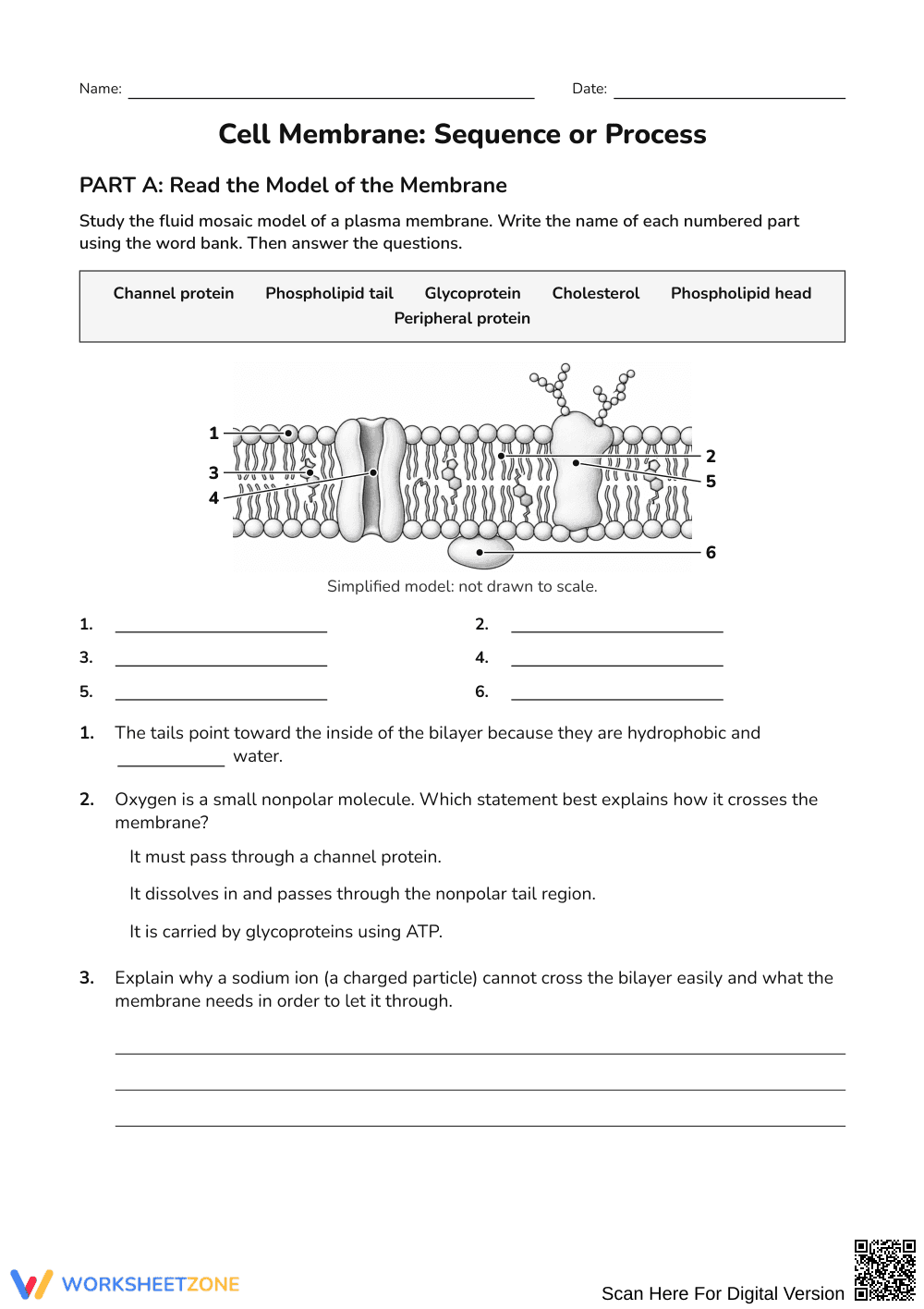
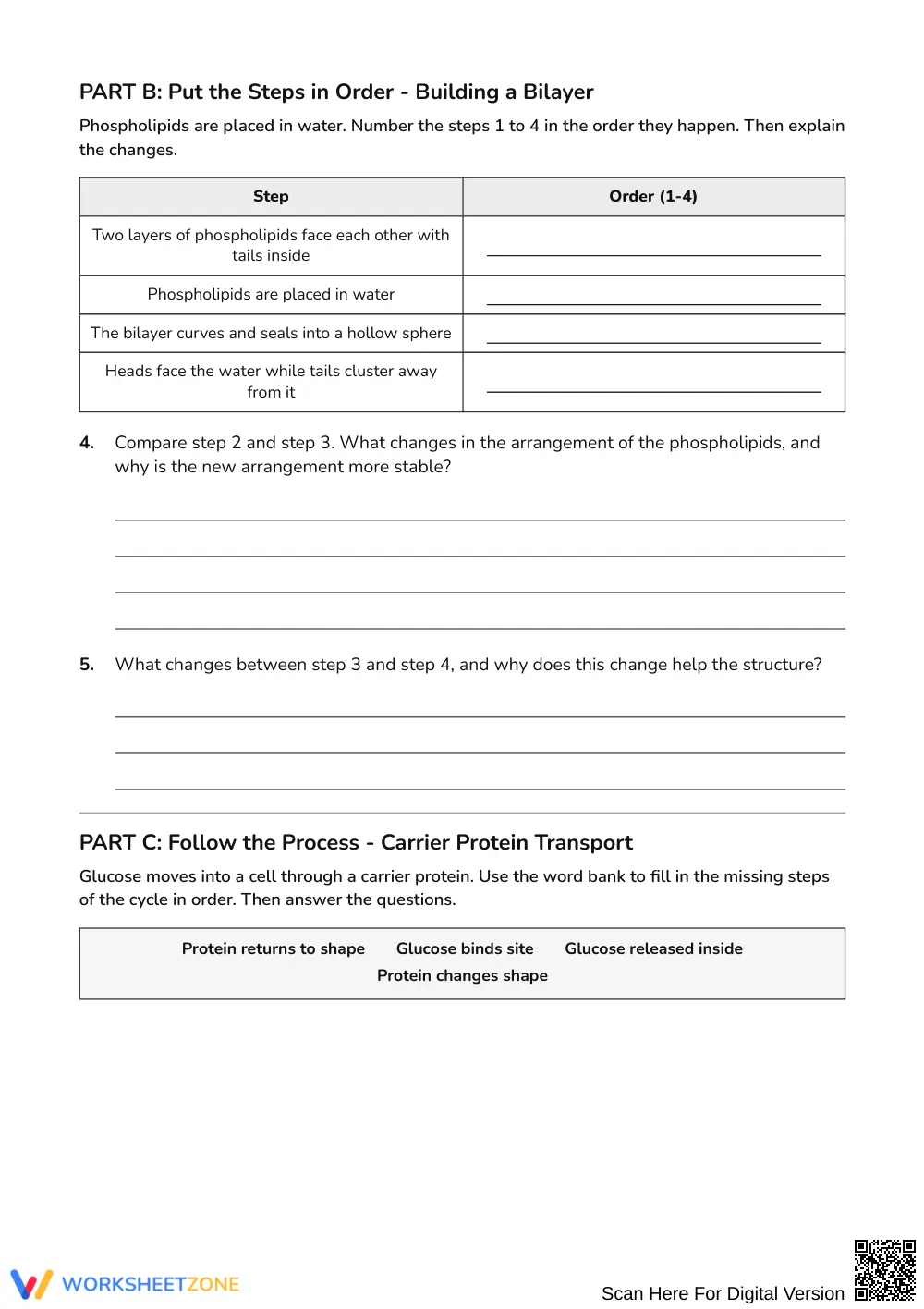
This 4-page resource features 30 items arranged across four parts. Students analyze fluid mosaic diagrams, sequence a four-step bilayer assembly model, complete a carrier transport cycle with a word bank, and evaluate potato osmosis data. A complete four-page teacher answer key provides full explanations and sample responses.
Skill Progression
- Guided practice (Part A, 8 problems): High scaffolding with a labeled membrane diagram and word bank to identify structures and predict solute movement.
- Supported practice (Parts B & C, 14 problems): Moderate scaffolding requiring students to sequence bilayer formation, trace carrier conformational cycles, and justify structural stability.
- Independent practice (Part D, 8 problems): Low scaffolding where students analyze potato osmosis data, explain equilibrium, and predict mass changes.
This sequence implements gradual-release instruction, moving learners from guided structural identification to independent data analysis.
Standards Alignment
This worksheet aligns with secondary life science standards requiring students to develop models showing how cell structures maintain stability via selective permeability. Tasks explore how lipid properties govern passive and active transport mechanisms. Both standard codes can be copied directly into lesson plans, IEP goals, or district curriculum mapping tools.
How to Use It
Deploy Parts A and B during direct instruction to reinforce polarity principles immediately after introducing bilayer anatomy. Circulate to formatively assess whether students grasp why hydrophobic tails assemble inward. Assign Parts C and D after transport lessons as an evaluative activity. Expect the full 30-item worksheet to take 45 to 60 minutes.
Who It's For
This activity is designed for middle and high school biology students studying cellular transport. Built-in word banks and diagrammatic sequencing support English learners and students needing visual scaffolding, while data interpretation extends proficient learners. Pair this worksheet directly with a membrane transport lab or classroom anchor chart.
Secondary science curricula require students to order the relevant stages or steps and explain changes within complex biophysical systems such as the cell membrane. According to Fisher & Frey (2014), academic achievement accelerates when structured problem sets combine visual models, chronological process sequencing, and scaffolded explanatory prompts that transition from guided structural identification to independent data analysis. This four-page cellular transport resource provides 30 targeted tasks spanning the fluid mosaic model, phospholipid bilayer self-assembly, carrier-mediated facilitated diffusion, and osmotic mass equilibrium in potato tissue. By requiring learners to articulate the causal chemical and physical mechanisms governing solute movement, the worksheet ensures students move beyond passive diagram labeling toward deep conceptual understanding of selective permeability. Educating secondary biology students through disciplined schema sequencing solidifies rigorous mechanistic reasoning across general life science coursework and standardized assessments.


