





























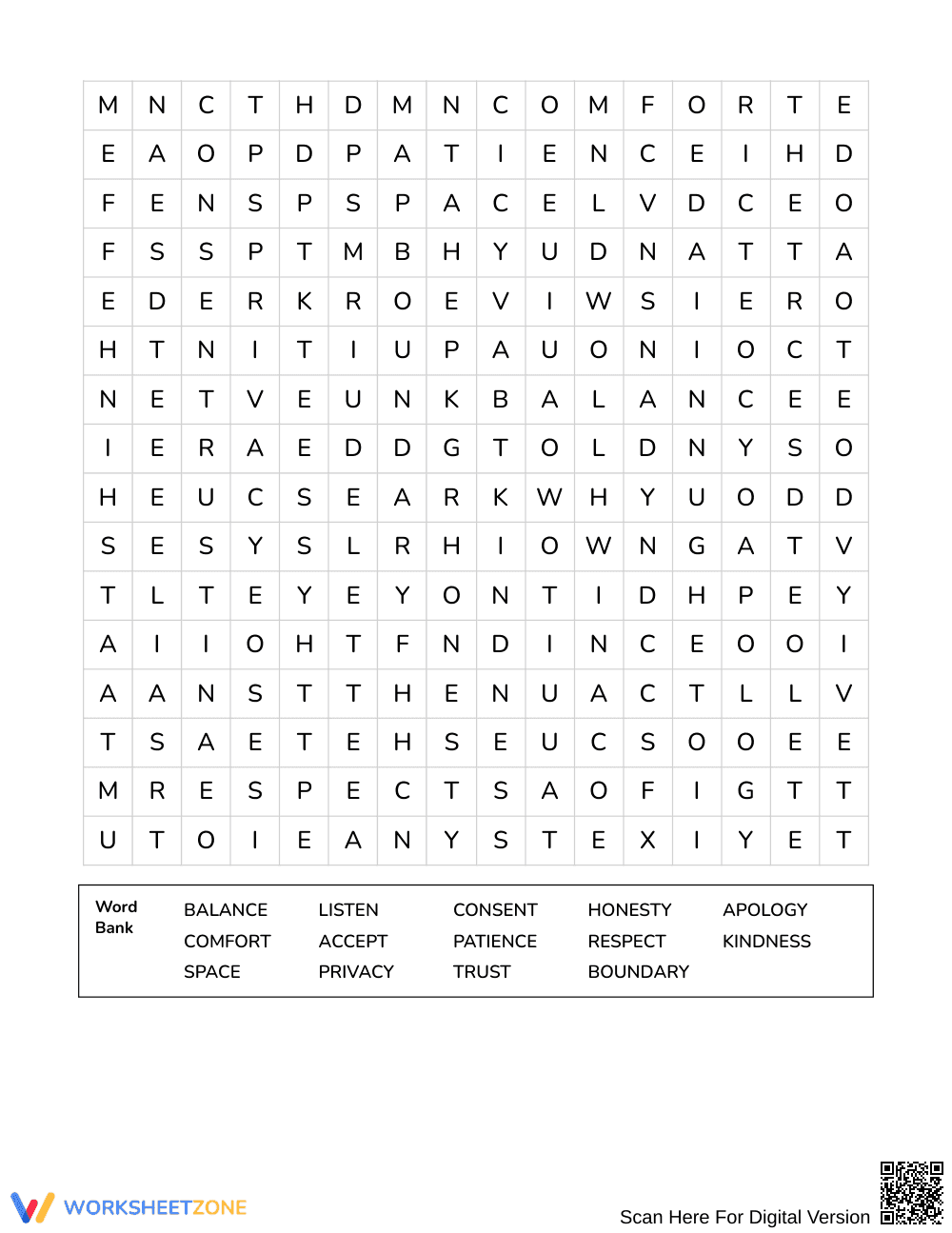


Ready Boundary Word Search | Grades 4–5 Behavior Worksheets

Paste this activity's link or code into your existing LMS (Google Classroom, Canvas, Teams, Schoology, Moodle, etc.).
Students can open and work on the activity right away, with no student login required.
You'll still be able to track student progress and results from your teacher account.
This friendship activity reinforces personal boundaries and respectful peer relationships by challenging learners to decode relationship concepts. Students read descriptive clues to define key social-emotional terms before locating them within the puzzle grid, transforming passive vocabulary drill into active reflection on mutual respect, consent, and personal space.
At a Glance
- Grade: Grades 4–5 · Subject: Behavior Worksheets
- Standard: Not standards-assessed — vocabulary enrichment
- Skill Focus: Understanding and keeping reasonable boundaries in peer relationships
- Format: 3 reproducible pages · 14 hidden vocabulary words · Full answer key included · Printable PDF
- Best For: Small-group counseling circles, homeroom advisory periods, and character-building discussions
- Time: 20–30 minutes of focused classroom work
This 3-page word search package features 14 hidden vocabulary words embedded in a 16 x 16 letter grid. Rather than scanning a basic list, students read 14 situational clues detailing concepts like consent, space, and honesty to deduce terms before searching. The puzzle includes a shuffled word bank for support alongside a 3-page answer key showing exact letter placements.
How the Puzzle Works
The activity organizes 14 boundary-related terms inside a 16 x 16 grid for intermediate elementary thinkers. Words run in four specific directions: northeast, east, southeast, and south, avoiding backwards-reading confusion while providing an engaging challenge. Learners match clues to terms like privacy, balance, and patience, using a shuffled word bank to verify words before circling them.
Standards Alignment
This resource focuses exclusively on vocabulary enrichment and character development, meaning it is not aligned to an academic content standard. Instead, it provides targeted social-emotional language practice that supports proactive classroom management, respectful communication, and healthy peer interaction across upper-elementary learning environments.
How to Use It
Introduce this word search after direct instruction on peer communication or during morning meeting. In small advisory groups, have students read clues aloud and find terms collaboratively. Alternatively, assign the puzzle as independent reflection after a guidance lesson. Circulate while learners work to check comprehension, noting whether students confuse terms like privacy and isolation. Most fourth and fifth graders complete the activity in 20 to 30 minutes.
Who It's For
This activity is designed for students in Grades 4–5 building social awareness and healthy relationship skills. It suits general education homerooms, counseling groups, and social skills blocks. For differentiated support, pair the word search with a peer-boundaries anchor chart or allow partners to solve definitions collaboratively.
According to Fisher & Frey (2014), intentional vocabulary acquisition is deeply tied to conceptual understanding when learners encounter terms within meaningful context rather than through isolated rote memorization. This Grades 4–5 character education resource targets the foundational skill of keeping reasonable boundaries through 14 definition-driven puzzle clues, reinforcing prosocial communication habits without relying on formal standardized assessment frameworks. By linking concrete relational behaviors such as consent, active listening, and personal space directly to active puzzle discovery, intermediate elementary students develop the precise communicative foundation necessary for sustained conflict resolution and positive peer interactions. Research in purposeful language development confirms that pairing clear, student-friendly definitions with interactive puzzle solving solidifies relational concepts in everyday school life. Consequently, this targeted vocabulary activity helps educators establish shared social norms, giving learners the linguistic tools needed to negotiate healthy boundaries cooperatively across diverse school settings.


