































Ready Bible Plants & Animals Word Search | Grades 5-6 ELA

Paste this activity's link or code into your existing LMS (Google Classroom, Canvas, Teams, Schoology, Moodle, etc.).
Students can open and work on the activity right away, with no student login required.
You'll still be able to track student progress and results from your teacher account.
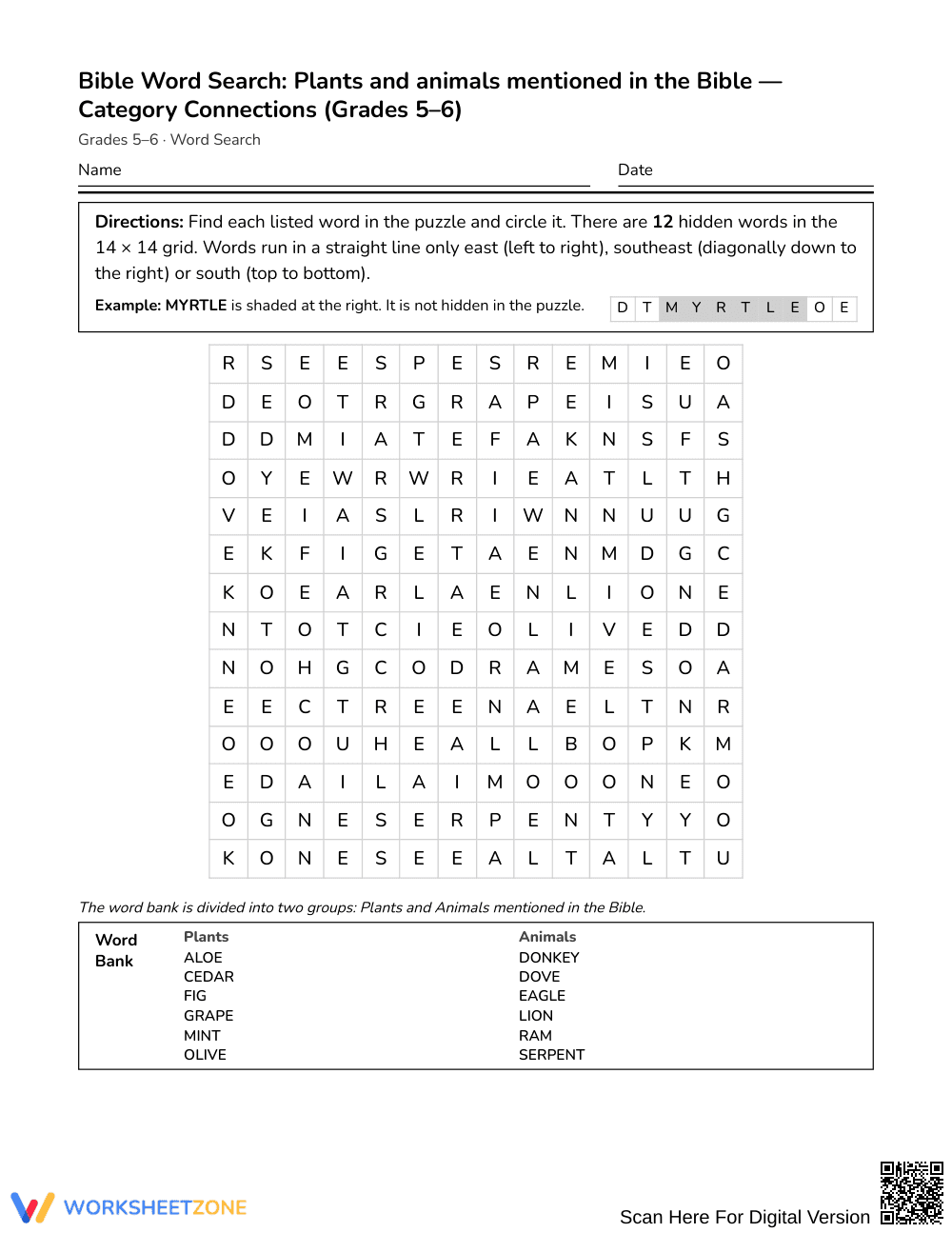
This Grades 5–6 ELA vocabulary word search introduces learners to biblical flora and fauna through targeted category sorting and orthographic recognition. Students identify 12 words embedded across the letter grid, reinforcing word recognition, spelling patterns, and cultural vocabulary associated with historical and scriptural texts.
At a Glance
- Grade: Grades 5–6 · Subject: ELA
- Standard: Not standards-assessed — vocabulary enrichment
- Skill Focus: Plants and animals mentioned in the Bible
- Format: 1 page · 12 words · Answer key included · PDF
- Best For: Vocabulary enrichment, sub plans, fast finishers
- Time: 15–25 minutes
What's Inside
This single-page puzzle delivers 12 vocabulary terms organized into two thematic categories: Plants (aloe, fig, grape, olive, cedar, mint) and Animals (lion, dove, ram, donkey, eagle, serpent). Each term features an informative contextual reference and scriptural citation that enriches background knowledge. A comprehensive 3-page answer key displays exact letter coordinates and solution pathways for rapid checking.
Puzzle Mechanics & Design
- Grid Structure: A focused 14 × 14 letter matrix provides accessible spatial scanning without overwhelming upper elementary and middle school learners.
- Search Trajectories: Words run along three predictable directional paths: East (horizontal left-to-right), South (vertical top-to-bottom), and Southeast (diagonal downward-right). No reverse backward paths are used.
- Clue-Supported Word Bank: Words are presented in distinct groups alongside descriptive definitions and scriptural citations that link terms to concrete textual contexts.
Standards Alignment
This puzzle serves as a targeted vocabulary enrichment resource rather than an assessed academic benchmark. It reinforces spelling, semantic sorting, and domain-specific terminology without requiring direct alignment to Common Core State Standards.
How to Use It
Deploy this activity as an independent warmup during a historical literature unit or as an engaging extension for early finishers. During completion, observe whether learners locate words by initial letter clusters or scan systematically along East, Southeast, and South vectors to evaluate spatial search strategies. Expected completion time ranges from 15 to 25 minutes.
Who It's For
Designed for learners in Grades 5–6 developing word analysis skills and historical vocabulary. It pairs naturally with introductory units on ancient world literature, cross-curricular religious studies, or semantic classification lessons.
Vocabulary acquisition research highlighted by Fisher & Frey (2014) demonstrates that structured orthographic exposure and category classification significantly enhance domain-specific lexical retrieval for middle-grade students. Engaging with thematic word searches enables learners to practice spatial letter-pattern discrimination while solidifying semantic associations between vocabulary items and conceptual categories. Rather than confronting rote memorization lists, students examining the 14 × 14 matrix actively decode consonant-vowel combinations across East, Southeast, and South linear paths. By contextualizing terms like cedar, olive, and dove within historical classifications, the resource supports associative memory networks. Fisher & Frey emphasize that intentional word play grounded in thematic domains establishes essential cognitive scaffolds, allowing learners in Grades 5–6 to build orthographic familiarity and background knowledge that improve overall reading comprehension across cross-curricular, historical, and literary units.


