




























Views
Downloads



Ready Bent-Light Misconceptions Worksheet | Grade 6 Science

Paste this activity's link or code into your existing LMS (Google Classroom, Canvas, Teams, Schoology, Moodle, etc.).
Students can open and work on the activity right away, with no student login required.
You'll still be able to track student progress and results from your teacher account.
This Grade 6 physical science worksheet trains students to analyze optical data, dismantle flawed reasoning, and correct persistent bent-light misconceptions. Learners examine synthetic experimental trials involving reflection, refraction, and absorption to replace intuitive false claims with accurate wave principles. The resource builds rigorous scientific literacy through targeted diagnostic evaluation.
At a Glance
- Grade: 6 · Subject: Science
- Standard: Wave Behavior — Explain light reflection, refraction, and transmission through evidence
- Skill Focus: Correct Bent-Light Misconceptions
- Format: 5 pages · 8 problems · Answer key included · PDF
- Best For: Light behavior error analysis practice
- Time: 40–50 minutes
What's Inside
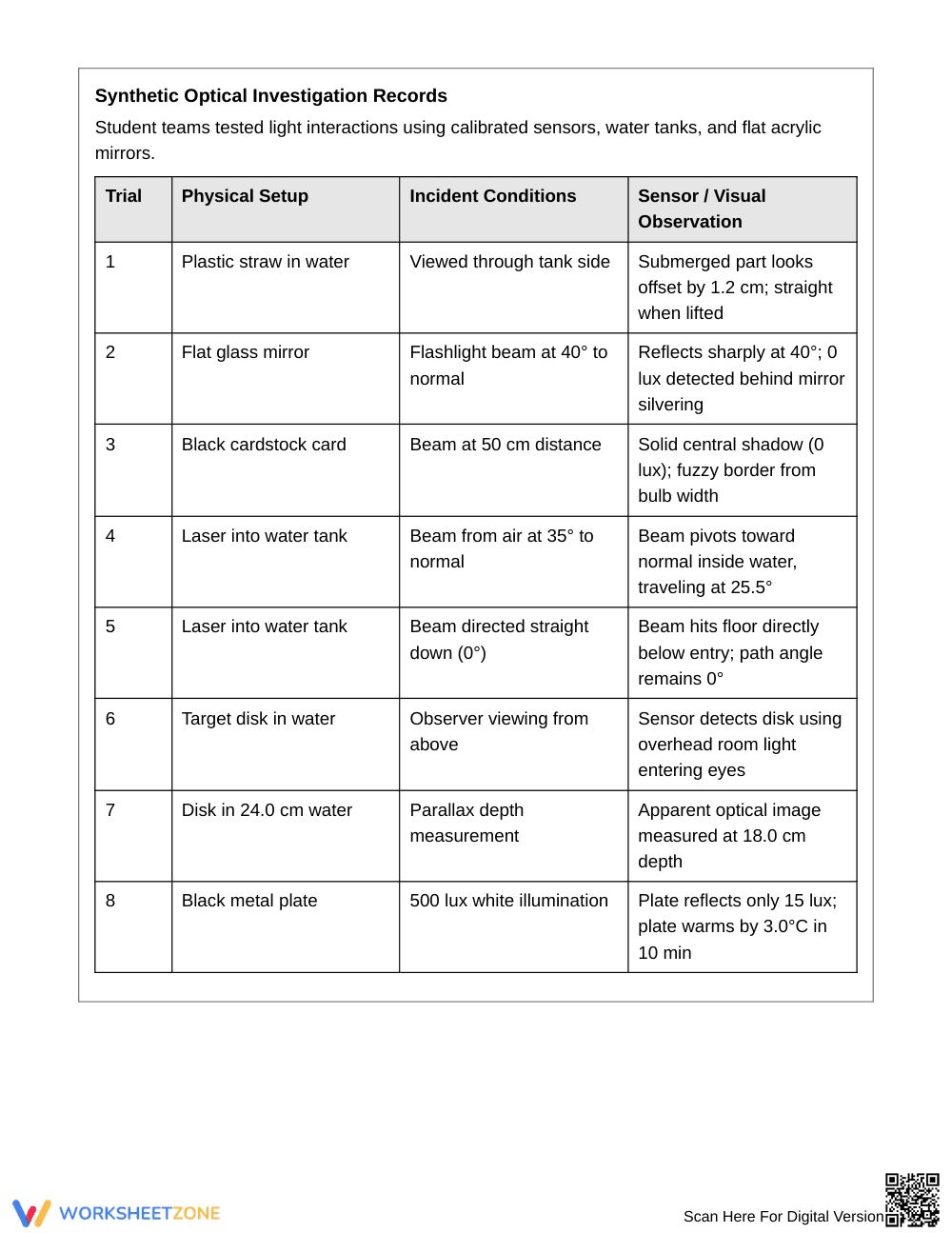
The 5-page printable document features a foundational reference section covering five core optical principles, followed by a worked Model Repair example that demonstrates how to diagnose and rectify flawed scientific claims. Students evaluate an 8-trial synthetic optical investigation dataset before completing eight structured error-analysis tasks. A comprehensive 2-page answer key provides clear physical explanations for every prompt.
Skill Progression
- Guided practice (Trial Model & Principles): Students review explicit optical rules alongside an annotated synthetic trial model demonstrating how to spot false claims about beam behavior.
- Supported practice (Trials 1–4): Learners inspect structured experimental sensor data measuring refraction angles, reflection lux, and shadow boundaries, identifying specific conceptual errors in student assertions.
- Independent practice (Trials 5–8): Students independently explain perpendicular boundary transmission, apparent depth shifts, and thermal absorption on opaque surfaces without scaffolding prompts.
This gradual-release structure moves students from supported error identification to autonomous physical justification.
Standards Alignment
Aligned to middle school physical science standards for wave interactions, this worksheet requires students to develop qualitative models explaining how light waves reflect, absorb, refract, and transmit across varying media. Both standard codes can be copied directly into lesson plans, IEP goals, or district curriculum mapping tools.
How to Use It
Deploy this worksheet after direct instruction on optical media boundaries or during a targeted mid-unit review. Have students partner to debate the flawed claims in Trials 1 through 4 before completing Trials 5 through 8 individually. Formative observation tip: check student explanations on Trial 5 to ensure they recognize that normal-incidence light changes velocity without altering its trajectory. Expected completion time is 40 to 50 minutes.
Who It's For
This resource serves sixth-grade general science students, introductory physical science classes, and middle school intervention groups addressing intuitive physics fallacies. Pair this practice packet directly with hands-on refraction tank demonstrations or an anchor chart tracking the law of reflection and straight-line ray propagation.
Addressing intuitive misconceptions in optical wave behavior requires deliberate cognitive confrontation, an instructional approach substantiated by Fisher & Frey (2014) in their foundational work on gradual-release frameworks and productive cognitive struggle. When middle school physical science students evaluate synthetic laboratory data and dissect erroneous claims, they move beyond surface-level recall to establish authentic mastery of wave transmission, reflection, and refraction. Rather than passively memorizing ray definitions, learners actively contrast physical evidence with common intuitive fallacies, such as the false belief that water bends light through gravitational mass or that eyes project vision rays. This diagnostic process aligns directly with empirical science standards, transforming abstract wave propagation rules into durable analytical capabilities. By requiring students to articulate precise physical justifications across 8 structured trials, the worksheet ensures that learners construct robust conceptual models grounded in observable experimental data.


