





























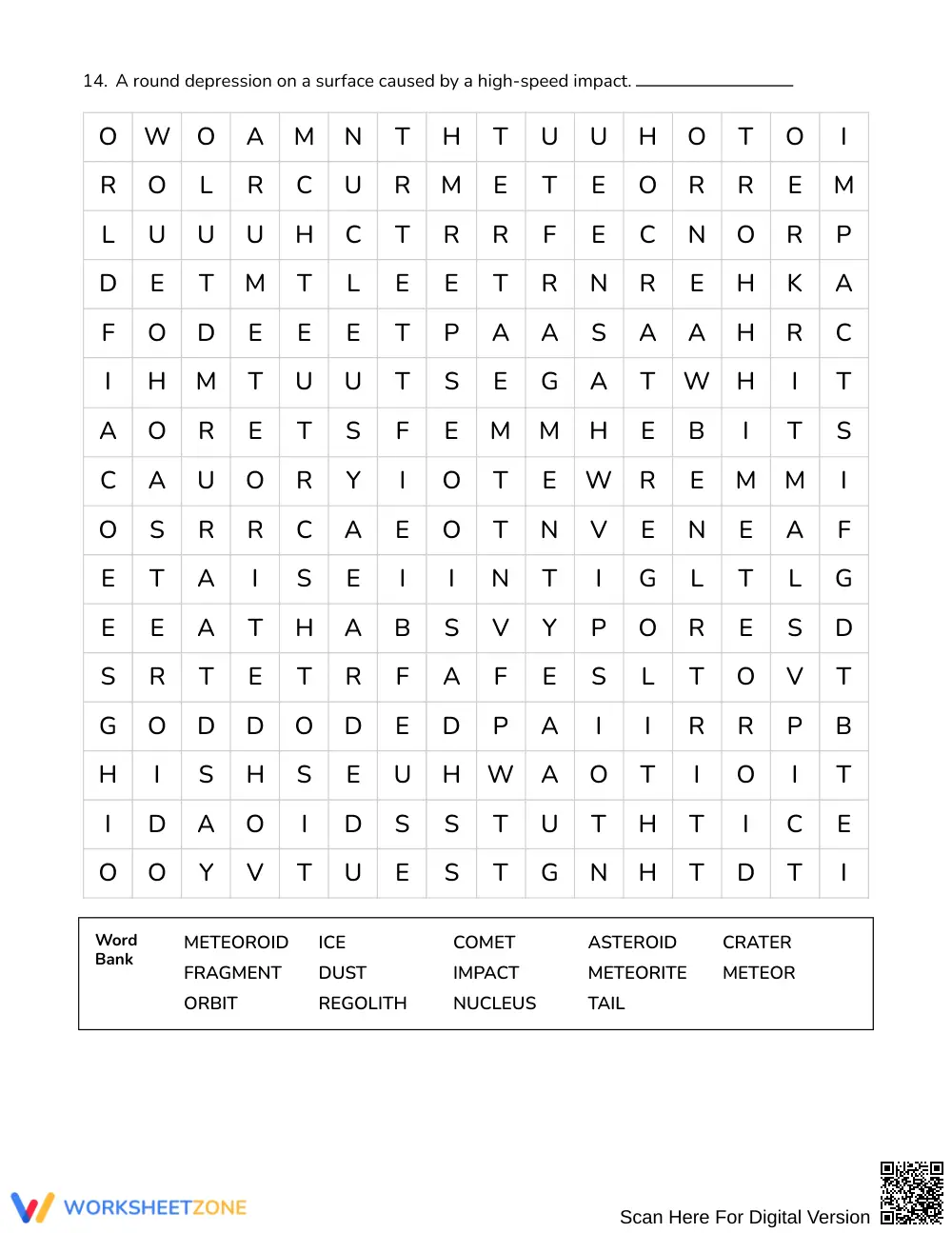


Ready Asteroids & Comets Word Search | Grades 4–5 Science

Paste this activity's link or code into your existing LMS (Google Classroom, Canvas, Teams, Schoology, Moodle, etc.).
Students can open and work on the activity right away, with no student login required.
You'll still be able to track student progress and results from your teacher account.
This Grades 4–5 science word search strengthens student understanding of small solar system bodies through contextual vocabulary retrieval. Students reinforce key terminology by matching science definitions to 14 hidden space terms, building conceptual distinctions among asteroids, comets, meteoroids, meteors, and meteorites during independent space science units.
At a Glance
- Grade: Grades 4–5 · Subject: Science
- Standard: Not standards-assessed — vocabulary enrichment
- Skill Focus: Asteroids, comets, and meteoroids
- Format: 2 pages · 14 words · Answer key included · PDF
- Best For: Solar system vocabulary practice and review
- Time: 20–30 minutes
What's Inside
The 2-page activity features a 14-word clue-detective puzzle paired with descriptive astronomy clues. Students read science definitions for terms such as regolith, nucleus, crater, and impact before locating them. A shuffled word bank provides reference support, and complete answer key pages show exact word placements for quick verification.
Puzzle Mechanics
Students search for 14 vocabulary terms hidden within a 16 × 16 letter grid. Words run in four specific orientations: northeast, east, southeast, and south. Rather than hunting through an alphabetical list, learners consult content clues that explain key characteristics of asteroids, comets, and meteors, combining reading comprehension with pattern recognition.
Standards Alignment
This learning resource is designed specifically for vocabulary enrichment and is not aligned to a formal standard. Teachers can integrate it into any upper-elementary astronomy unit to reinforce domain-specific language before summative testing or hands-on planetary modeling activities.
How to Use It
Use this word search as an engaging mid-unit review after introducing solar system debris, or assign it as an independent station task during center rotations. During work time, circulate to verify that students connect each clue to its term rather than scanning letters randomly. Expect students to finish in 20 to 30 minutes.
Who It's For
Designed for Grades 4–5 general science classrooms, this activity supports visual learners, early finishers, and English language learners needing contextual exposure to planetary terminology. Pair this word search with an illustrated anchor chart displaying the asteroid belt and comet orbits to deepen conceptual understanding.
Vocabulary acquisition in upper-elementary science requires repeated, contextualized exposure to domain-specific terminology. Research synthesized by Fisher & Frey (2014) demonstrates that intentional word-learning routines, including definitional clues and active retrieval practice, significantly enhance disciplinary literacy and conceptual comprehension in STEM subject areas. In Grades 4–5 astronomy studies, students frequently conflate related celestial bodies, such as asteroids, meteoroids, meteors, and meteorites, or overlook critical structural features like comet nuclei, sublimating dust, and glowing tails. By requiring learners to interpret substantive scientific definitions covering orbital pathways, impact craters, and loose regolith before identifying terms, this 14-word enrichment resource reinforces critical conceptual distinctions. The structured combination of definitional analysis and visual pattern searching provides purposeful, low-stakes vocabulary consolidation that strengthens long-term memory retention and prepares elementary students for complex space science coursework.


