


























Views
Downloads




Ready Area & Volume Modeling Worksheet | Grade 10 Geometry
Paste this activity's link or code into your existing LMS (Google Classroom, Canvas, Teams, Schoology, Moodle, etc.).
Students can open and work on the activity right away, with no student login required.
You'll still be able to track student progress and results from your teacher account.
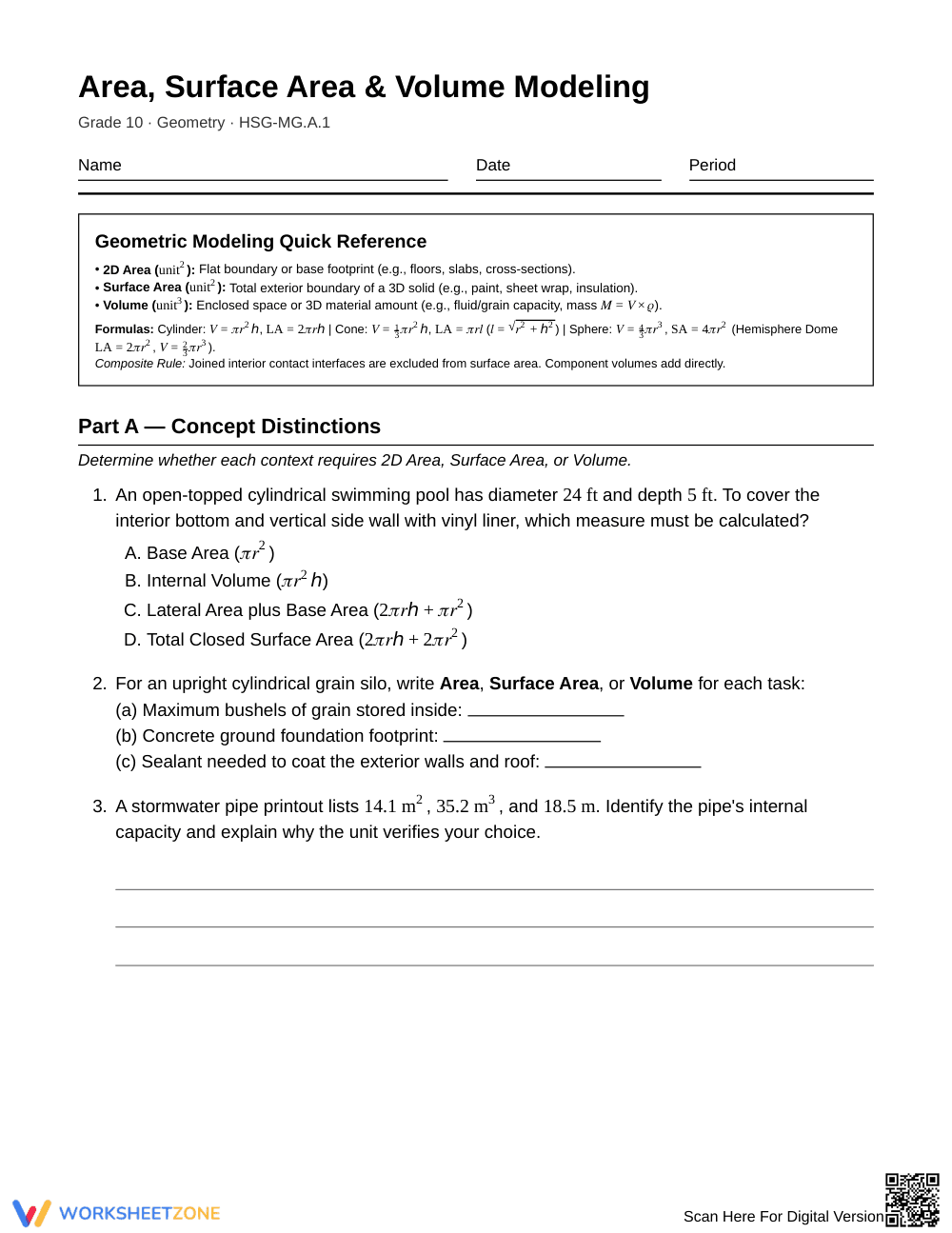
This high school geometry worksheet builds geometric modeling fluency by training students to distinguish between 2D base area, exterior surface area, and internal volume in real-world contexts. Learners analyze 16 multi-step modeling tasks, applying geometric formulas to complex composite solids, packaging scenarios, and engineering applications with complete precision.
At a Glance
- Grade: 10 · Subject: Geometry
- Standard:
HSG-MG.A.1— Apply geometric methods to solve design and real-world modeling problems- Skill Focus: Choose Area, Surface Area, or Volume
- Format: 5 pages · 16 problems · Answer key included · PDF
- Best For: Geometry modeling units and assessment review
- Time: 45–60 minutes
The 5-page resource includes a student quick-reference reference bar with 2D and 3D formulas, labeled composite figures, and a complete 3-page worked answer key. Tasks span concept classification, composite shape calculations, scale factor relationships, dimensional analysis, and error analysis across cylinders, cones, spheres, and rectangular prisms.
Skill Progression
- Guided Practice (Part A, Problems 1–4): Categorize real-world contexts and unit dimensions (square versus cubic units) to select 2D area, lateral area, total surface area, or volume.
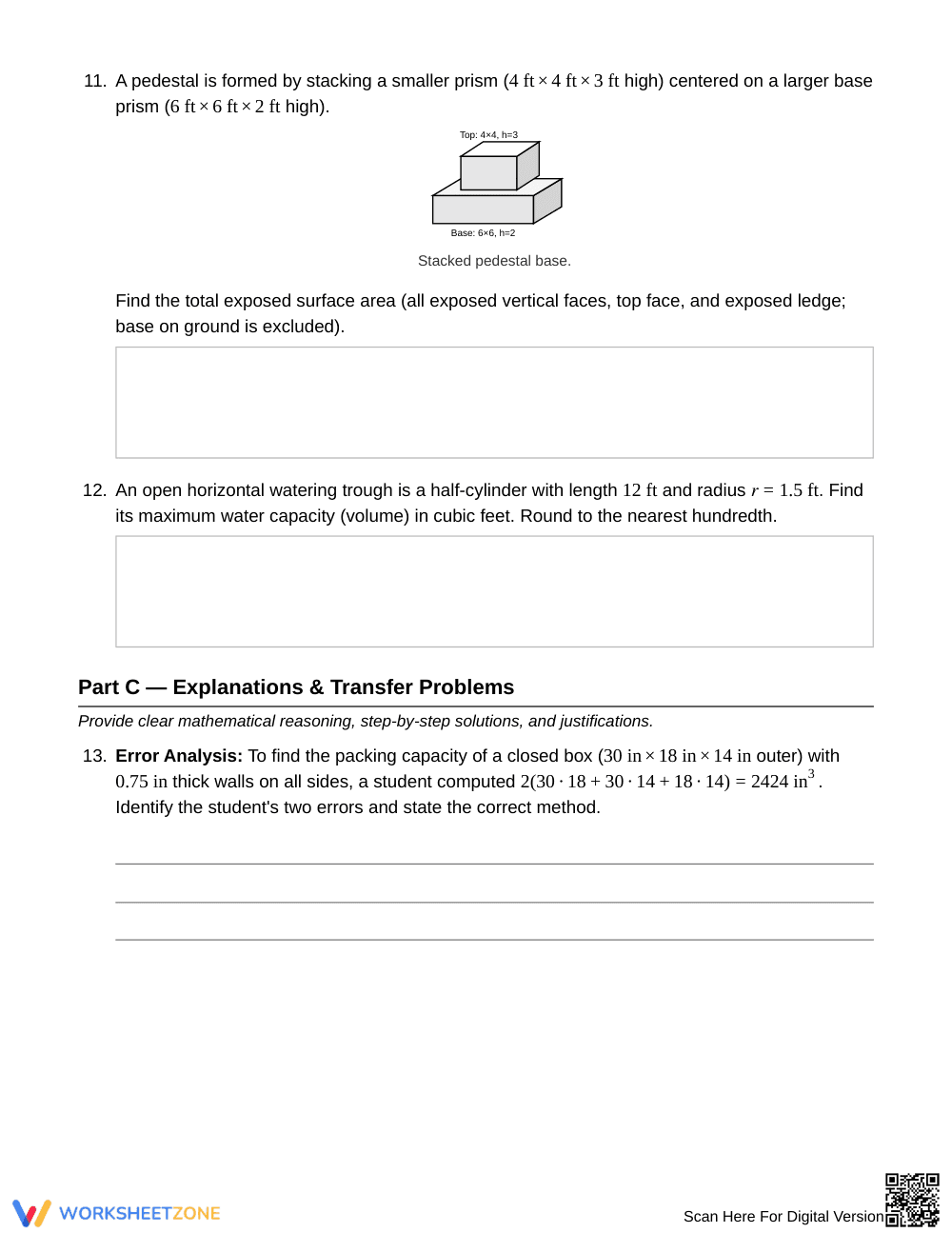
- Supported Practice (Part B, Problems 5–12): Apply formulas to composite shapes, including silos, planter boxes, and stacked pedestals with labeled diagrams.
- Independent Practice (Part C, Problems 13–16): Complete advanced transfer tasks, including error analysis, quadratic versus cubic scale modeling, packaging optimization, and density calculations.
This structured progression follows the gradual release of responsibility model, ensuring students master foundational dimensional distinctions before tackling non-routine engineering calculations.
Standards Alignment
Primary alignment is to HSG-MG.A.1: Use geometric shapes, their measures, and their properties to describe objects. Supporting alignment includes HSG-GMD.A.3, which requires applying volume formulas for cylinders, cones, and spheres to solve mathematical problems. Both standard codes can be copied directly into lesson plans, IEP goals, or district curriculum mapping tools.
How to Use It
Deploy this worksheet after direct instruction on 3D geometric formulas to reinforce conceptual differences between boundary area and interior capacity. Alternatively, use it during mid-unit review stations before summative assessments. During classwork, observe whether students identify internal contact surfaces in composite solids to ensure they do not overcount surface area. Expected completion time is 45 to 60 minutes.
Who It's For
This activity is designed for Grade 10 Geometry students learning applied solid geometry. Built-in formula references support striving learners, while multi-step density and scaling problems challenge advanced students. Pair this activity with concrete 3D geometric manipulatives or an interactive solid geometry demonstration.
High school geometry students frequently struggle to differentiate between surface area and volume when modeling real-world objects, often treating 3D boundary measurements and volumetric capacity interchangeably. According to research synthesized by Fisher & Frey (2014) on guided instruction, explicit scaffolding that moves from concept categorization to complex composite calculation significantly strengthens mathematical reasoning and spatial transfer. Under Common Core standard HSG-MG.A.1, learners must accurately select and apply geometric measures to design scenarios and physical modeling contexts. This 16-problem resource systematically builds that skill through clear structural formulas, composite solids, and dimensional error analysis. By isolating boundary measures from enclosed capacities, students master the conceptual distinctions required for advanced STEM coursework and standards-aligned performance assessments.


