































Ready Ancient Rome Word Search | Grades 7–8 Social Studies

Paste this activity's link or code into your existing LMS (Google Classroom, Canvas, Teams, Schoology, Moodle, etc.).
Students can open and work on the activity right away, with no student login required.
You'll still be able to track student progress and results from your teacher account.
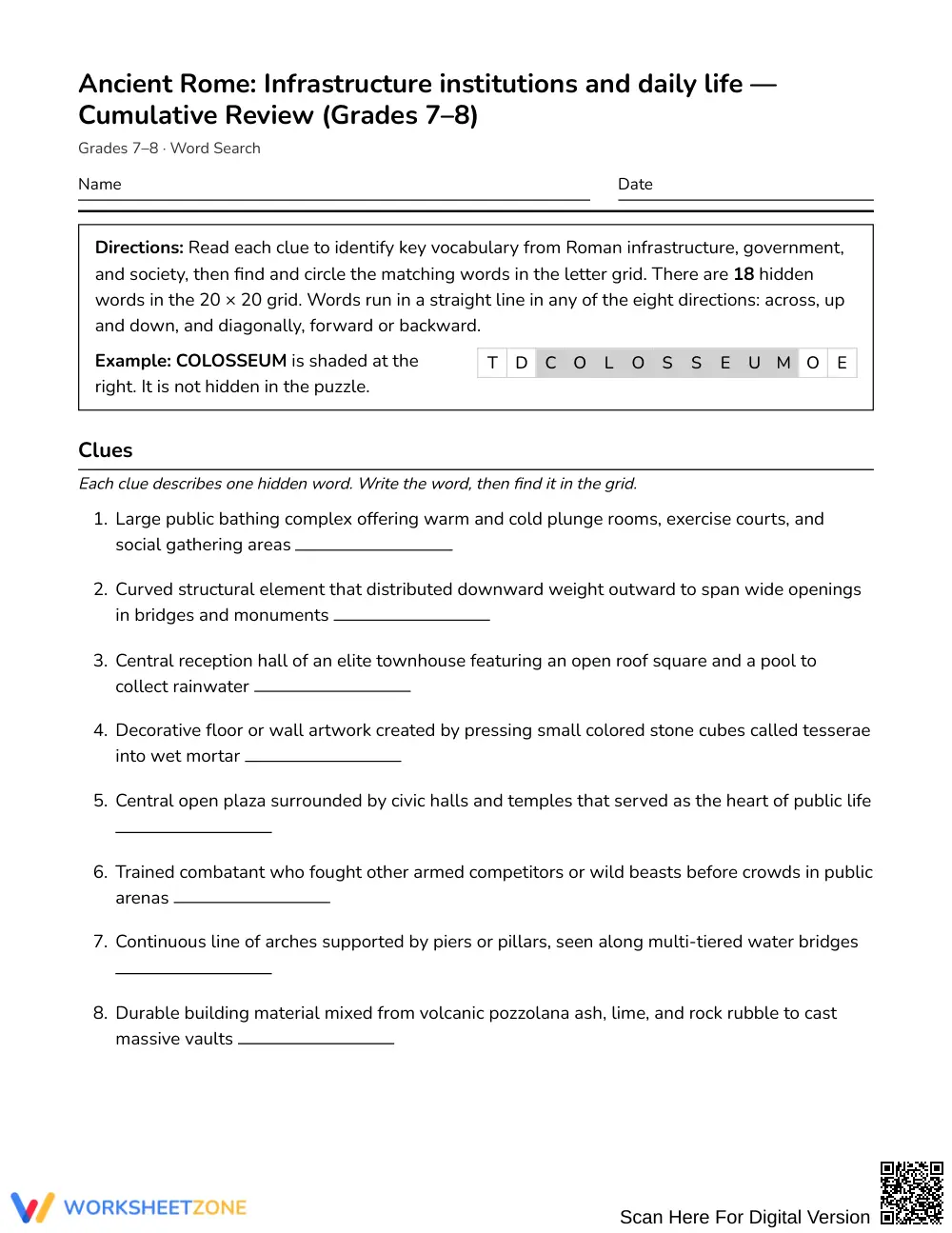
This Ancient Rome word search strengthens Grades 7–8 social studies vocabulary by challenging students to identify and locate 18 foundational terms related to Roman infrastructure, government institutions, and everyday life. By matching descriptive historical clues to key concepts, learners reinforce essential academic terminology across a comprehensive three-page cumulative review activity.
At a Glance
- Grade: Grades 7–8 · Subject: Social Studies (World History Unit)
- Standard: Not standards-assessed — vocabulary enrichment
- Skill Focus: Ancient Roman infrastructure, republican government institutions, social hierarchy, and daily civic life
- Format: 3 student pages · 18 hidden vocabulary words · 4-page answer key included · Printable PDF
- Best For: Cumulative unit review, historical term reinforcement, early finishers, and sub plans
- Time: 25–35 minutes of focused student engagement
What's Inside
The resource spans three printable student pages containing 18 domain-specific vocabulary terms organized around Roman civilization. Instead of a standard passive list, the worksheet provides detailed architectural, civic, and cultural clues that students must read to determine each target word. A complete four-page answer key follows, illustrating full grid solutions with word locations clearly highlighted for rapid checking.
Puzzle Structure and Mechanics
This puzzle is constructed on a 20 x 20 letter grid designed to provide an engaging cognitive challenge for middle school students. The 18 vocabulary words run in all eight possible directions: North, Northeast, East, Southeast, South, Southwest, West, and Northwest, including forward, backward, and diagonal placements. Students engage with a shuffled word bank paired with contextual clues covering engineering marvels like the aqueduct and concrete, governance concepts including consul and veto, and daily social structures like the insula and plebeian.
Standards Alignment
This word search serves strictly as vocabulary enrichment and is not aligned to a specific state or national content standard. It is designed to reinforce essential historical terminology, supporting overall reading comprehension and concept retention within secondary World History units without assessing individual standards.
How to Use It
Deploy this activity immediately after direct instruction on the Roman Republic and Empire to consolidate unit vocabulary, or assign it as an independent station task during review rotations. For formative assessment, circulate as students solve the clues before searching the grid to identify which architectural or governmental terms require targeted reteaching. Expected student completion time is 25 to 35 minutes.
Who It's For
This resource is tailored for Grades 7–8 social studies students exploring ancient Mediterranean civilizations. The detailed contextual clues provide built-in reading scaffolds for developing readers and English language learners, while the multi-directional grid offers stimulating challenge for advanced learners. Pair this puzzle with an architectural diagram of a Roman aqueduct or an anchor chart outlining Roman social hierarchy.
Secondary social studies instruction requires students to master dense domain-specific terminology to comprehend complex historical systems and cultural practices. According to Fisher & Frey (2014), intentional vocabulary acquisition that combines definitional clues with orthographic recognition significantly enhances content-area retention and reading comprehension across middle school humanities curricula. This word search supports student mastery of Ancient Roman infrastructure, republican governance, and social institutions by requiring learners to decode descriptive historical clues before locating 18 key terms within a 20 x 20 letter grid. Engaging with concepts such as patricians, aqueducts, and the senate through multi-directional puzzle mechanics encourages cognitive retrieval without relying on passive memorization. By integrating vocabulary enrichment into regular unit reviews, educators build necessary background knowledge that prepares learners for rigorous primary source analysis, historical writing, and cumulative social studies assessments throughout seventh and eighth grade.


