




























Ready Ancient Greece Word Search | Grades 7–8 Social Studies
Paste this activity's link or code into your existing LMS (Google Classroom, Canvas, Teams, Schoology, Moodle, etc.).
Students can open and work on the activity right away, with no student login required.
You'll still be able to track student progress and results from your teacher account.
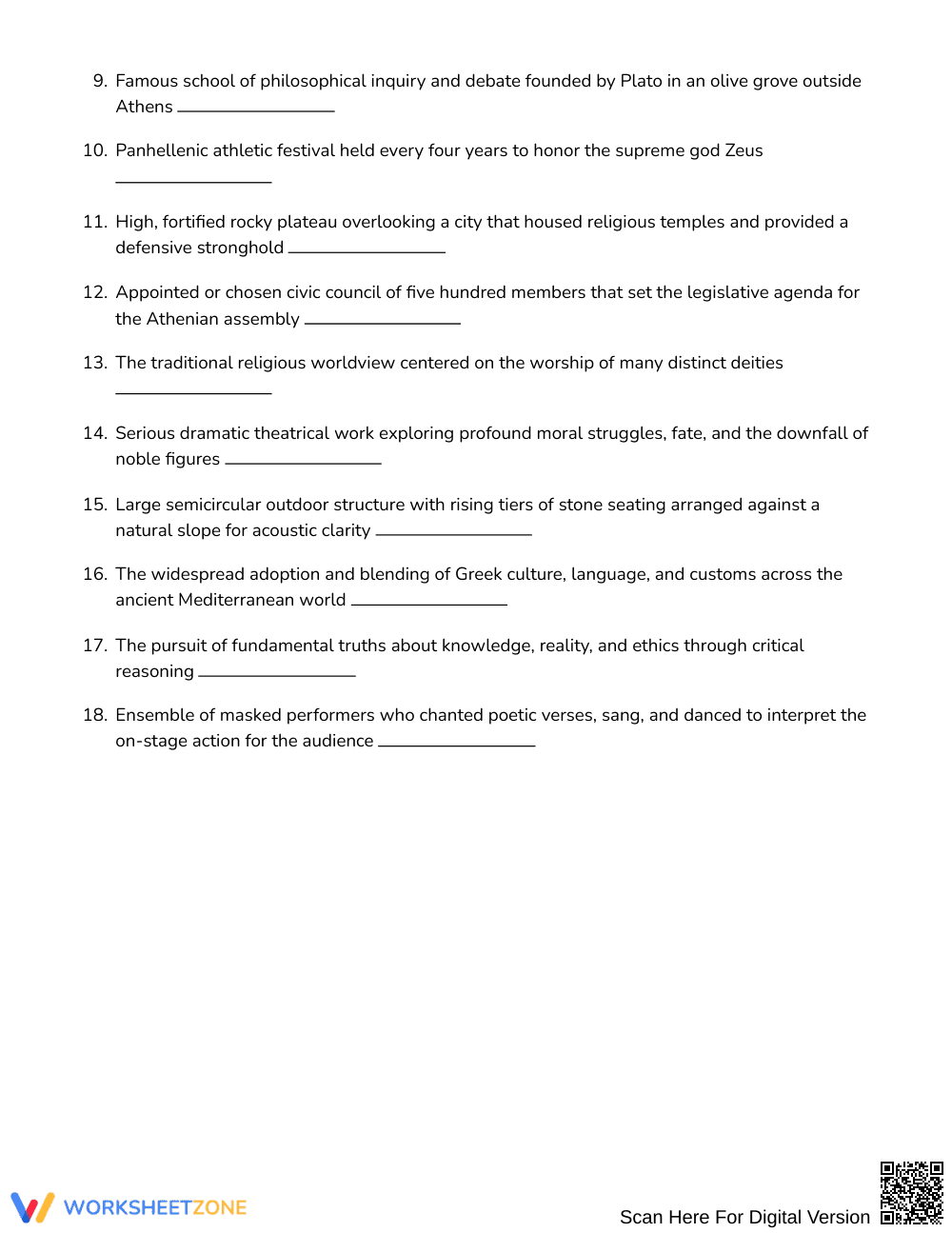
This Ancient Greece word search strengthens middle school social studies vocabulary through clue-based term identification and spatial puzzle solving. Designed for Grades 7–8 world history units, the activity requires students to decode historical definitions covering civic institutions, cultural practices, and philosophical concepts before locating 18 terms within the letter grid.
At a Glance
- Grade: Grades 7–8 · Subject: Social Studies
- Standard: Not standards-assessed — vocabulary enrichment
- Skill Focus: Ideas, institutions, civic systems, and cultural practices of ancient Greece
- Format: 3 pages · 18 words · Answer key included · PDF
- Best For: Cumulative unit review, sub plans, and social studies vocabulary reinforcement
- Time: 25–35 minutes
Inside this 3-page printable set, students receive an 18-word search puzzle accompanied by concise historical clues for each vocabulary entry. Rather than merely copying terms from a passive list, learners match definitions for foundational concepts like democracy, ostracism, agora, and philosophy to the word bank. A comprehensive answer key provides teachers with an easy-to-read reference displaying letter coordinates and circled solution paths.
How the Puzzle Works
The activity features a challenging 20 × 20 letter grid containing 18 hidden vocabulary words. Words are hidden in all 8 possible directions: north, northeast, east, southeast, south, southwest, west, and northwest. Students read content-rich clues defining Greek governance, religion, and theater, consult the shuffled word bank to verify spelling, and trace the intersecting paths across the puzzle grid.
Standards Alignment
This activity serves as vocabulary enrichment and is not aligned to a specific state or national content standard. It reinforces essential social studies terminology across middle school classical Mediterranean studies, strengthening reading comprehension for non-fiction historical texts without formal standards testing constraints.
How to Use It
Deploy this word search after direct instruction on classical Greece as an engaging cumulative review, or keep copies ready for independent substitute lesson plans. During puzzle work, circulate formatively to observe whether students recognize institutional terms like boule or rely exclusively on letter hunting. Expect completion within 25 to 35 minutes depending on student familiarity with directional grids.
Who It's For
This resource is tailored for Grades 7–8 social studies learners exploring ancient Mediterranean civilizations. The integrated definition clues scaffold access for striving readers and English language learners, while the multidirectional 20 × 20 grid maintains cognitive engagement for advanced learners. Pair this activity with an Athenian democracy anchor chart or an ancient Greek architecture reading passage.
Vocabulary acquisition in secondary social studies requires intentional exposure to tier-three domain words that define complex historical concepts. According to Fisher & Frey (2014), content-area literacy expands when students actively interact with specialized academic terminology through contextual definitions rather than isolated memorization drills. This Ancient Greece word search provides Grades 7–8 social studies learners with targeted vocabulary enrichment, engaging students in identifying 18 key historical terms spanning political systems, civic institutions, and cultural traditions. Operating on a 20 × 20 letter matrix with eight directional paths, the resource bridges semantic comprehension and orthographic recognition. Designed without a formal state standard alignment, the activity functions as an accessible review tool that reinforces foundational knowledge of Athenian democracy, classical philosophy, and civic architecture. Teachers can efficiently evaluate vocabulary retention while providing meaningful, low-stress review during world history instructional units.


