




























Ready Ancient Greece Word Search | Grades 6–7 Social Studies
Paste this activity's link or code into your existing LMS (Google Classroom, Canvas, Teams, Schoology, Moodle, etc.).
Students can open and work on the activity right away, with no student login required.
You'll still be able to track student progress and results from your teacher account.
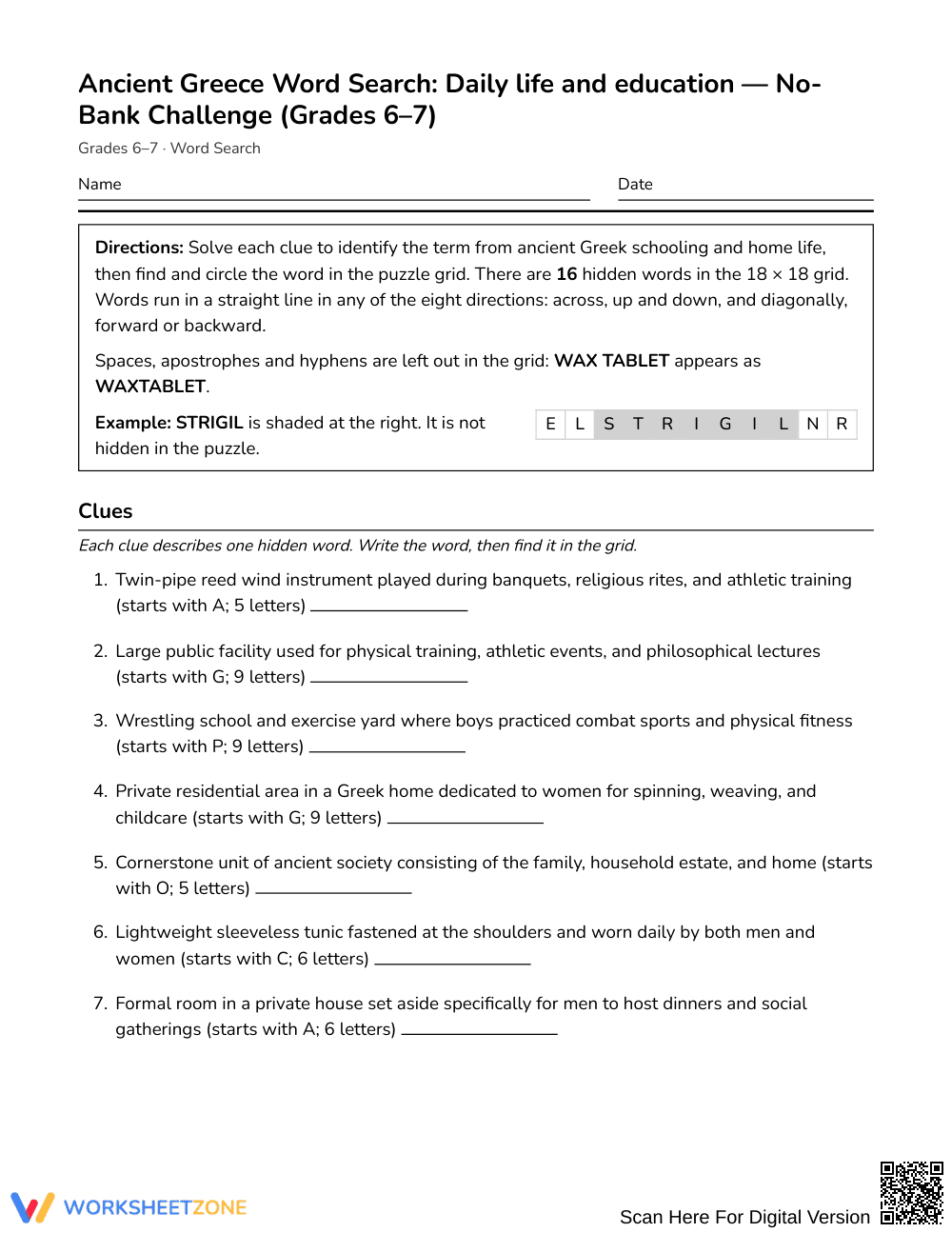
This ancient Greece word search reinforces historical vocabulary connected to daily life, family roles, and education in the classical world. Students in Grades 6–7 analyze descriptive historical clues to determine 16 specialized terms before locating them across the grid, strengthening content retention and conceptual recall during social studies units.
At a Glance
- Grade: Grades 6–7 · Subject: Social Studies (World History)
- Standard: Not standards-assessed — vocabulary enrichment across classical civilizations
- Skill Focus: Classical Greek daily life, household structures, and education
- Format: 3 student pages · 16 hidden words · Full answer key included · PDF
- Best For: Independent vocabulary review, historical terminology enrichment, or sub plans
- Time: 25–35 minutes
What's Inside
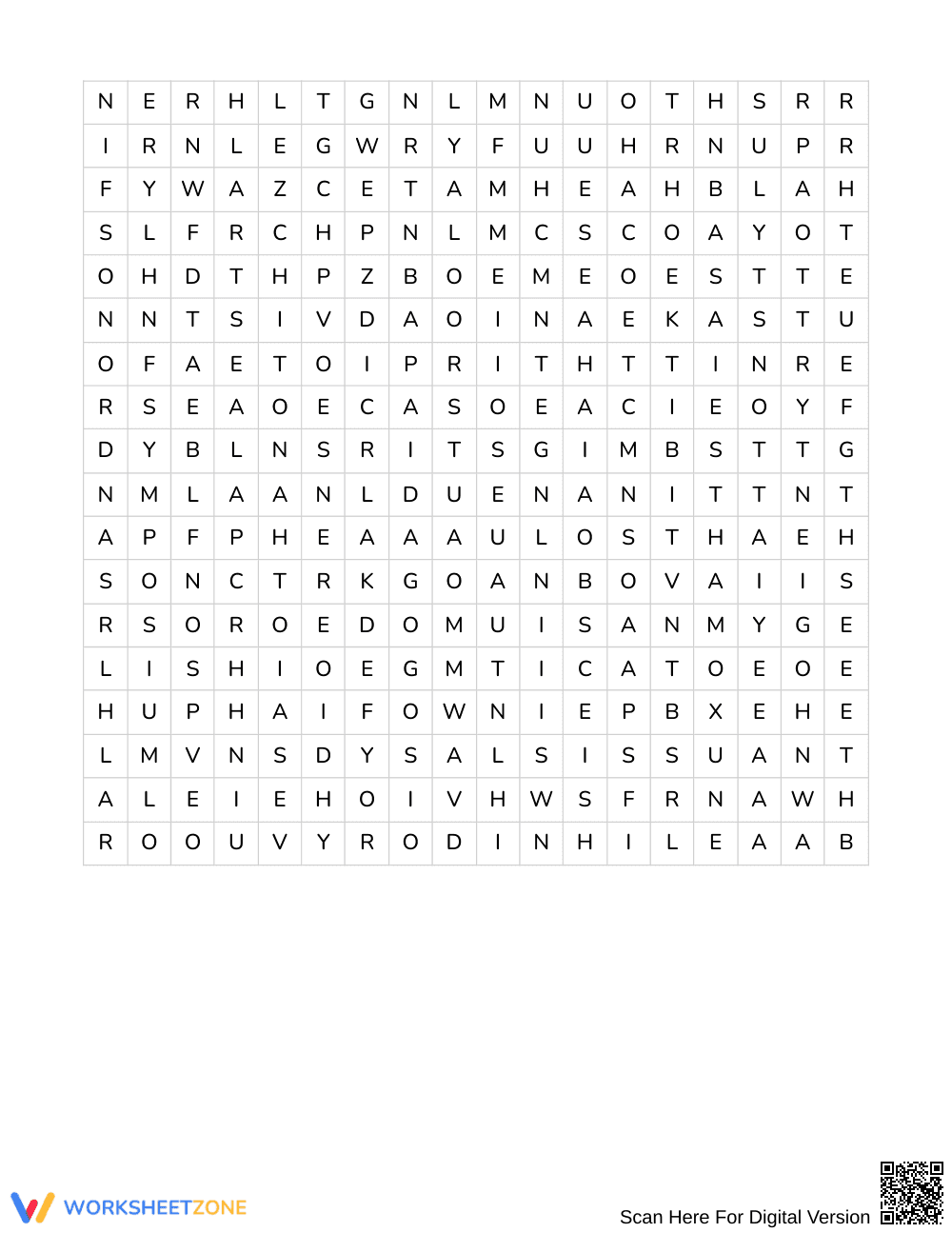
The activity provides an authentic challenge by replacing a conventional word list with context-rich definition clues. Students read 16 detailed descriptions detailing garments like the chiton, educational implements such as the wax tablet and stylus, and spaces like the gymnasium and andron. This 3-page printable set includes a clean student puzzle grid, a full page of historical clues, and complete answer key reference pages highlighting all word locations.
Puzzle Mechanics and Structure
This puzzle utilizes an 18 x 18 grid that challenges students to apply close visual scanning. Because there is no standard word bank, learners must first deduce each target vocabulary term directly from its historical clue. Words run in all 8 compass directions: north, northeast, east, southeast, south, southwest, west, and northwest. This multidirectional arrangement encourages sustained spatial focus and active problem-solving as students verify letter sequences across the letter field.
Standards Alignment
This activity serves strictly as cross-curricular vocabulary enrichment and is not aligned to a formal state or national content standard. It supports general world history literacy by introducing authentic Greek terminology related to domestic living, social roles, and ancient schooling traditions.
How to Use It
Deploy this activity after direct instruction on ancient Mediterranean civilizations as a formative vocabulary checkpoint, or assign it before a research unit to introduce domain-specific vocabulary. During the 25 to 35 minutes allotted for completion, circulate while students analyze the clues; note whether students struggle to differentiate architectural terms like the andron and gynaeceum to guide subsequent review.
Who It's For
This resource is designed for general education students in Grades 6–7 exploring classical antiquity. For students requiring extra support, teachers can highlight the first letter of each clue answer, while advanced learners can compose original sentences using each identified term. Pair this puzzle with an introductory textbook chapter or an illustrated cultural anchor chart on Athenian domestic life.
Vocabulary acquisition in secondary social studies requires consistent exposure to domain-specific terminology within meaningful historical contexts. According to Fisher & Frey (2014), intentional vocabulary instruction that pairs descriptive contextual clues with active retrieval significantly improves student comprehension of informational texts and complex historical concepts. This Grades 6–7 resource reinforces 16 essential terms regarding ancient Greek daily life, household organization, and education without relying on passive word identification. By removing the traditional word bank and requiring students to resolve detailed historical definitions before locating terms in an 18 x 18 grid, learners engage in deeper semantic processing. The activity strengthens long-term memory pathways, aids morphological awareness, and builds the foundational cultural knowledge necessary for analyzing classical world history. Consequently, integrating clue-driven word puzzles into middle school social studies curricula offers an effective method for solidifying academic vocabulary, supporting disciplinary literacy, and enhancing student engagement during independent or collaborative historical study.


