































Ready Ancient China Word Search | Grades 7–8 Social Studies

Paste this activity's link or code into your existing LMS (Google Classroom, Canvas, Teams, Schoology, Moodle, etc.).
Students can open and work on the activity right away, with no student login required.
You'll still be able to track student progress and results from your teacher account.
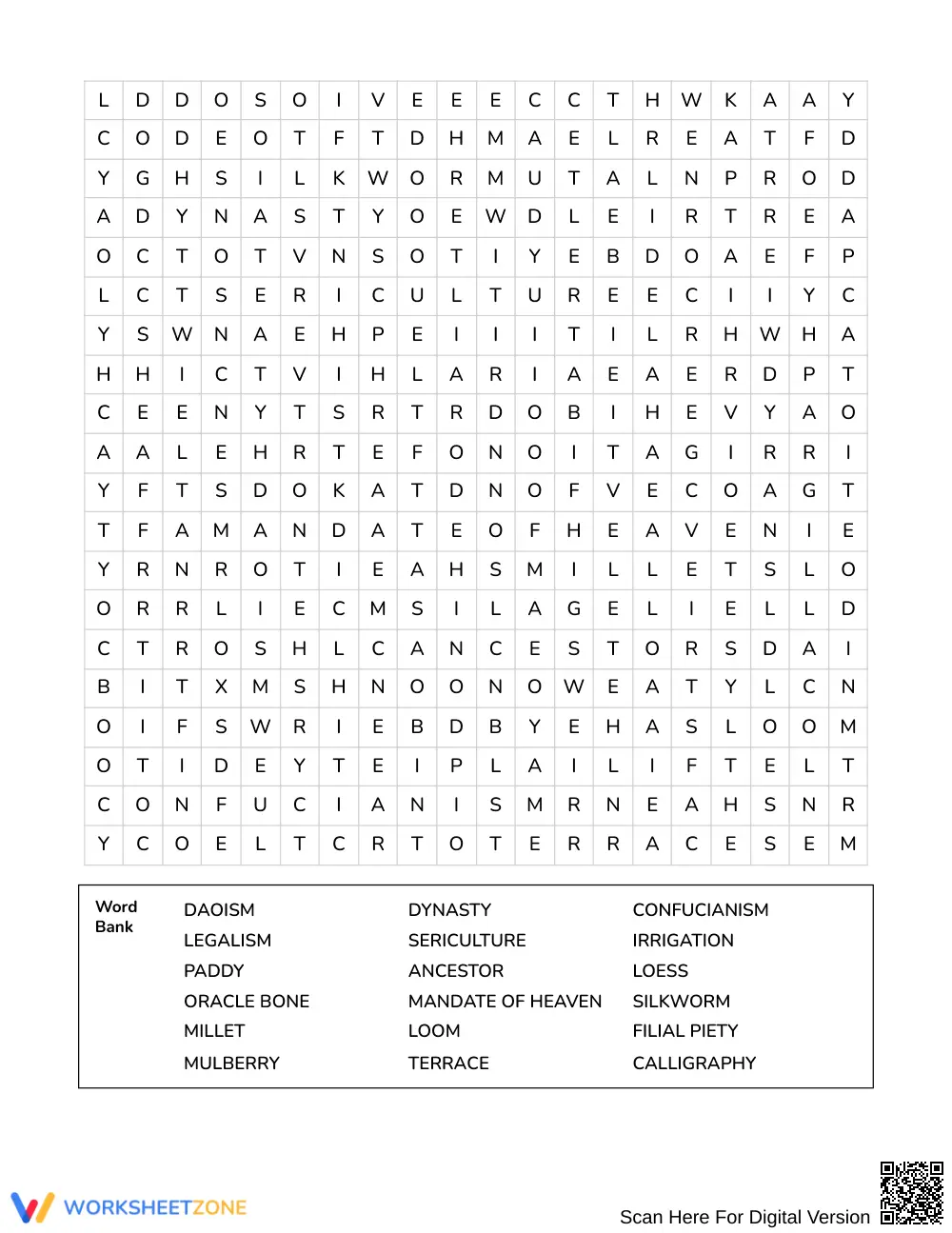
This ancient Chinese society and culture review activity helps Grades 7–8 social studies students reinforce foundational World History terminology through active vocabulary retrieval. Learners read historical definition clues to identify 18 essential terms spanning classical philosophies, imperial governance, and agricultural technologies before locating each hidden word within an expansive puzzle grid.
At a Glance
- Grade: Grades 7–8 · Subject: Social Studies (World History)
- Standard: Not standards-assessed — vocabulary enrichment
- Skill Focus: Ancient Chinese society, culture, philosophy, and agriculture
- Format: 3 student pages · 18 words · 4-page answer key included · PDF
- Best For: Cumulative unit review and vocabulary reinforcement
- Time: 25–35 instructional minutes
What's Inside
This 3-page printable activity packet features 18 historical vocabulary words paired with rigorous definition clues. A shuffled word bank challenges students to match foundational terms with academic descriptions before searching. The package includes a comprehensive 4-page answer key that visually highlights every hidden term across the puzzle grid for rapid, transparent grading.
Puzzle Mechanics and Structure
The activity is built around a large 20 x 20 letter grid designed to engage middle school learners in substantive visual scanning. All 18 hidden vocabulary terms run across eight compass directions: north, northeast, east, southeast, south, southwest, west, and northwest. Students read detailed contextual clues defining key philosophical movements, agricultural practices, and imperial structures, consulting the shuffled word bank to verify spelling before locating the terms in the grid.
Standards Alignment
This resource serves as supplemental vocabulary enrichment and is not aligned to a specific state or national content standard. It reinforces essential historical literacy by familiarizing seventh and eighth graders with core domain-specific vocabulary—including Confucianism, Legalism, sericulture, and the Mandate of Heaven—supporting broader World History comprehension across diverse curricula.
How to Use It
Deploy this word search after direct instruction as a cumulative review before a unit exam, or assign it during independent seatwork while facilitating small-group reteaching. For formative assessment, circulate as students work through the definition clues to observe whether they can match concepts like filial piety and oracle bones without relying immediately on the word bank. Learners typically complete the full puzzle in 25 to 35 minutes.
Who It's For
This resource is tailored for Grades 7–8 social studies classrooms studying ancient river valley civilizations. It supports English language learners and developing readers by combining explicit definition clues with orthographic visual cues. Pair this activity with an ancient China anchor chart or introductory reading passage to anchor abstract philosophies in concrete historical context.
Vocabulary acquisition in secondary social studies depends on repeated, meaningful interactions with domain-specific terminology across varied instructional modalities. This Grades 7–8 word search provides deliberate practice in ancient Chinese society and culture vocabulary review by linking historical terms, such as Confucianism, calligraphy, loess, and dynasty, directly to academic definitions. According to Fisher & Frey (2014), intentional word exposure coupled with contextual retrieval structures solidifies disciplinary literacy and strengthens reading comprehension in content-area coursework. By requiring middle school students to process definitions before conducting orthographic searches across a 20 by 20 letter grid, this activity bridges conceptual understanding and vocabulary retention. The inclusion of 18 foundational terms supports long-term schema building regarding early civilizations, governance, and daily life. Educators can utilize this 3-page printable resource alongside primary source readings to cultivate enduring historical literacy and academic language proficiency in the classroom.


