































Ready Ancient China Word Search | Grades 7–8 Social Studies

Paste this activity's link or code into your existing LMS (Google Classroom, Canvas, Teams, Schoology, Moodle, etc.).
Students can open and work on the activity right away, with no student login required.
You'll still be able to track student progress and results from your teacher account.
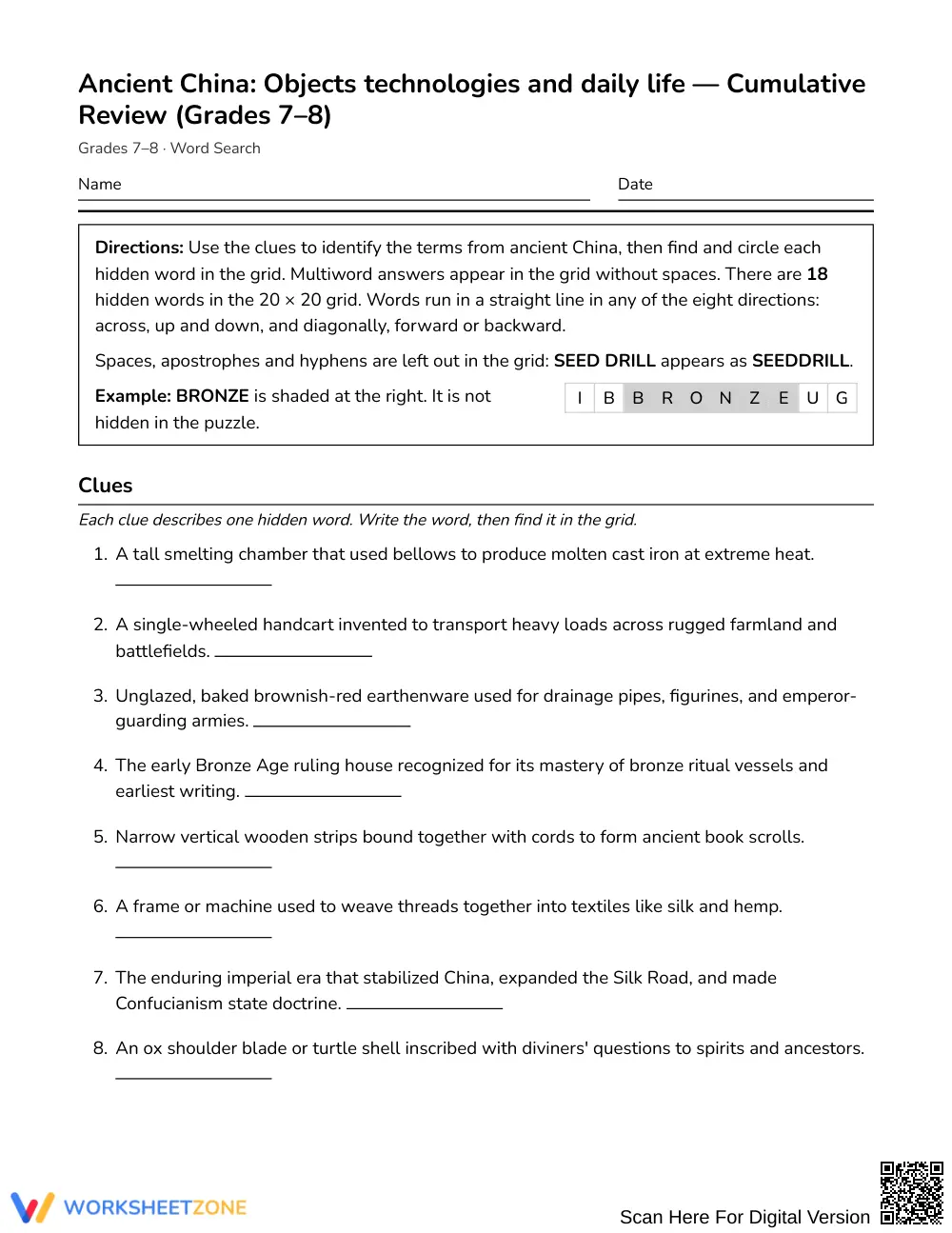
This ancient China word search reinforces essential World History vocabulary for middle school students, connecting key inventions, governance concepts, and cultural artifacts to everyday life in early imperial dynasties. Students read definition-rich clues to identify 18 historical terms, locating each hidden word to solidify conceptual retention and content-area literacy.
At a Glance
- Grade: Grades 7–8 · Subject: Social Studies
- Standard: Not standards-assessed — vocabulary enrichment
- Skill Focus: Objects, technologies, and daily life in ancient China
- Format: 3 pages · 18 words · Answer key included · PDF
- Best For: Unit vocabulary review or sub plans
- Time: 25–35 minutes
What's Inside
This 3-page printable resource pairs rigorous historical definitions with an engaging puzzle format. Rather than relying on a passive word list, the activity provides 18 contextual clues spanning agriculture, metallurgy, administration, and scholarship. Students deduce each term before finding it, supported by an exhaustive 4-page answer key showing full grid letter locations.
Puzzle Mechanics and Structure
The activity is built on a dense 20 × 20 letter grid designed to challenge middle school search strategies. Words run in all 8 cardinal and diagonal directions: north, northeast, east, southeast, south, southwest, west, and northwest. The word bank is presented in shuffled order alongside historical clues, requiring students to interpret definitions for multiword terms like blast furnace and Mandate of Heaven without spaces in the grid.
Standards Alignment
This resource serves as targeted vocabulary enrichment and is not aligned to a formal state or national content standard. It reinforces cross-curricular reading comprehension in historical contexts by prompting students to analyze specialized terminology, technological milestones, and social systems across China's Shang, Zhou, and Han eras.
How to Use It
Deploy this word search directly after direct instruction on early Chinese dynasties to cement terminology, or assign it as an independent review station during cumulative exam preparation. As students work, circulate to observe whether they can identify terms from clues alone before checking the word bank; hesitation on concepts like sericulture or oracle bones signals a need for reteaching. Expect completion in 25 to 35 minutes.
Who It's For
Designed for seventh and eighth grade World History classrooms, this activity supports general education students, early finishers, and English language learners benefiting from embedded context clues. Pair this puzzle with an introductory primary source reading on Han Dynasty agricultural tools or a museum gallery walk highlighting Shang Dynasty bronze vessels.
Content-area vocabulary acquisition is essential for historical comprehension in secondary social studies classrooms. According to Fisher & Frey (2014), intentional exposure to domain-specific terminology through paired definitional clues and retrieval tasks accelerates conceptual understanding and long-term retention across informational texts. This educational word search provides Grades 7–8 learners with targeted vocabulary enrichment focused on ancient Chinese objects, technological innovations, and daily living patterns. By decoding contextual clues for eighteen foundational terms—ranging from sericulture and blast furnaces to calligraphy and the Mandate of Heaven—students bridge technical terminology with historical significance. The integration of clue-driven search mechanics reinforces word recognition, semantic association, and cognitive processing without requiring preliminary rote memorization. Consequently, pairing rigorous definitions with structured word discovery offers an accessible, low-stakes entry point for diverse learners mastering complex world history topics prior to summative unit assessments.


