





























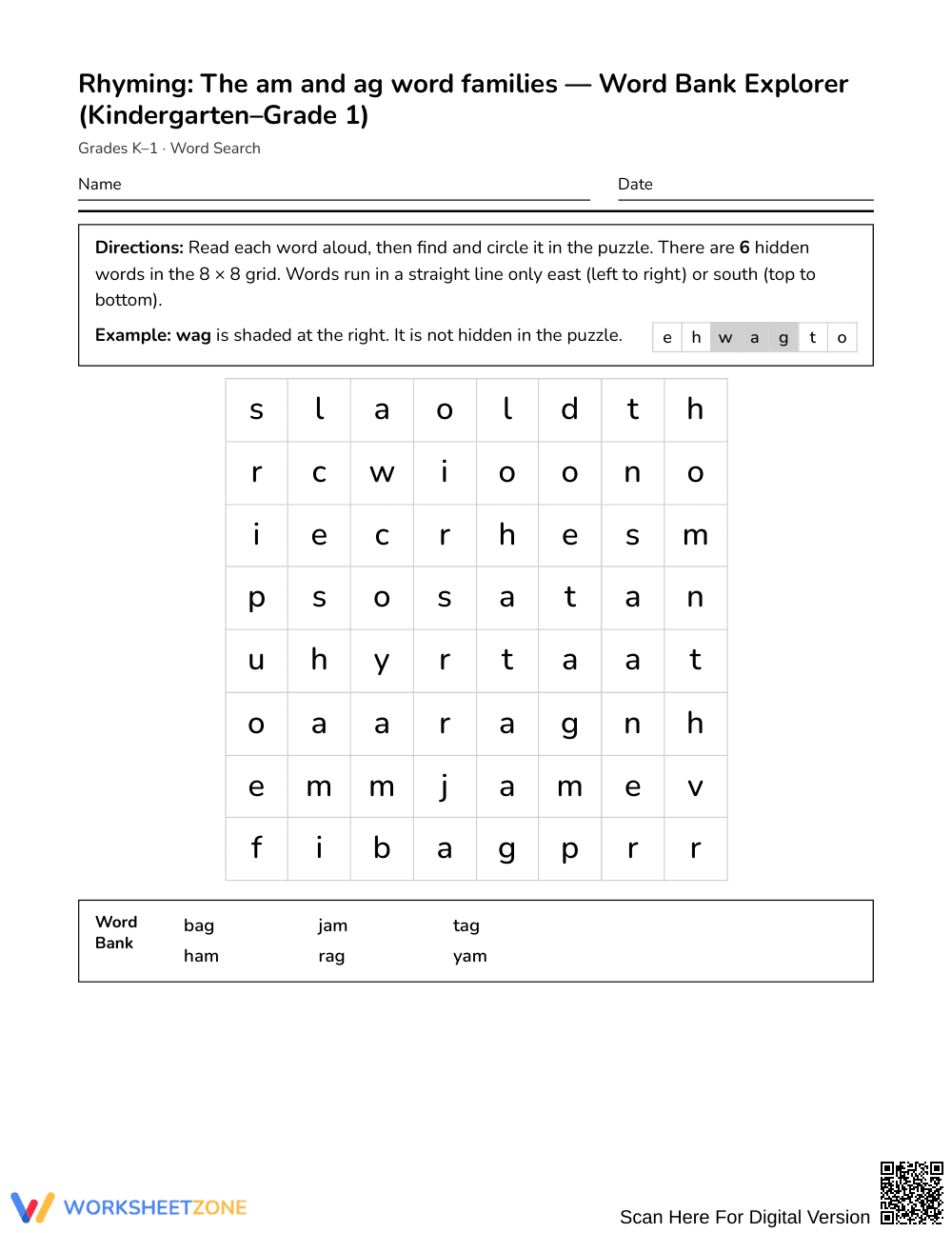


Ready am & ag Word Families Word Search | Grades K–1 ELA

Paste this activity's link or code into your existing LMS (Google Classroom, Canvas, Teams, Schoology, Moodle, etc.).
Students can open and work on the activity right away, with no student login required.
You'll still be able to track student progress and results from your teacher account.
This early literacy word search reinforces phonics pattern recognition for the am and ag word families. Young readers identify rhyming structures, practice left-to-right visual tracking, and connect target spelling patterns to foundational vocabulary through accessible puzzle play. It delivers engaging, screen-free phonics reinforcement with zero teacher preparation required.
At a Glance
- Grade: Grades K–1 · Subject: English Language Arts (ELA)
- Standard: Not standards-assessed — vocabulary enrichment
- Skill Focus: the am and ag word families
- Format: 1 pages · 6 words · Answer key included · PDF
- Best For: Literacy centers and morning work
- Time: 10–15 minutes
What's Inside
This 1-page printable features an uncluttered letter grid paired with an alphabetical word bank containing 6 target words: BAG, HAM, JAM, RAG, TAG, and YAM. Student-friendly definition clues accompany each term to support receptive language development alongside decoding. A clear 2-page answer key provides visual highlight overlays for fast verification.
Puzzle Mechanics & Layout
Designed specifically for emerging readers in kindergarten and first grade, the activity limits visual fatigue while encouraging sustained focus:
- Grid Size: An accessible 8 x 8 grid offers ample letter spacing tailored to early primary hand-eye coordination.
- Placement Directions: Hidden terms run strictly East (left-to-right) and South (top-to-bottom), matching natural reading directionality and avoiding confusing diagonal or backward orientations.
- Word Bank Support: An alphabetized word list allows early readers to check off familiar short-a rhyming patterns as they locate each term.
Standards Alignment
This phonics activity serves as targeted vocabulary enrichment and is not aligned to a formal standard. It supplements foundational phonological awareness and early spelling curricula by giving emergent decoders tactile practice with high-frequency short-a word endings.
How to Use It
Distribute this word search during independent literacy stations following direct instruction on the -am and -ag rimes. Alternatively, assign it as a calming morning starter or an effortless sub-plan activity. As students search, circulate to prompt verbal blending: invite learners to pronounce each onset and rime separately before reading the full word aloud. Expected completion time spans 10 to 15 minutes.
Who It's For
This resource supports kindergarteners building early print awareness and first graders cementing short-vowel phonics patterns. It offers gentle scaffolding for English language learners acquiring basic nouns through simple definitions. Pair this word search with a rhyming anchor chart or tactile letter-tile blending trays during small-group reading rotations.
Early phonics mastery depends on high-volume exposure to consistent orthographic patterns. According to Fisher & Frey (2014), purposeful word-study tasks help emerging readers consolidate orthographic mapping by linking speech sounds directly to stable letter sequences. This 1-page puzzle provides targeted practice with the am and ag word families, requiring young children to identify 6 vocabulary terms within an 8 x 8 letter grid. Restricting word orientation strictly to left-to-right and top-to-bottom paths honors early developmental reading trajectories while preventing directional frustration. Because student-facing definitions accompany each target term, learners build semantic knowledge alongside phonemic awareness. This engaging activity serves as a dependable vocabulary enrichment tool that strengthens print concept awareness, boosts letter-sound recognition, and builds reading confidence during foundational literacy instruction.


