




























Views
Downloads

Ready African Travel Word Search | Grades 5–6 Social Studies

Paste this activity's link or code into your existing LMS (Google Classroom, Canvas, Teams, Schoology, Moodle, etc.).
Students can open and work on the activity right away, with no student login required.
You'll still be able to track student progress and results from your teacher account.
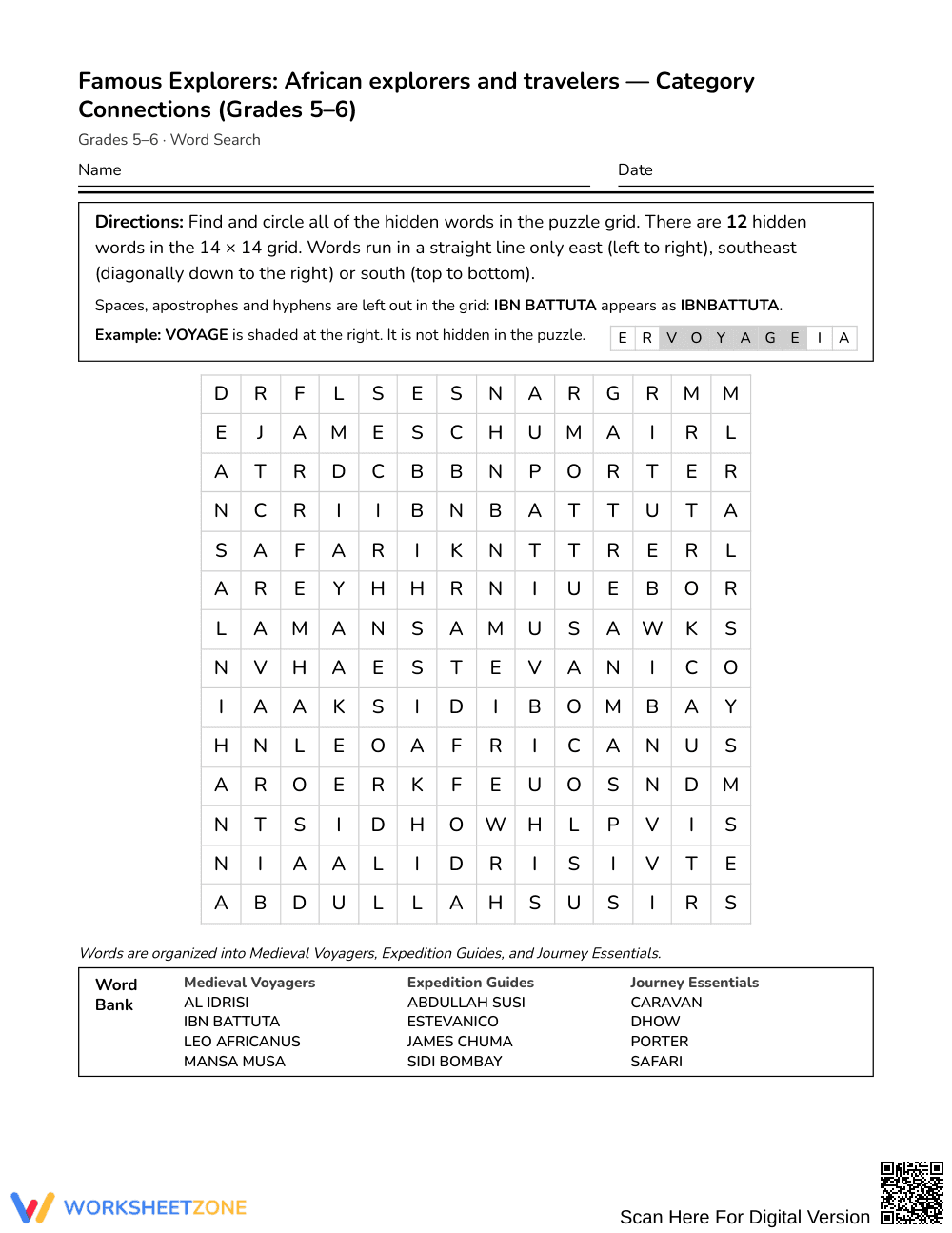
This African explorers and travelers word search introduces Grades 5–6 students to notable historical voyagers, caravan scouts, and trade terminology across world history. Learners locate 12 key vocabulary terms hidden in a letter grid, expanding their historical background knowledge and familiarizing themselves with influential African figures before analyzing primary sources or textbook chapters.
At a Glance
- Grade: Grades 5–6 · Subject: Social Studies
- Standard: Not standards-assessed — vocabulary enrichment
- Skill Focus: African explorers and travelers
- Format: 1 student page · 12 hidden words · 3-page answer key included · PDF
- Best For: Introductory unit hook or world history vocabulary reinforcement
- Time: 15–25 minutes
What's Inside
This printable word search features a compact 1-page student layout alongside a comprehensive 3-page answer key for quick verification. The activity presents 12 vocabulary terms arranged into three categorized thematic groups: Medieval Voyagers, Expedition Guides, and Journey Essentials. Each entry pairs with an informative clue detailing the traveler's biographical significance or the term's historical function, providing meaningful context rather than isolated letter-hunting.
Puzzle Mechanics
The puzzle is built on a 14 x 14 letter grid designed specifically for intermediate learners. Words run exclusively in three orientations: East (horizontal left-to-right), Southeast (diagonal downward-right), and South (vertical downward). Students consult the categorized word bank and accompanying historical clues to identify names and concepts before tracking them through the grid.
Standards Alignment
This word search serves strictly as vocabulary enrichment and is not aligned to a specific state or national content standard. It reinforces essential social studies terminology, supporting reading comprehension and background schema across general world history and geography curricula.
How to Use It
Deploy this activity at the start of a world history unit to spark curiosity before formal instruction on medieval trade routes, or assign it as an independent fast-finisher task during station rotations. During completion, observe whether students connect the clue descriptions with the names in the word bank or rely solely on letter matching, noting which historical figures require further direct review. Students typically finish the 12 words in 15 to 25 minutes.
Who It's For
This resource is crafted for Grades 5–6 social studies classrooms, social studies intervention blocks, and homeschool geography studies. For English language learners or striving readers, provide highlighters to isolate the first three letters of each voyager's name. Pair this word search directly with a medieval African trade map or an introductory biographical passage on Ibn Battuta and Mansa Musa.
Vocabulary enrichment activities support historical literacy by anchoring proper nouns and specialized terminology before complex text analysis. According to Fisher & Frey (2014), intentional exposure to domain-specific vocabulary through engaging review tasks strengthens student word recognition, improves contextual recall, and develops content schema during social studies units. This word search introduces Grades 5–6 students to twelve notable African travelers, expedition scouts, and maritime transport terms, reinforcing cross-cultural perspectives in medieval and early modern geography. By categorizing figures such as Ibn Battuta, Mansa Musa, and Sidi Bombay into clear thematic groups, the resource helps middle-grade learners organize historical concepts, retain key terminology, and build confidence when reading primary and secondary sources. Integrating structured vocabulary puzzles into introductory or review routines ensures students encounter significant historical figures frequently enough to secure long-term semantic retention and factual fluency across world history investigations.


