


























Views
Plays

Reading Strategies Test | Grade 3 Essential Worksheet
Paste this activity's link or code into your existing LMS (Google Classroom, Canvas, Teams, Schoology, Moodle, etc.).
Students can open and work on the activity right away, with no student login required.
You'll still be able to track student progress and results from your teacher account.
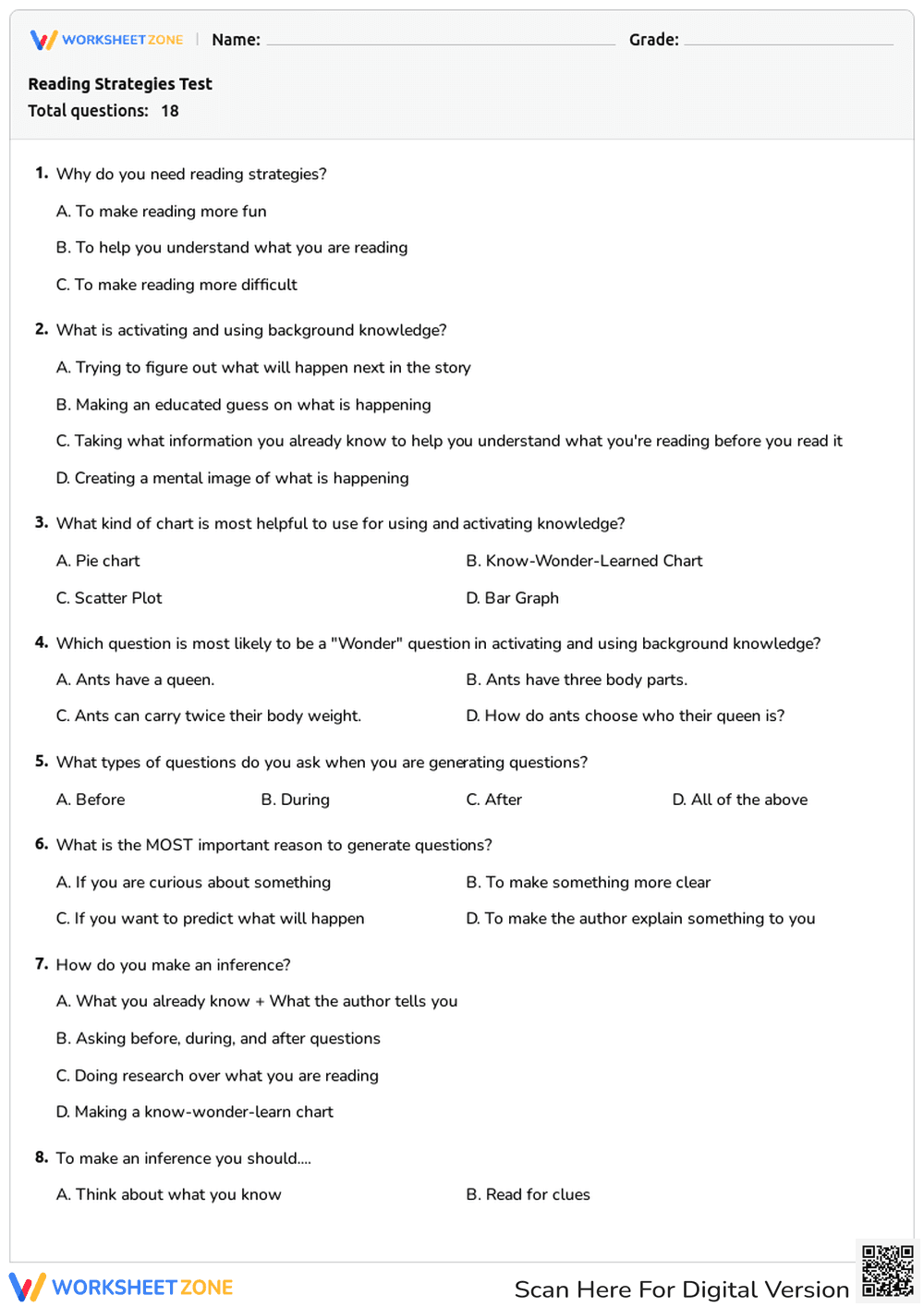
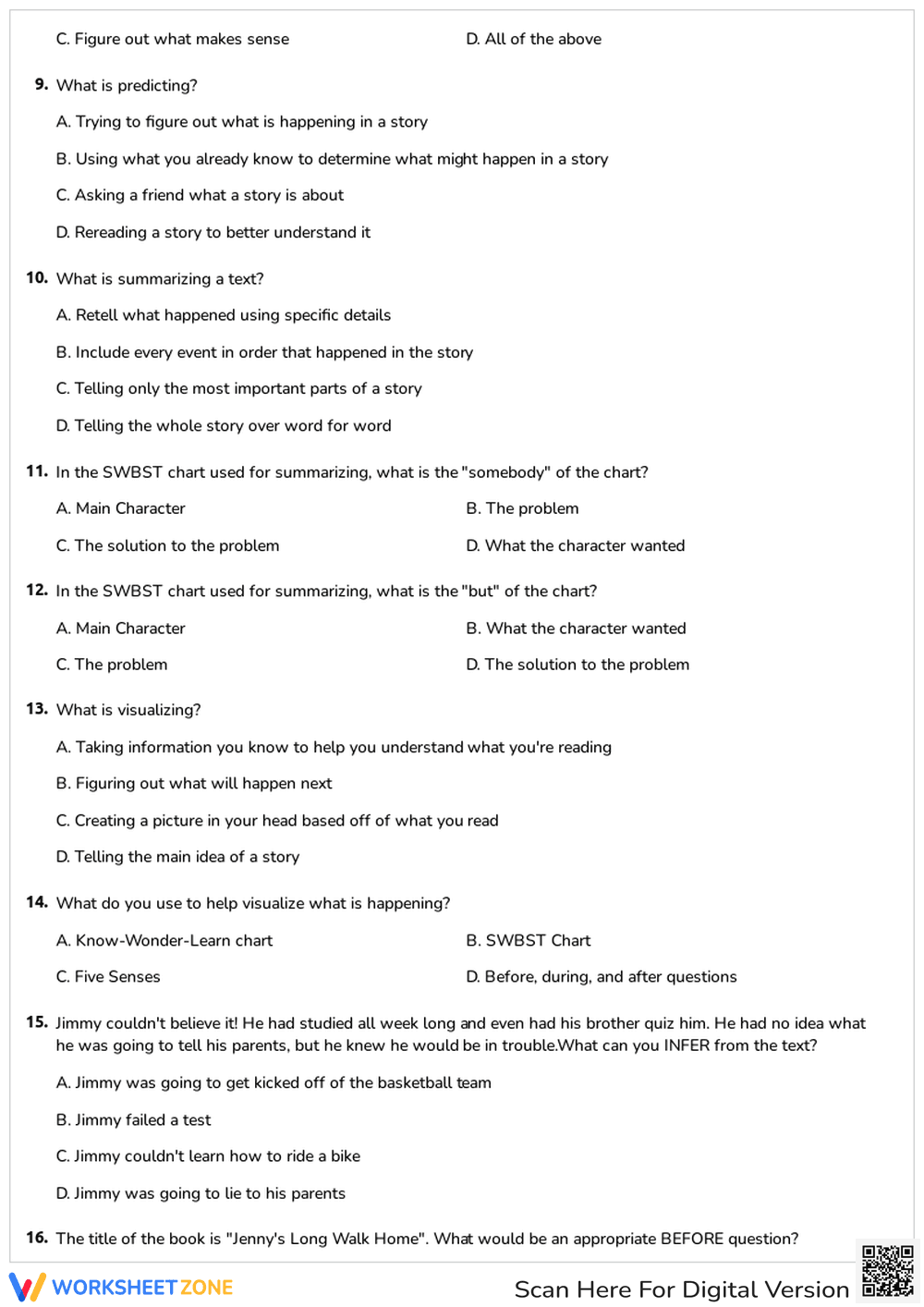
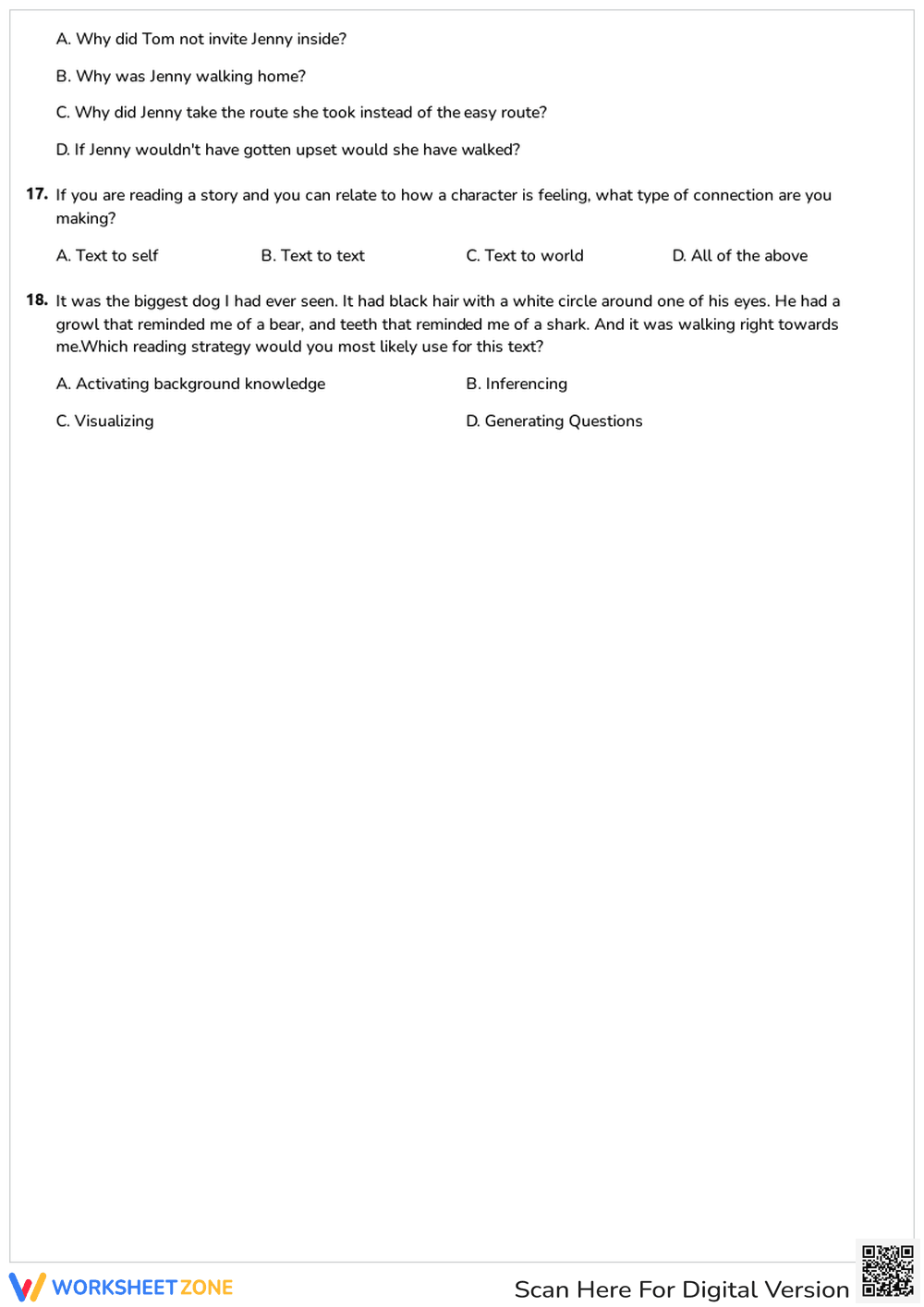
This Grade 3 reading strategies worksheet provides a comprehensive assessment of core comprehension skills. Students demonstrate mastery of background knowledge, inferencing, and the SWBST summarizing method through 18 targeted multiple-choice questions. It is designed to evaluate how effectively learners apply metacognitive tools to improve their understanding of various texts.
At a Glance
- Grade: 3 · Subject: ELA
- Standard:
CCSS.ELA-LITERACY.RI.3.1— Ask and answer questions to demonstrate understanding of a text- Skill Focus: Reading Comprehension Strategies
- Format: 3 pages · 18 problems · Answer key included · PDF
- Best For: Summative assessment or test prep
- Time: 25–35 minutes
The packet contains a three-page assessment featuring 18 multiple-choice questions. It covers a wide array of strategies including KWL charts, generating questions (before, during, and after reading), making inferences, predicting, and visualizing. A significant portion focuses on the "Somebody Wanted But So Then" (SWBST) framework for summarizing, ensuring students understand narrative structure and character motivation.
Zero-Prep Workflow
- Print: Generate the three-page PDF in seconds (1 minute).
- Distribute: Hand out to students for independent work or a quiet assessment period (30 seconds).
- Review: Use the included answer key for rapid grading or whole-class review (30 seconds).
This resource is ideal for emergency sub plans or end-of-unit evaluations where teacher prep time must be kept under 2 minutes.
Standards Alignment
The primary focus is `CCSS.ELA-LITERACY.RI.3.1`: "Ask and answer questions to demonstrate understanding of a text, referring explicitly to the text as the basis for the answers." It also supports RI.3.2 by requiring students to identify the most important parts of a story for summarizing. Both standard codes can be copied directly into lesson plans, IEP goals, or district curriculum mapping tools.
How to Use It
Use this worksheet as a summative assessment after a unit on reading strategies to gauge individual student mastery. Alternatively, assign it as a diagnostic tool at the beginning of the year to identify which comprehension skills require more intensive direct instruction. Expect students to complete the 18 questions within 30 minutes, allowing for a quick formative check of their ability to apply strategies to short text snippets.
Who It's For
This assessment is tailored for Grade 3 students but is highly effective for Grade 2 enrichment or Grade 4 intervention. It serves general education populations and English Language Learners who benefit from the structured multiple-choice format. Pair this test with a strategy anchor chart or a short mentor text for a complete instructional cycle that reinforces active reading habits.
This 18-question assessment aligns with CCSS.ELA-LITERACY.RI.3.1, focusing on the plain-English skill of using specific strategies like inferencing and summarizing to decode complex texts. According to Fisher & Frey (2014), the explicit teaching and testing of metacognitive strategies are essential for developing independent readers who can monitor their own comprehension. By evaluating student knowledge of the SWBST framework and KWL charts, educators can pinpoint specific gaps in the gradual release of responsibility model. Research from EdReports 2024 emphasizes that high-quality assessments must move beyond simple recall to test the application of strategies in context. This worksheet provides that bridge, offering measurable data on how students synthesize information. The inclusion of visualizing and predicting tasks ensures a holistic view of the reading process, making it a reliable tool for tracking progress toward state-level literacy benchmarks and individual learning goals.


