


























Views
Downloads

Reading Comprehension Worksheet | Grade 6 Printable
Paste this activity's link or code into your existing LMS (Google Classroom, Canvas, Teams, Schoology, Moodle, etc.).
Students can open and work on the activity right away, with no student login required.
You'll still be able to track student progress and results from your teacher account.
This Grade 6 reading comprehension worksheet strengthens literary analysis skills through close reading and evidence citation. Students read an original narrative titled 'The Sound Map' and answer 12 text-dependent questions that target paragraph citations, character inference, theme identification, and claim evaluation, helping learners justify thinking directly from print.
At a Glance
- Grade: 6 · Subject: ELA and Reading
- Standard:
CCSS.ELA-LITERACY.RL.6.1— Cite textual evidence to support explicit analysis and inferences drawn from literature- Skill Focus: Close reading, textual evidence citation, and narrative analysis
- Format: 4 pages · 12 problems · Answer key included · PDF
- Best For: Independent practice and reading comprehension assessment
- Time: 35–45 minutes
What's Inside
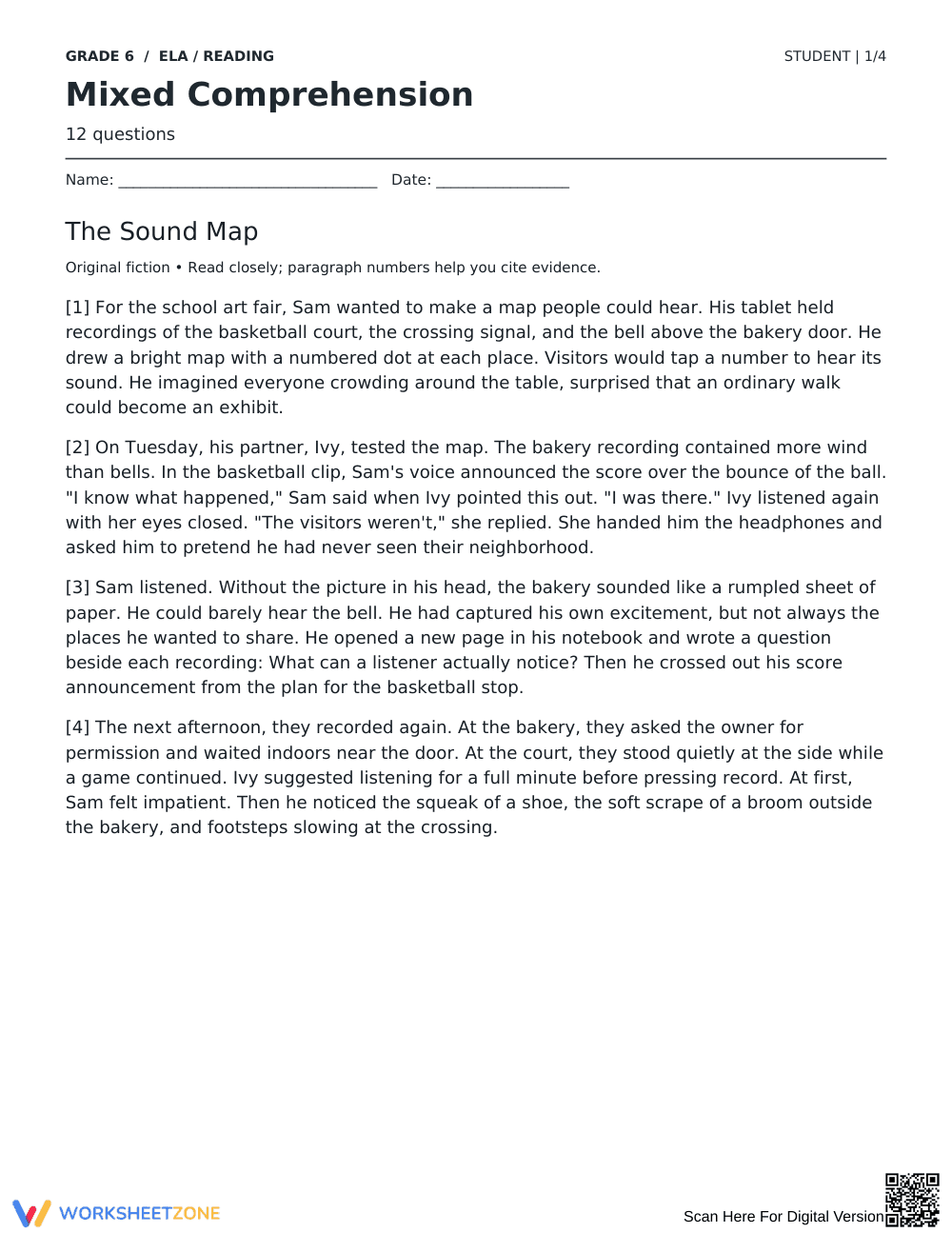
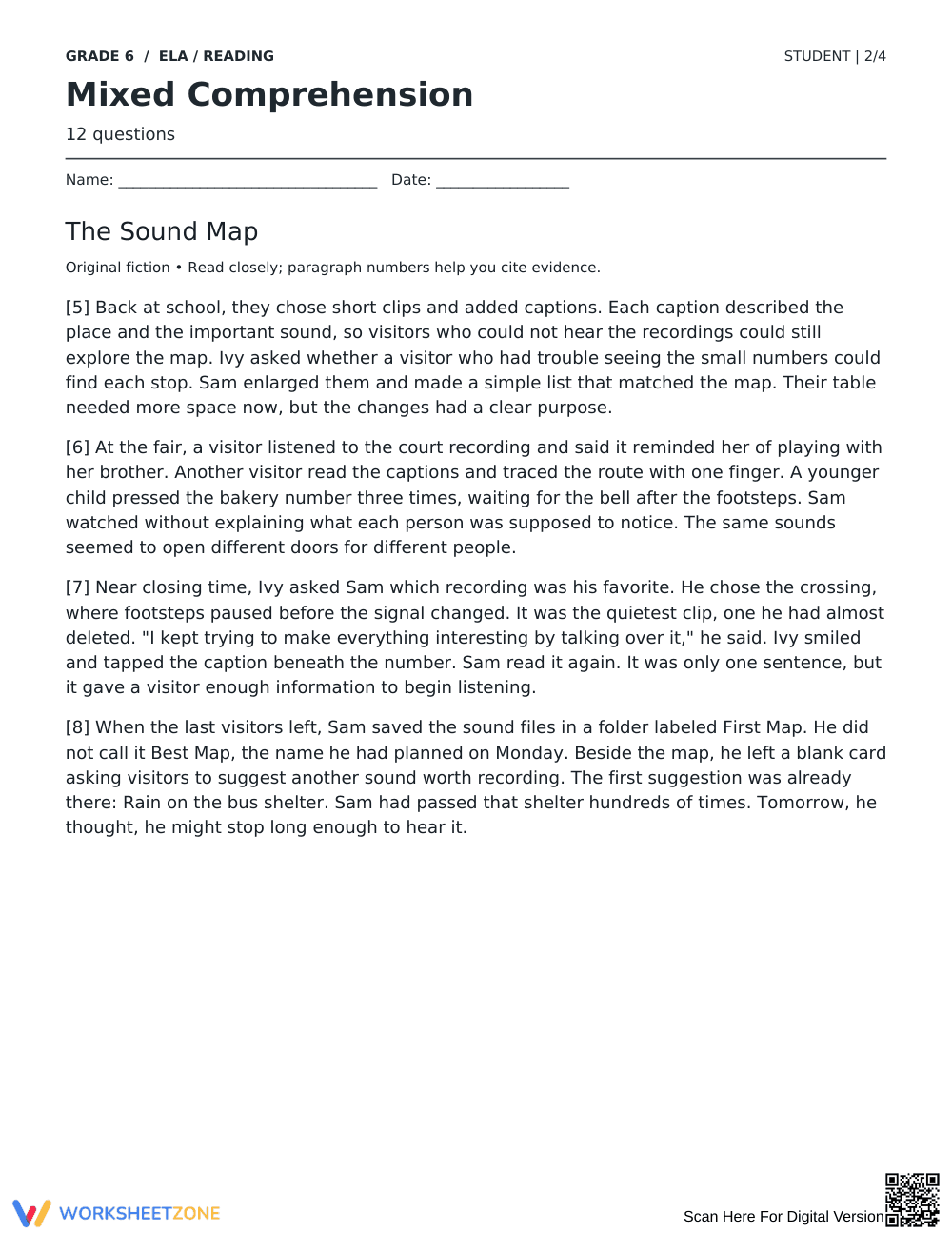
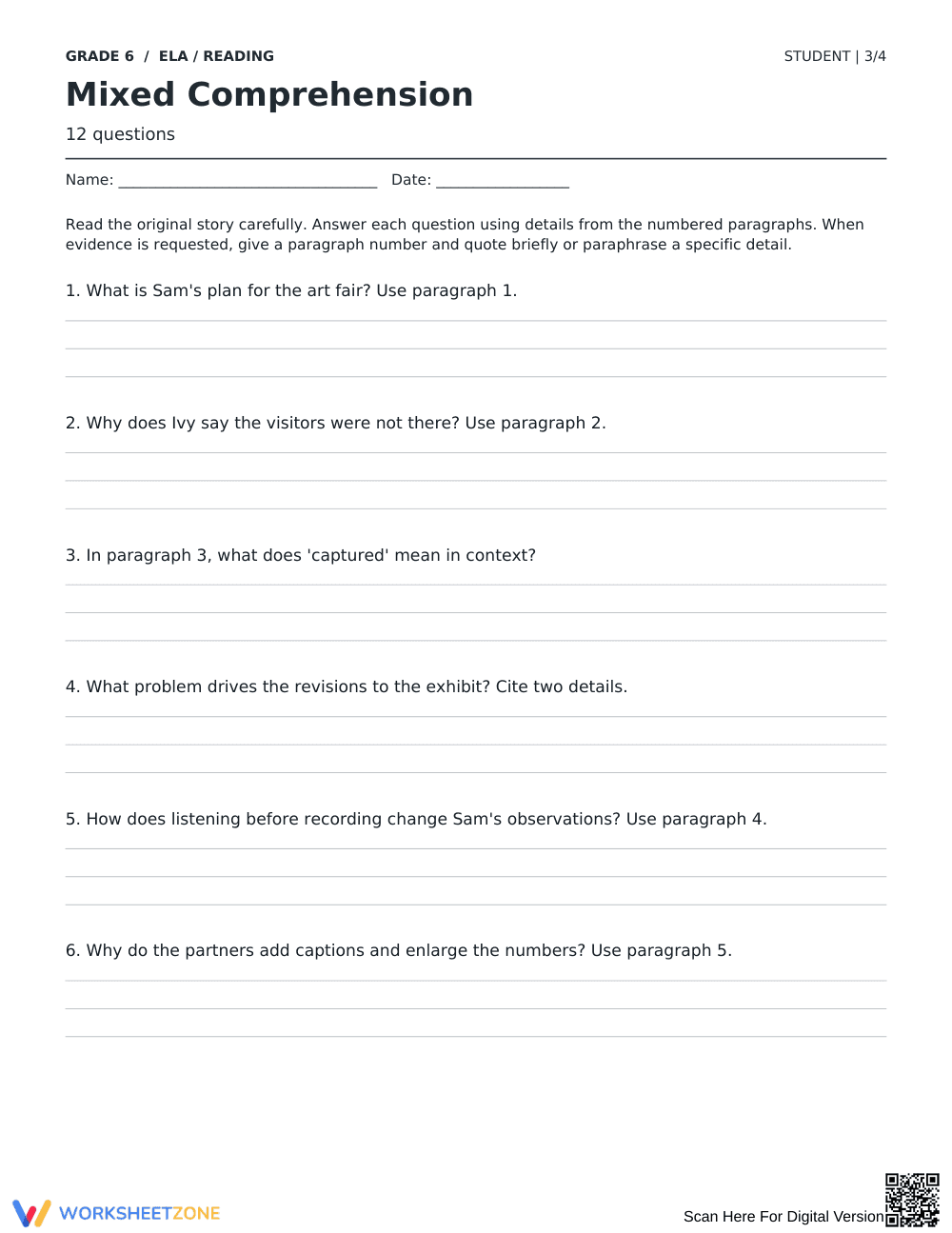
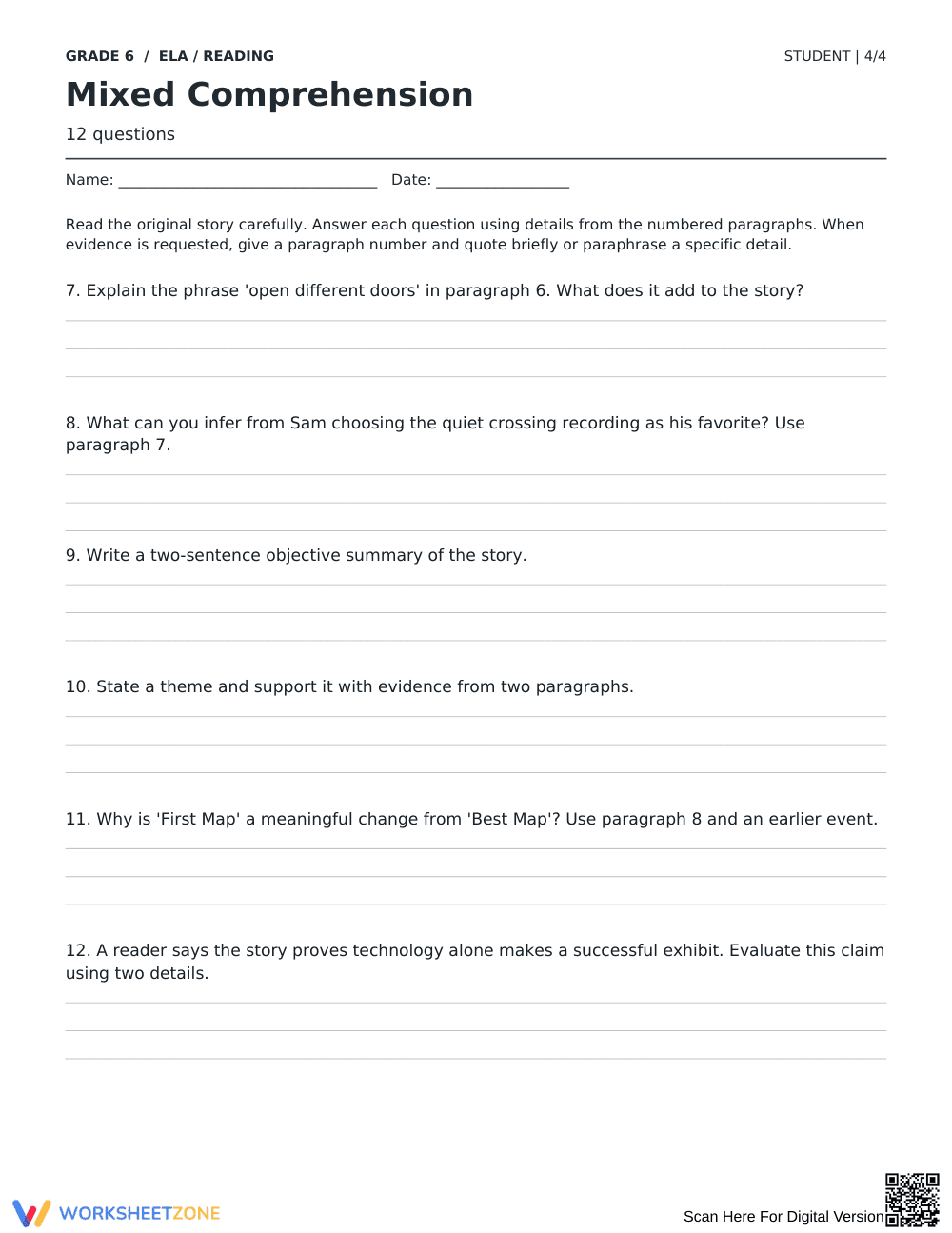
The worksheet includes a four-page student packet and a two-page answer key. Pages 1 and 2 feature the original fiction passage 'The Sound Map,' formatted with numbered paragraphs for evidence retrieval. Pages 3 and 4 provide 12 open-ended comprehension questions with lined answer spaces. The answer key supplies sample responses with a two-point scoring guide.
Skill Progression
- Guided practice (Questions 1–4): Direct retrieval items prompt learners with specific paragraph cues to establish evidence-gathering habits.
- Supported practice (Questions 5–8): Intermediate questions require character inferences and contextual vocabulary analysis with reduced paragraph prompts.
- Independent practice (Questions 9–12): Capstone prompts demand objective summarization, theme articulation, and claim evaluation without paragraph hints.
This structure follows the gradual release of responsibility model, moving students from guided retrieval to independent analysis.
Standards Alignment
This resource aligns to primary standard `CCSS.ELA-LITERACY.RL.6.1`, requiring students to cite textual evidence to support explicit analysis and inferences drawn from literary text. Supporting standard `CCSS.ELA-LITERACY.RL.6.2` is addressed as students state a theme and produce an objective summary. Both standard codes can be copied directly into lesson plans, IEP goals, or district curriculum mapping tools.
How to Use It
Use this worksheet after direct instruction on evidence citation to reinforce close-reading strategies. Assign it as independent seatwork completed within 35 to 45 minutes, or use it during small-group reading intervention to coach students through evidence retrieval. For formative assessment, observe whether students quote text accurately or write unsupported summaries before addressing the capstone items.
Who It's For
This activity suits Grade 6 ELA students, striving readers needing paragraph scaffolds, and English language learners practicing academic text citation. Differentiate by pairing struggling readers for text reading or providing sentence starters for constructed responses. Pair this resource with an anchor chart detailing evidence-based sentence stems.
Mastering standard CCSS.ELA-LITERACY.RL.6.1 requires middle school readers to cite textual evidence to support both explicit comprehension and subtle inferences drawn from literary texts. Grounded in foundational research by Fisher & Frey (2014), structured text-dependent questioning bridges literal reading with critical analysis by requiring students to return repeatedly to specific textual excerpts. When students interact with narrative passages through scaffolded, paragraph-referenced prompts, they construct durable habits of textual verification rather than relying on ungrounded assumptions or personal recollection. This Grade 6 reading resource operationalizes that research through 12 carefully sequenced questions that demand precise textual justification, character deduction, and theme synthesis across an engaging eight-paragraph story. Systematic practice with constructed response prompts strengthens reading accuracy, builds academic vocabulary, and prepares young adolescents for complex secondary text analysis and critical evaluation across all core content disciplines.


