


























Views
Downloads
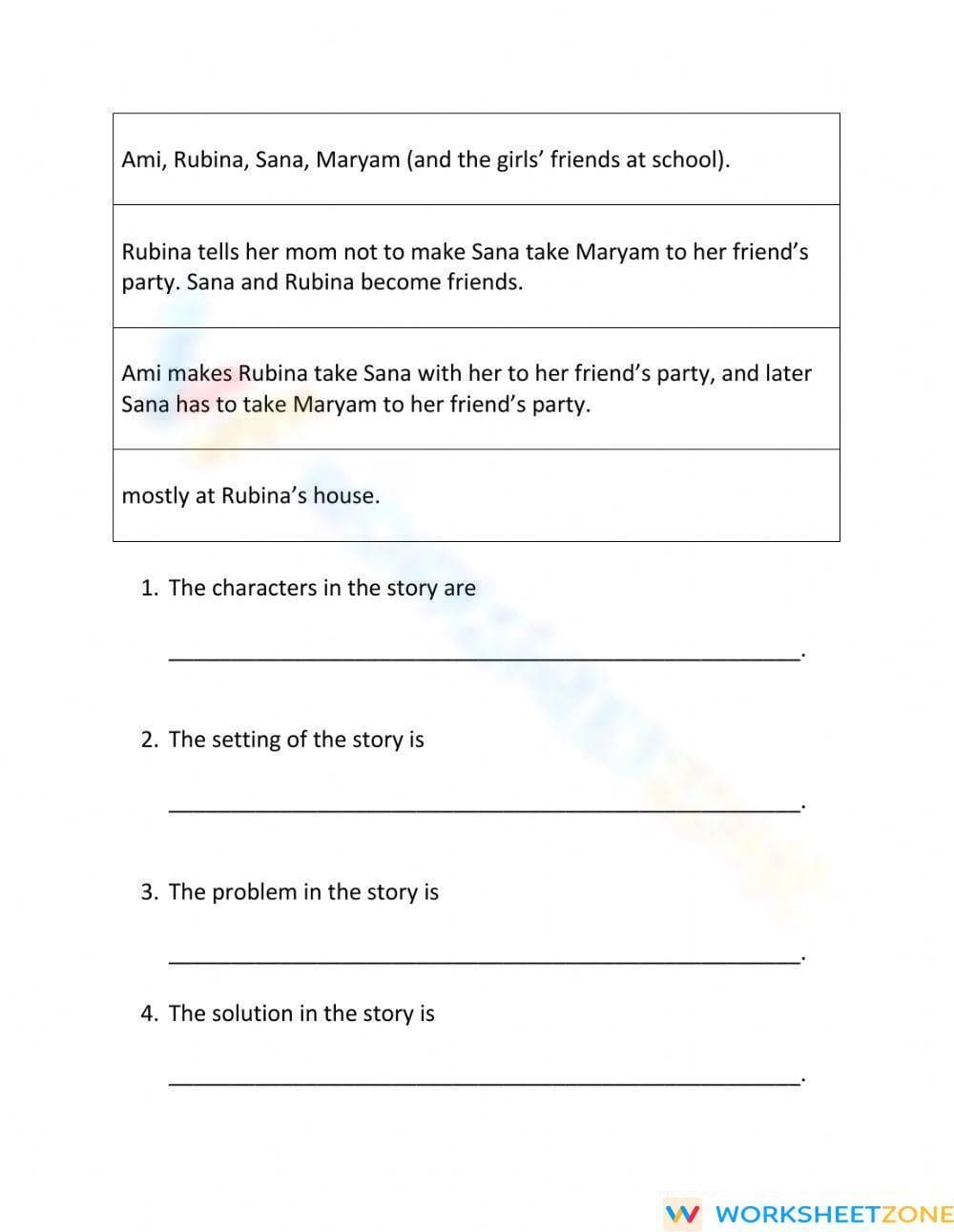

Grade 2 Big Red Lollipop Reading — Printable Worksheet
Paste this activity's link or code into your existing LMS (Google Classroom, Canvas, Teams, Schoology, Moodle, etc.).
Students can open and work on the activity right away, with no student login required.
You'll still be able to track student progress and results from your teacher account.
This Grade 2 Big Red Lollipop reading comprehension worksheet helps students identify key story elements including characters, setting, problem, and solution. By using a provided word bank, students demonstrate their understanding of Rukhsana Khan's classic story about siblings and sharing. This activity ensures learners can pinpoint essential narrative details to build strong foundational literacy skills.
At a Glance
- Grade: 2 · Subject: English Language Arts
- Standard:
CCSS.ELA-LITERACY.RL.2.1— Ask and answer who, what, where, when, why, and how for key details.- Skill Focus: Identifying story elements (Characters, Setting, Problem, Solution)
- Format: 1 page · 4 problems · Answer key included · PDF
- Best For: Literacy centers and independent reading response
- Time: 15–20 minutes
This resource includes a single-page PDF focused on the narrative structure of "Big Red Lollipop." The top of the worksheet features a clear word bank containing the answers to the comprehension questions, providing visual support for developing readers. Students complete four open-ended response items that require them to map the story's characters, the domestic setting, the central conflict, and the resolution.
Implementing this lesson is exceptionally efficient for busy educators. First, print the single-page document in seconds. Second, distribute the worksheet to students immediately following a reading of the text. Third, review the responses as a whole class or individually to check for comprehension. The total teacher preparation time is under 2 minutes, making it an ideal choice for substitute plans or morning work.
The primary alignment for this activity is CCSS.ELA-LITERACY.RL.2.1, which requires students to "Ask and answer such questions as who, what, where, when, why, and how to demonstrate understanding of key details in a text." It also supports story structure goals. Both standard codes can be copied directly into lesson plans, IEP goals, or district curriculum mapping tools.
Use this worksheet as a post-reading check during a small-group literacy rotation. Teachers can observe how students utilize the word bank to scaffold their writing, noting which students can independently connect the specific phrases to the story's plot points. It also serves as a quick formative assessment after a whole-class read-aloud for the main conflict. Expect completion in 15 minutes.
This resource is designed for second-grade students, but it is also suitable for first-grade enrichment or third-grade review. It provides excellent support for English Language Learners (ELLs) through the inclusion of the word bank and clear, predictable question formats. Pair this worksheet with an anchor chart detailing "Story Elements" or a character map comparing Rubina and Sana's perspectives.
According to Fisher & Frey (2014), the use of guided practice tools like word banks and narrative mapping is essential for developing "close reading" habits in primary learners. This Big Red Lollipop worksheet aligns with this research by providing structured scaffolds that allow Grade 2 students to interact deeply with text details without becoming overwhelmed by open-ended writing. By focusing on the CCSS.ELA-LITERACY.RL.2.1 standard, the activity ensures that students are not just recalling facts but are identifying the specific narrative mechanics—characters, setting, and plot—that form the basis of literary analysis. This method has been proven to improve retention of story sequences and character motivations in early elementary classrooms. This tool offers an evidence-based approach to meeting literacy benchmarks while minimizing administrative burden.


