


























Views
Downloads
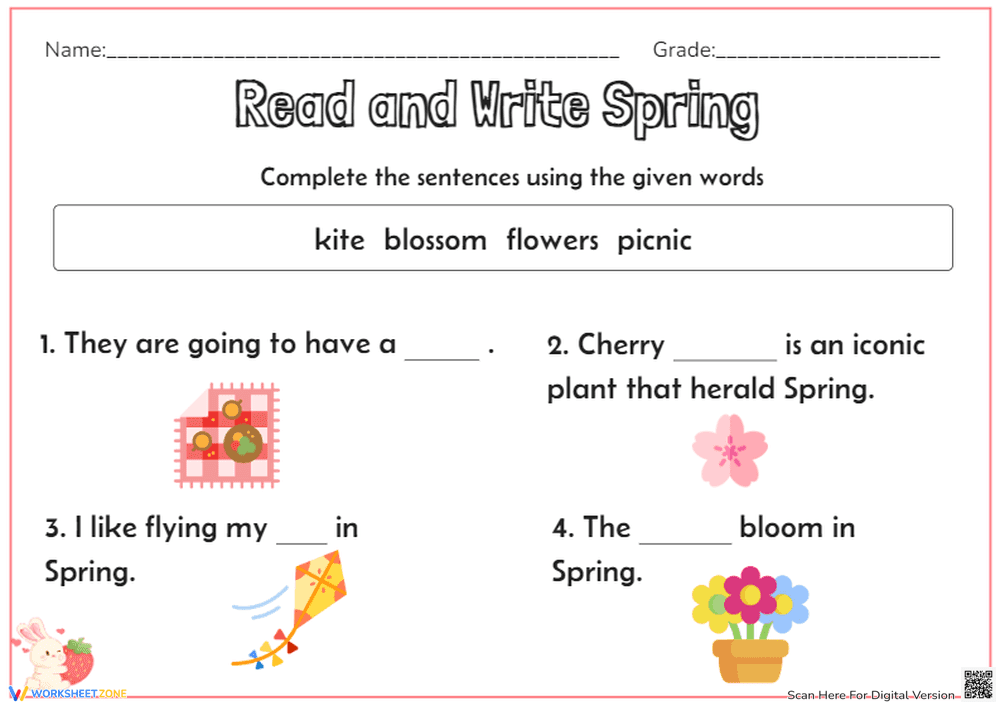

Spring Vocabulary Worksheet | Grade 2 Essential
Paste this activity's link or code into your existing LMS (Google Classroom, Canvas, Teams, Schoology, Moodle, etc.).
Students can open and work on the activity right away, with no student login required.
You'll still be able to track student progress and results from your teacher account.
This Spring-themed literacy resource helps early elementary students strengthen their vocabulary and sentence construction skills through targeted context clue practice. By matching seasonal terms to descriptive sentences, learners develop a deeper understanding of word relationships and seasonal concepts. This worksheet ensures students can accurately identify and write key vocabulary in a structured format.
At a Glance
- Grade: 2 · Subject: ELA
- Standard:
CCSS.ELA-LITERACY.L.2.6— Use words and phrases acquired through reading and responding to texts- Skill Focus: Context Clues & Vocabulary
- Format: 1 page · 4 problems · Answer key included · PDF
- Best For: Independent morning work or literacy centers
- Time: 10–15 minutes
The worksheet features a clear word bank containing four essential Spring terms: kite, blossom, flowers, and picnic. Below the bank, four numbered sentences provide specific context clues paired with colorful visual icons to support decoding and comprehension. The layout is spacious, providing ample room for young writers to practice their penmanship while completing the fill-in-the-blank tasks. A full answer key is provided for quick grading.
Zero-Prep Workflow
- Print: Download and print the single-page PDF for your class or small group in under 1 minute.
- Distribute: Hand out the sheets during your literacy block; the self-explanatory word bank allows students to begin immediately.
- Review: Spend 5 minutes reviewing the answers as a whole group to reinforce pronunciation and usage of the seasonal vocabulary.
This activity aligns with CCSS.ELA-LITERACY.L.2.6, which requires students to use words and phrases acquired through reading, including using adjectives and adverbs to describe. By identifying the correct noun to complete each sentence, students demonstrate mastery of context-dependent vocabulary. This standard code can be copied directly into lesson plans, IEP goals, or district curriculum mapping tools.
Use this worksheet as a formative assessment during the first week of Spring to gauge students' prior knowledge of seasonal vocabulary. It works exceptionally well as a "bell-ringer" activity to settle the class after recess. Teachers should observe whether students rely on the visual icons or the text clues to select their answers, providing a quick check on reading fluency versus visual processing.
This resource is ideal for Grade 1 through Grade 3 students, particularly those requiring visual supports or English Language Learners (ELLs) building basic Tier 1 vocabulary. It pairs naturally with a seasonal read-aloud or an anchor chart detailing the signs of Spring.
Research by Fisher & Frey (2014) emphasizes the importance of the gradual release of responsibility and the use of scaffolds like word banks to support vocabulary acquisition in early childhood. This worksheet applies these principles by providing a constrained choice set and visual supports, which reduces cognitive load for emerging readers. According to the NAEP, students who engage in frequent, contextualized vocabulary practice show higher reading comprehension scores in later grades. By focusing on CCSS.ELA-LITERACY.L.2.6, this resource targets the foundational ability to integrate new words into a student's active lexicon. The inclusion of 4 specific tasks allows for a high-success environment that builds student confidence. This structured approach ensures that vocabulary instruction is not isolated but integrated into meaningful sentence-level practice, a key factor in long-term retention and linguistic development for primary learners.


