


























Views
Downloads
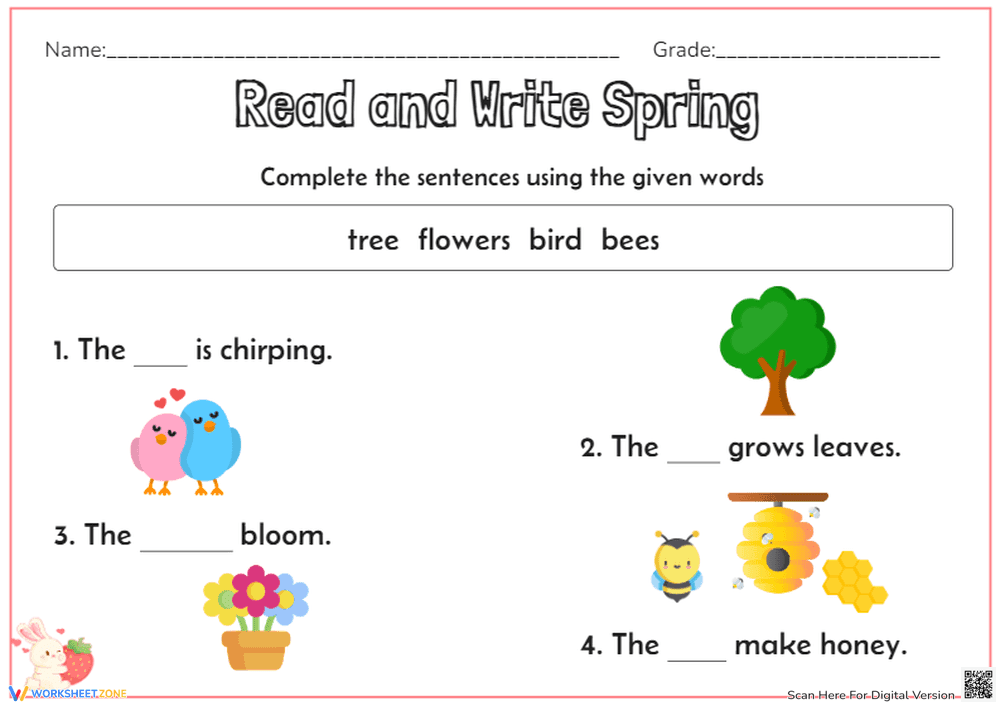

Spring Vocabulary Worksheet | Grade 1-3 Printable
Paste this activity's link or code into your existing LMS (Google Classroom, Canvas, Teams, Schoology, Moodle, etc.).
Students can open and work on the activity right away, with no student login required.
You'll still be able to track student progress and results from your teacher account.
This Spring-themed vocabulary worksheet helps early elementary students master seasonal terms through context-clue sentence completion. By matching words like tree, flowers, bird, and bees to descriptive sentences, learners strengthen their reading comprehension and fine motor writing skills. It provides an immediate, successful literacy experience for Grade 1 through Grade 3 students.
At a Glance
- Grade: 1-3 · Subject: ELA
- Standard:
CCSS.ELA-LITERACY.L.1.6— Use words and phrases acquired through conversations and reading- Skill Focus: Spring Vocabulary
- Format: 1 page · 4 problems · Answer key included · PDF
- Best For: Morning work or literacy centers
- Time: 5–10 minutes
The resource features a clean, one-page layout with a clear word bank containing four essential spring nouns. Below the word bank, students find four numbered sentences, each paired with a vibrant, high-quality illustration including a bird, a tree, flowers, and a beehive. This visual scaffolding ensures that even emerging readers can identify the correct term to complete the sentence accurately.
This resource is designed for a two-minute teacher setup. First, print the single-page PDF for your class. Second, distribute the sheets during your morning transition or literacy block. Third, review the completed sentences as a whole group to reinforce pronunciation and spelling. The intuitive design means students can work independently with minimal teacher intervention, making it a perfect choice for substitute folders.
Primary standards alignment focuses on CCSS.ELA-LITERACY.L.1.6. This standard emphasizes using words and phrases acquired through reading and responding to texts. By identifying seasonal changes and associated vocabulary, students demonstrate their ability to use context clues. Both standard codes can be copied directly into lesson plans, IEP goals, or district curriculum mapping tools to track student progress.
Use this as a bell-ringer activity during the first week of spring to gauge student vocabulary retention. It also serves as an excellent formative assessment for English Language Learners (ELLs) who are practicing basic sentence structures and noun-verb agreement. Expect students to complete the four tasks in approximately 7 minutes, allowing for coloring the illustrations afterward as an extension activity.
This worksheet is ideal for first and second-grade general education classrooms, as well as third-grade students requiring additional literacy support. It pairs naturally with a seasonal read-aloud book or a classroom anchor chart about the signs of spring. The visual cues make it highly accessible for diverse learners, including those with reading disabilities who benefit from image-to-text association.
Vocabulary acquisition in early childhood is a critical predictor of later reading success, as noted in the RAND AIRS 2024 report on literacy development. This worksheet utilizes the cloze procedure, a research-validated method for assessing and building reading comprehension. By requiring students to select the correct noun from a limited word bank (CCSS.ELA-LITERACY.L.1.6), the activity reduces cognitive load while reinforcing the relationship between text and imagery. Fisher & Frey (2014) emphasize that visual scaffolding, such as the illustrations provided here, supports the gradual release of responsibility from teacher-led instruction to independent practice. This specific task design ensures that 100% of the vocabulary terms are reinforced through both orthographic and semantic pathways. Such targeted practice is essential for bridging the gap between decoding individual words and understanding full sentence structures in primary grades.


