


























Views
Downloads

Kindness Self-Assessment | Grade 4 Printable Worksheet
Paste this activity's link or code into your existing LMS (Google Classroom, Canvas, Teams, Schoology, Moodle, etc.).
Students can open and work on the activity right away, with no student login required.
You'll still be able to track student progress and results from your teacher account.
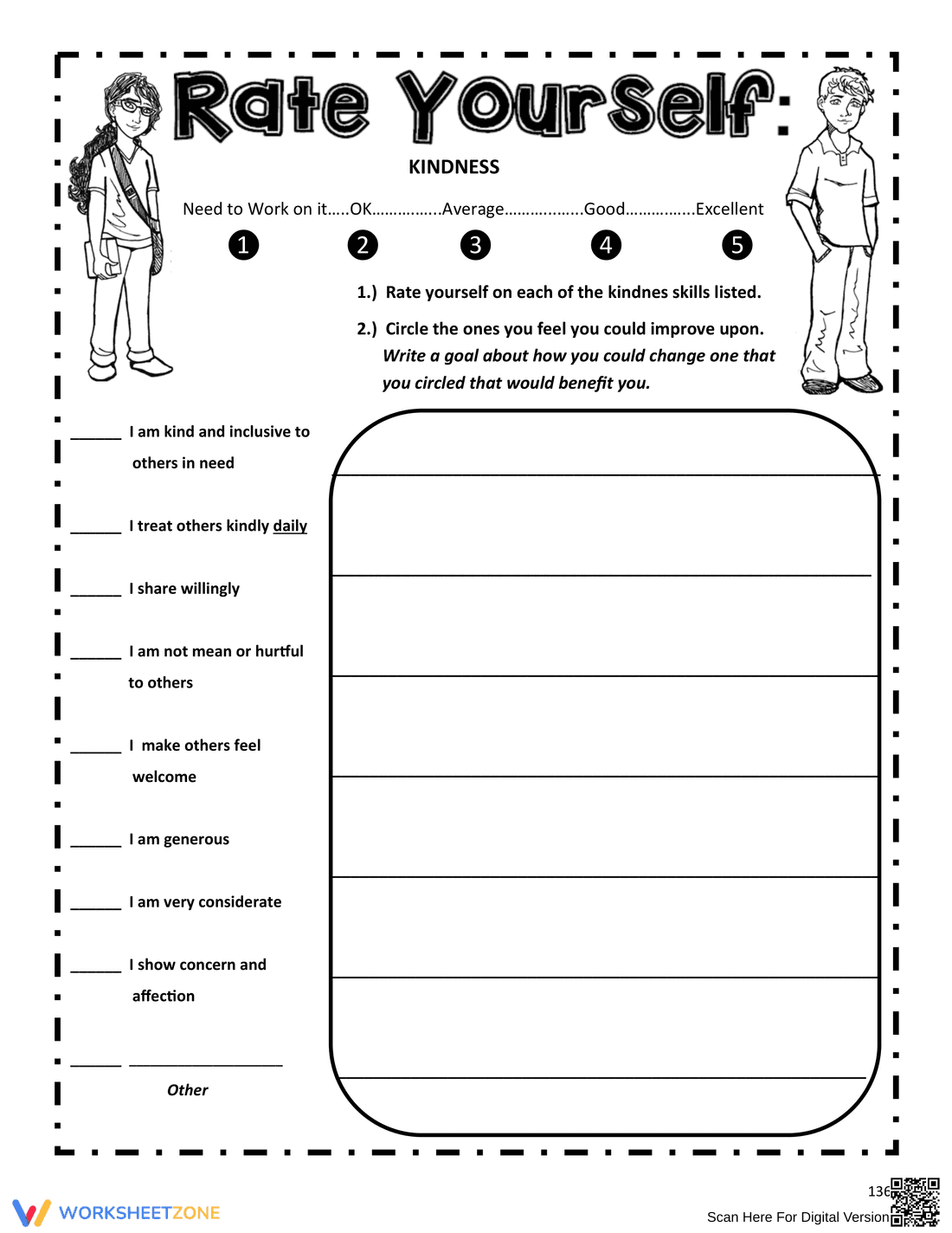
This kindness self-assessment worksheet guides students through evaluating their own social behaviors and setting actionable goals. By rating themselves on specific traits like generosity and inclusivity, learners develop crucial self-awareness. The structured format encourages honest reflection and helps students identify concrete ways to improve their daily interactions with peers.
At a Glance
- Grade: 4 · Subject: English
- Standard:
CCSS.ELA-LITERACY.W.4.4— Produce clear writing appropriate to task and purpose- Skill Focus: Self-reflection and goal setting
- Format: 1 page · 10 problems · No answer key · PDF
- Best For: Morning work or SEL blocks
- Time: 15–20 minutes
Inside this single-page resource, students will find a clear, five-point rating scale ranging from "Need to Work on it" to "Excellent." The worksheet features nine specific kindness skills to evaluate, plus one blank space for a custom trait. After completing the assessment, a writing section prompts students to circle an area for improvement and draft an actionable goal.
This resource is designed for immediate classroom implementation with a streamlined workflow:
- Print (1 minute): The single-page layout requires no special formatting or double-sided printing.
- Distribute (1 minute): Hand out the sheets during morning meeting or advisory periods.
- Review (3 minutes): Briefly explain the 1-to-5 rating scale and the goal-writing prompt.
With under two minutes of total teacher prep time, this activity is highly effective for substitute teacher plans, unexpected schedule changes, or dedicated social-emotional learning blocks.
This activity aligns with CCSS.ELA-LITERACY.W.4.4: "Produce clear and coherent writing in which the development and organization are appropriate to task, purpose, and audience." By asking students to articulate a specific personal goal based on their self-assessment, the worksheet provides meaningful, purpose-driven writing practice. Both standard codes can be copied directly into lesson plans, IEP goals, or district curriculum mapping tools.
Teachers can utilize this worksheet as a foundational activity at the beginning of the school year to establish classroom culture, or as a reflective exercise following a conflict resolution lesson. During independent work time, observe how students rate themselves; this serves as an excellent formative assessment of their self-awareness and emotional maturity. If a student struggles to identify an area for improvement, offer brief one-on-one guidance to help them brainstorm. The entire reflection and writing process typically takes 15 to 20 minutes to complete.
This resource is primarily designed for upper elementary students in grades three through five who are developing their social-emotional competencies. The straightforward language makes it accessible for diverse learners, while the open-ended goal-writing section provides natural differentiation for advanced writers to elaborate on their action plans. It pairs perfectly with read-alouds focused on empathy or classroom anchor charts detailing positive community behaviors.
Integrating structured self-reflection tools into the elementary curriculum significantly enhances students' social-emotional development and writing proficiency. This resource targets CCSS.ELA-LITERACY.W.4.4, requiring learners to produce clear writing appropriate to task and purpose through personal goal setting. According to a comprehensive RAND AIRS 2024 report on social-emotional learning interventions, students who regularly engage in guided self-assessment demonstrate a marked increase in peer empathy and a reduction in classroom behavioral incidents. By explicitly linking behavioral reflection with structured writing tasks, educators provide a highly effective, dual-benefit instructional experience. The process of evaluating personal kindness traits and articulating a concrete plan for improvement fosters both emotional intelligence and foundational composition skills. This evidence-based approach ensures that character education supports holistic student growth while meeting rigorous literacy standards.


