
































Proven Thematic Defense Worksheet | Grade 11 English III

Paste this activity's link or code into your existing LMS (Google Classroom, Canvas, Teams, Schoology, Moodle, etc.).
Students can open and work on the activity right away, with no student login required.
You'll still be able to track student progress and results from your teacher account.
This Grade 11 literary analysis worksheet guides high school students to analyze motifs, allegories, and thematic development in complex prose. Students examine symbolic infrastructure and sensory imagery across eight structured analytical tasks to defend claims about institutional control, language, and personal autonomy.
At a Glance
- Grade: 11 · Subject: English III
- Standard:
RL.11-12.2— Analyze how two or more themes interact and develop over a text- Skill Focus: Defend a Pattern’s Thematic Significance
- Format: 6 pages · 8 problems · Answer key included · PDF
- Best For: Advanced literary analysis and thematic defense
- Time: 45–60 minutes
What’s Inside
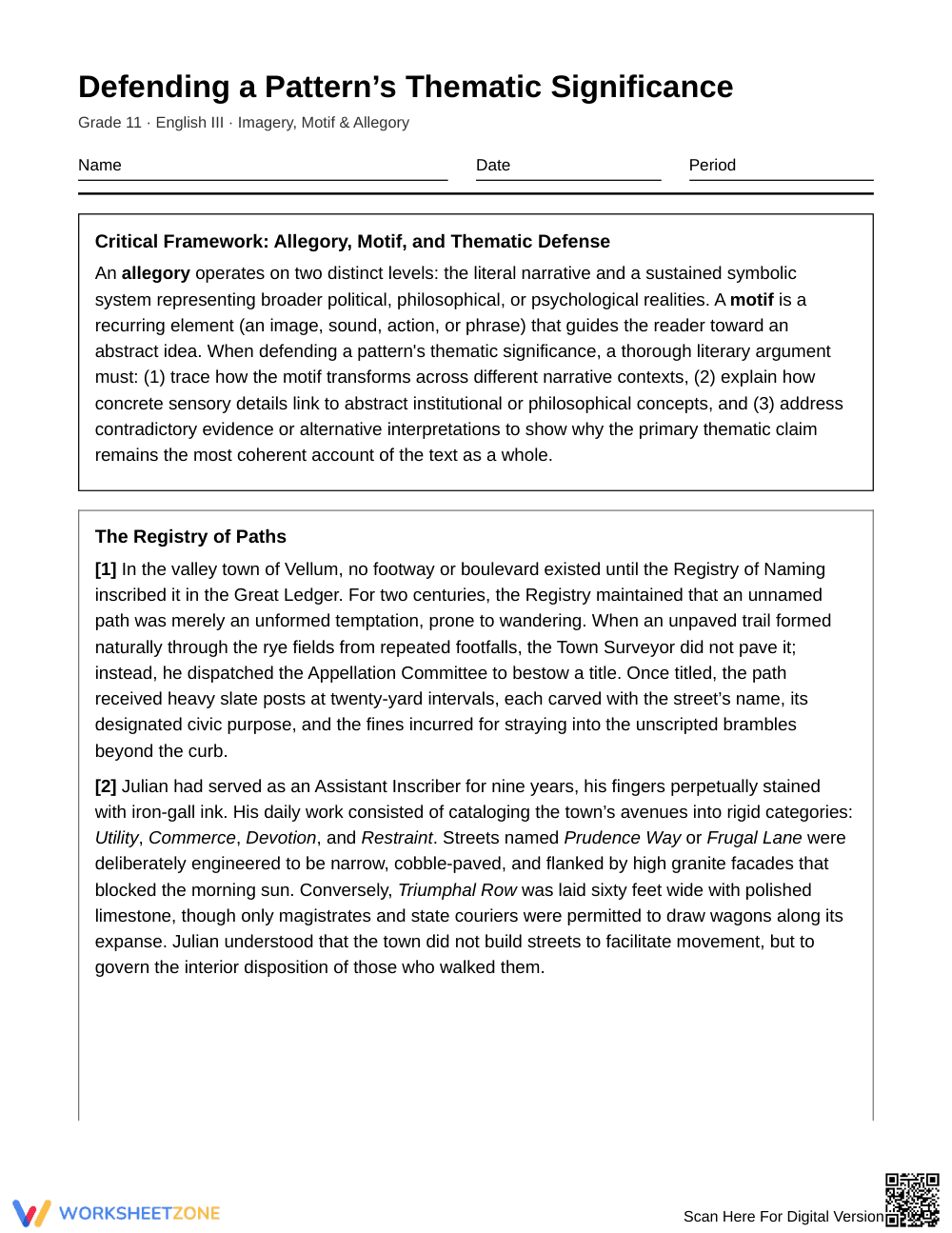
The 6-page printable resource includes the complete allegorical short story “The Registry of Paths,” an opening critical framework on motifs and thematic arguments, eight rigorous written-response prompts, and a comprehensive 4-page answer key featuring complete sample arguments, textual citations, and evaluative rationales.
Skill Progression
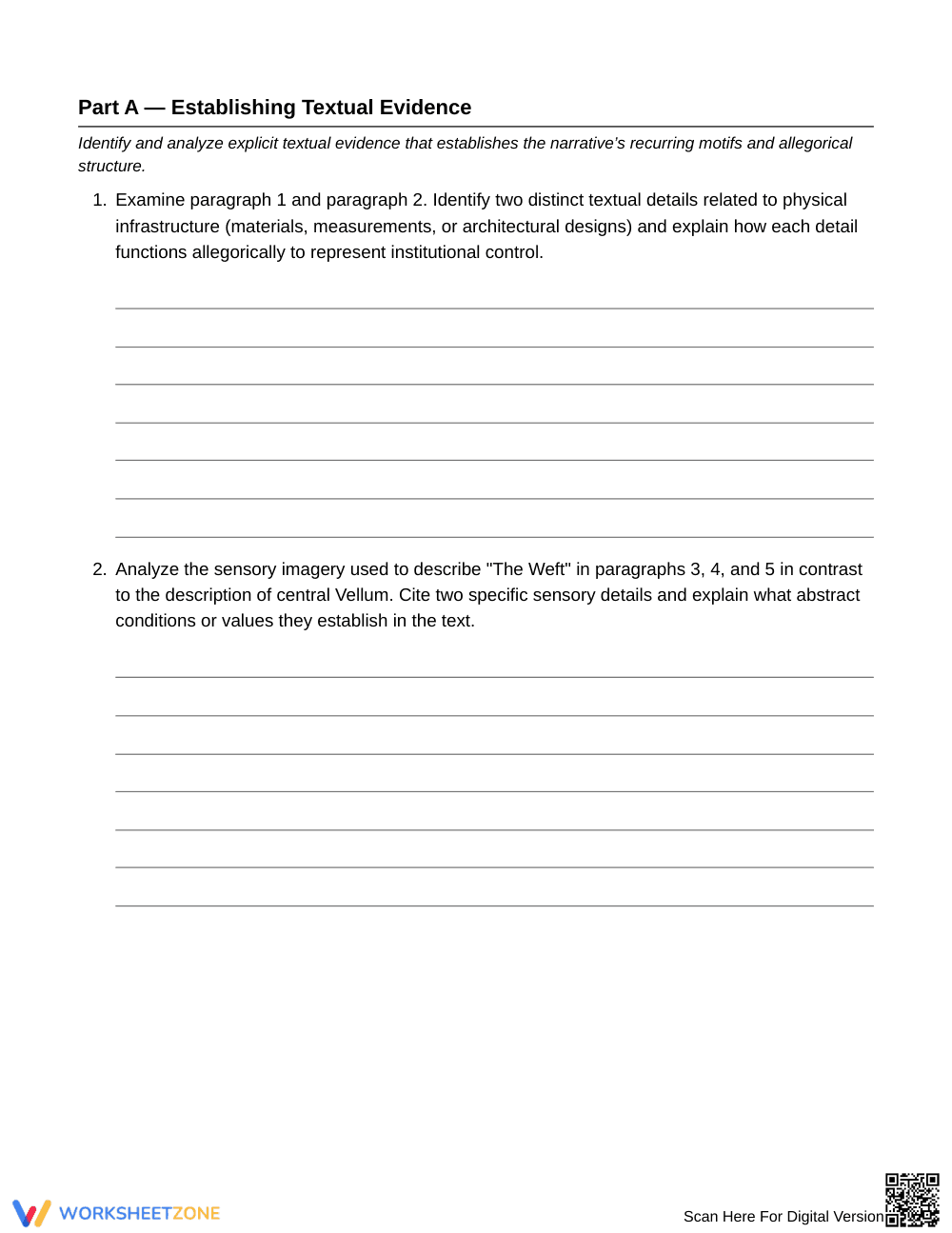
- Guided Practice (Part A, 2 tasks): Students isolate sensory details and architectural motifs with structured prompts that target explicit allegorical markers.
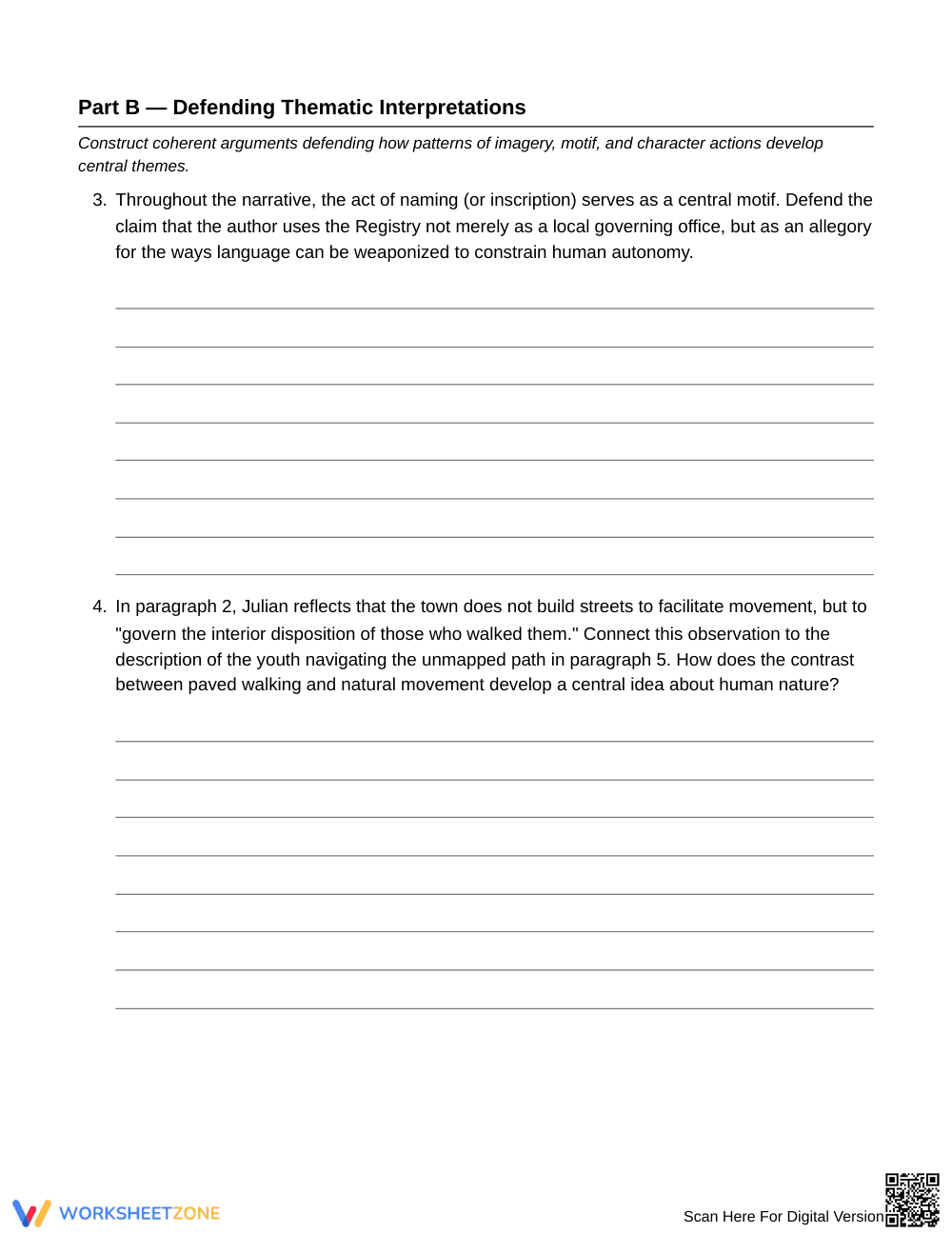
- Supported Practice (Part B, 4 tasks): Learners construct thesis-driven arguments and trace motif evolutions from systemic oppression to individual resistance.
- Independent Practice (Part C, 2 tasks): Students evaluate counterevidence and defend why ambiguous textual resolutions demonstrate thematic sophistication over overt rebellion.
This architecture follows the gradual release of responsibility model, shifting students from guided evidence location to independent thematic synthesis.
Standards Alignment
This resource directly aligns with `RL.11-12.2`: Determine two or more themes or central ideas of a text and analyze their development over the course of the text, including how they interact and build on one another to produce a complex account. It also supports `RL.11-12.1` through rigorous textual citations. Both standard codes can be copied directly into lesson plans, IEP goals, or district curriculum mapping tools.
How to Use It
Deploy this worksheet after direct instruction on allegory and motif. Use Part A for partner close-reading check-ins, then assign Parts B and C for individual analysis. During work time, observe whether students connect physical sensory details to abstract conceptual systems rather than merely summarizing plot events. Expect 45 to 60 minutes for thorough student completion.
Who It’s For
Designed for Grade 11 English III and honors or AP Literature students mastering complex textual defense. Differentiate by providing the critical framework box as an ongoing anchor tool. Pair this assignment with a mini-lesson on dystopian world-building or bureaucratic satire.
According to Fisher & Frey (2014), purposeful close reading instruction requires students to move beyond surface-level comprehension toward analyzing how structural patterns and recurring motifs generate multifaceted literary arguments. This Grade 11 English III resource directly addresses standard RL.11-12.2 by requiring learners to defend a pattern’s thematic significance within an original allegorical narrative. Rather than merely identifying recurring symbols, students evaluate how contrasting motifs—such as rigid slate markers versus fluid, unmapped footpaths—interact to communicate complex commentaries on institutional power and human autonomy. Through eight structured analytical prompts spanning textual identification, thesis formulation, and counterargument rebuttal, learners demonstrate mastery by explaining how minute sensory shifts signal ideological transformations. By grounding thematic interpretation in sustained textual defense, the worksheet equips eleventh-grade students with the analytical rigor demanded in collegiate literary studies and advanced secondary English language arts coursework.


