

































Proven Repairing Warrants Worksheet | Grade 10 English II

Paste this activity's link or code into your existing LMS (Google Classroom, Canvas, Teams, Schoology, Moodle, etc.).
Students can open and work on the activity right away, with no student login required.
You'll still be able to track student progress and results from your teacher account.
Students master argument evaluation by diagnosing logical leaps and rewriting flawed reasoning in student-facing debates. This rigorous resource equips tenth graders to dissect paired texts, isolate unwarranted assumptions, and craft evidence-backed warrants that connect claims to data with academic precision.
At a Glance
- Grade: 10 · Subject: English II
- Standard:
RI.9-10.8— Evaluate argument validity by identifying logical gaps and repairing flawed reasoning- Skill Focus: Repair an Unsupported Warrant
- Format: 6 pages · 10 problems · Answer key included · PDF
- Best For: Argumentative text analysis and revision practice
- Time: 45–60 minutes
What's Inside
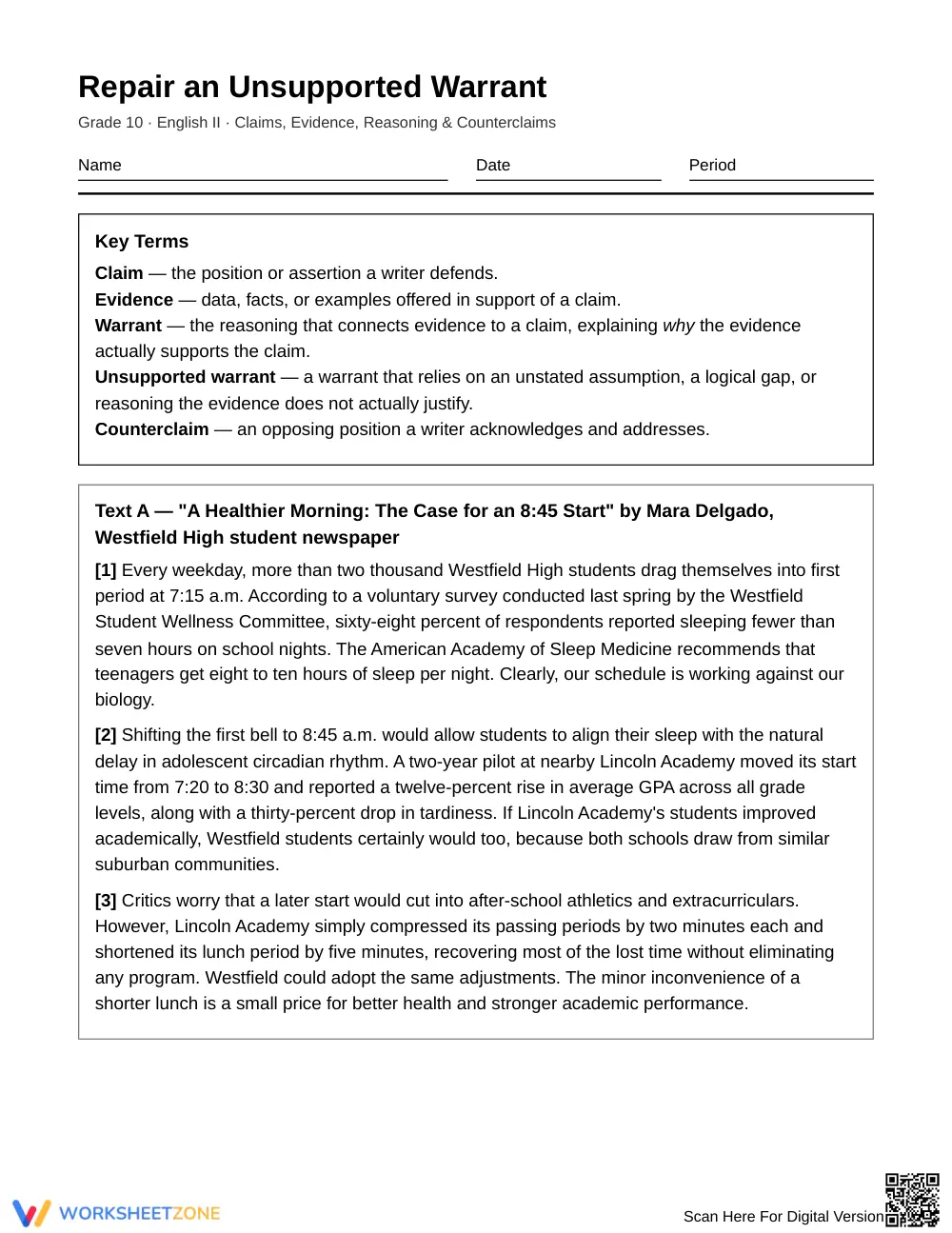
This 6-page printable packet features two competing op-eds on school start times, key term definitions, and an annotated worked model. Students complete 10 tasks across two parts: five diagnostic identification prompts and five warrant revision prompts. A comprehensive 4-page answer key provides complete model rewrites.
Skill Progression
- Guided practice: Students review an annotated model diagnosing a flawed warrant and demonstrating an evidence-based correction.
- Supported practice: In Part A (5 problems), students inspect flawed peer responses to isolate unstated assumptions, confounding variables, and logical gaps across both texts.
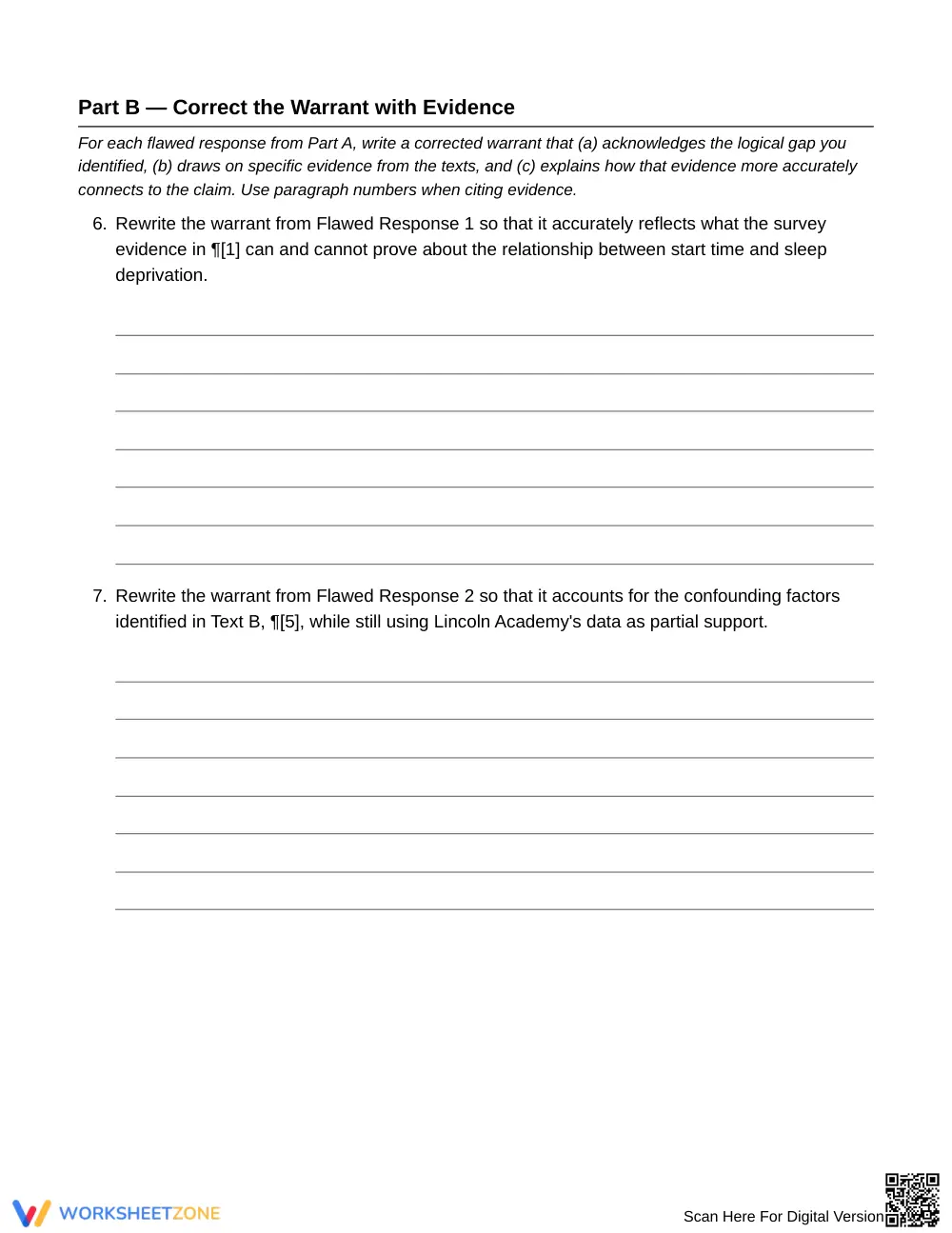
- Independent practice: In Part B (5 problems), students rewrite flawed warrants independently using textual evidence and qualified reasoning.
This sequence implements the gradual-release model, transitioning students from scaffolded analysis to independent argument revision.
Standards Alignment
This worksheet aligns directly to `RI.9-10.8`: evaluate the argument and specific claims in a text, assessing whether reasoning is valid and evidence is relevant and sufficient. It also reinforces `W.9-10.1` through written warrant revisions. Both standard codes can be copied directly into lesson plans, IEP goals, or district curriculum mapping tools.
How to Use It
Use this resource during the mid-point of an argumentative unit following direct instruction on Toulmin argumentation. Have students complete Part A in pairs before tackling Part B individually. During independent practice, check whether students explain the reasoning link rather than simply quoting additional data. Anticipate 45 to 60 minutes for full completion.
Who It's For
This worksheet serves Grade 10 English II students mastering rhetorical analysis and evidence-based writing. Built-in definitions support developing readers, while rigorous critique challenges advanced learners. Pair this activity with a mini-lesson on logical fallacies.
Under the instructional framework described by Fisher & Frey (2014), purposeful gradual-release instruction requires students to move from structured modeling to targeted evaluative discourse before attempting unassisted synthesis. This Grade 10 worksheet operationalizes standard RI.9-10.8 by prompting learners to evaluate argument validity and repair unsupported warrants within high-interest informational texts. Rather than treating claims and evidence as isolated components, the diagnostic and revision tasks require high school readers to interrogate the reasoning mechanism itself. By identifying false equivalencies, confounding variables, and unsupported causal assumptions across 10 targeted tasks, students develop the metacognitive discipline necessary to dismantle fallacious arguments in complex academic writing and standardized assessments. The included four-page annotated answer key offers explicit benchmark responses that support targeted teacher feedback and self-regulated peer revision. Consequently, learners acquire transferable critical-thinking routines that reinforce both reading comprehension and persuasive drafting across disciplines.


