




























Views
Downloads


Proven Reflection & Refraction Worksheet | Grade 6 Science

Paste this activity's link or code into your existing LMS (Google Classroom, Canvas, Teams, Schoology, Moodle, etc.).
Students can open and work on the activity right away, with no student login required.
You'll still be able to track student progress and results from your teacher account.
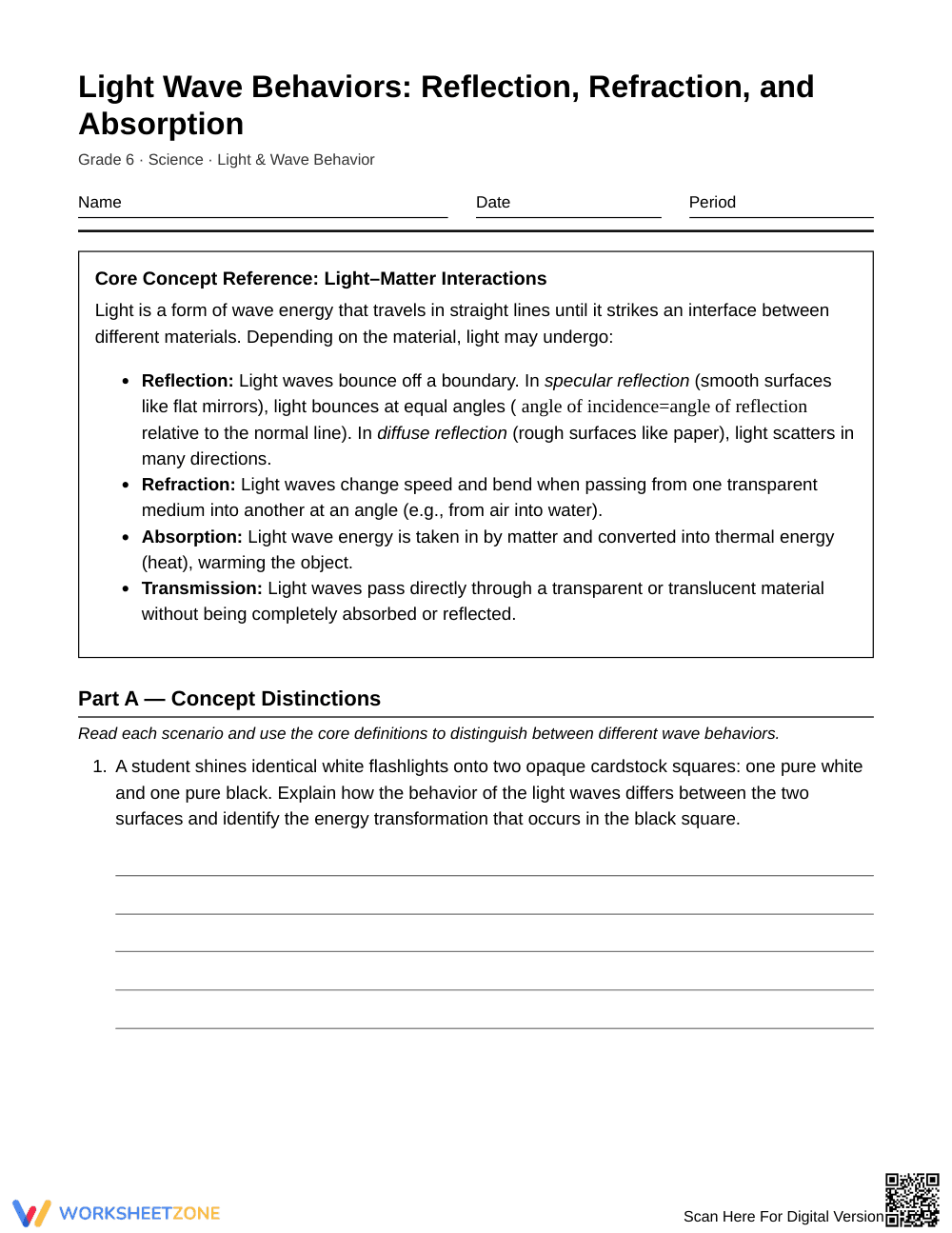
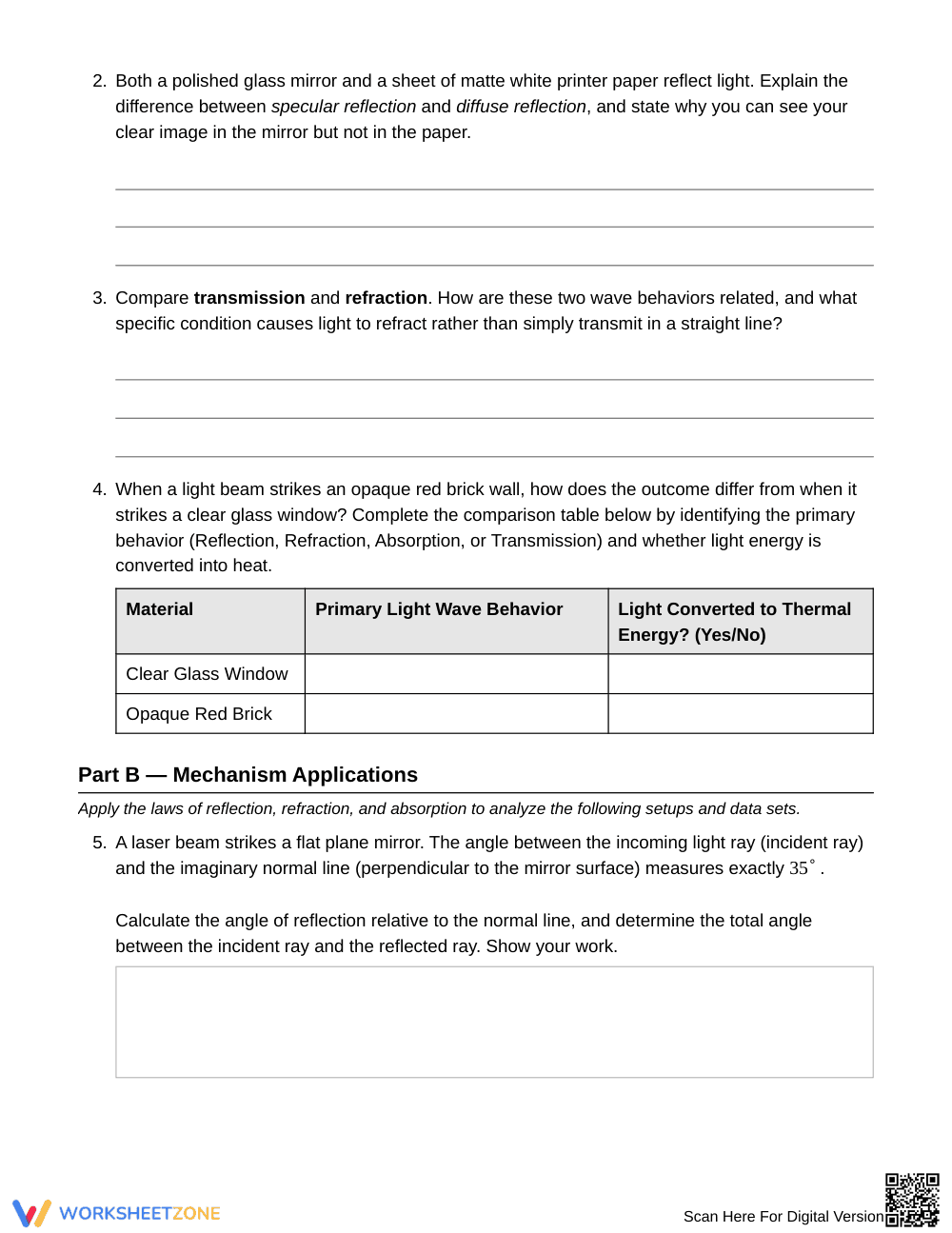
This Grade 6 science worksheet develops student mastery of light-matter interactions, emphasizing reflection, refraction, and absorption. Through 12 scaffolded tasks, students analyze ray behaviors across materials, calculate reflection angles, explain optical illusions, and evaluate thermal absorption data to connect wave principles to real-world phenomena.
At a Glance
- Grade: 6 · Subject: Middle School Science
- Standard: Investigate and describe how light waves reflect, refract, transmit, and absorb through materials
- Skill Focus: Reflection, Refraction, and Absorption
- Format: 5 pages · 12 problems · Comprehensive answer key included · Printable PDF
- Best For: Guided physical science practice and assessment
- Time: 40–50 minutes of instructional time
This 5-page worksheet includes 12 multi-step problems supported by an introductory Core Concept Reference guide on wave interactions. Students complete comparison tables, calculate specular reflection angles, analyze laboratory temperature data across four irradiated test plates, and evaluate periscope and urban roofing scenarios. A 4-page answer key provides complete explanations for every task.
Skill Progression
- Guided practice (Problems 1–4): Students distinguish core behaviors and complete a comparison table contrasting transparent glass and opaque brick surfaces.
- Supported practice (Problems 5–10): Learners apply ray mechanics to calculate angles, explain pencil refraction illusions, analyze thermal data plates, and identify color absorption filters.
- Independent practice (Problems 11–12): Students design solutions for periscope optics and urban heat island mitigation using wave reflection and thermal absorption principles.
This structure follows a gradual-release model, transitioning students from guided classification to independent engineering analysis.
Standards Alignment
This resource supports middle school physical science curricula on wave properties. Students investigate how light waves reflect, absorb, transmit, and refract across different media, modeling energy transfer and directional shifts. This standard alignment can be copied directly into lesson plans, IEP goals, or district curriculum mapping tools.
How to Use It
Use this worksheet after direct instruction on wave behavior or as a post-lab conceptual review. During class, monitor student responses on Problem 5 and Problem 7 to verify proper differentiation between diffuse reflection and thermal absorption. The full 12-problem assignment requires approximately 40 to 50 minutes of instructional time.
Who It's For
This printable is designed for Grade 6 science classrooms, introductory physical science units, and targeted review sessions. Teachers can support struggling learners with the included Core Concept Reference guide or assign Part C as an advanced extension challenge. Pair this resource with a hands-on laser refraction prism demonstration.
According to Fisher & Frey (2014), structured instructional progressions that guide students from conceptual definitions to authentic engineering applications substantially enhance content retention and scientific reasoning in middle school classrooms. This Grade 6 physical science worksheet operationalizes that pedagogical architecture across 12 targeted problems focusing on reflection, refraction, and wave absorption. Learners systematically examine light behaviors by contrasting specular and diffuse surfaces, calculating geometric reflection angles, analyzing quantitative temperature shifts across irradiated test materials, and resolving complex optical refraction scenarios. By coupling scaffolded reference definitions with unprompted synthesis prompts in the final section, the resource ensures students master how electromagnetic waves transfer energy and alter pathways across material boundaries. The included 4-page answer key provides clear diagnostic rationales, equipping educators to identify and remediate persistent student misconceptions regarding wave transmission versus absorption efficiently during regular classroom practice or summative review sessions.


