

































Proven Non-Mendelian Crosses Worksheet | Grade 10 Biology

Paste this activity's link or code into your existing LMS (Google Classroom, Canvas, Teams, Schoology, Moodle, etc.).
Students can open and work on the activity right away, with no student login required.
You'll still be able to track student progress and results from your teacher account.
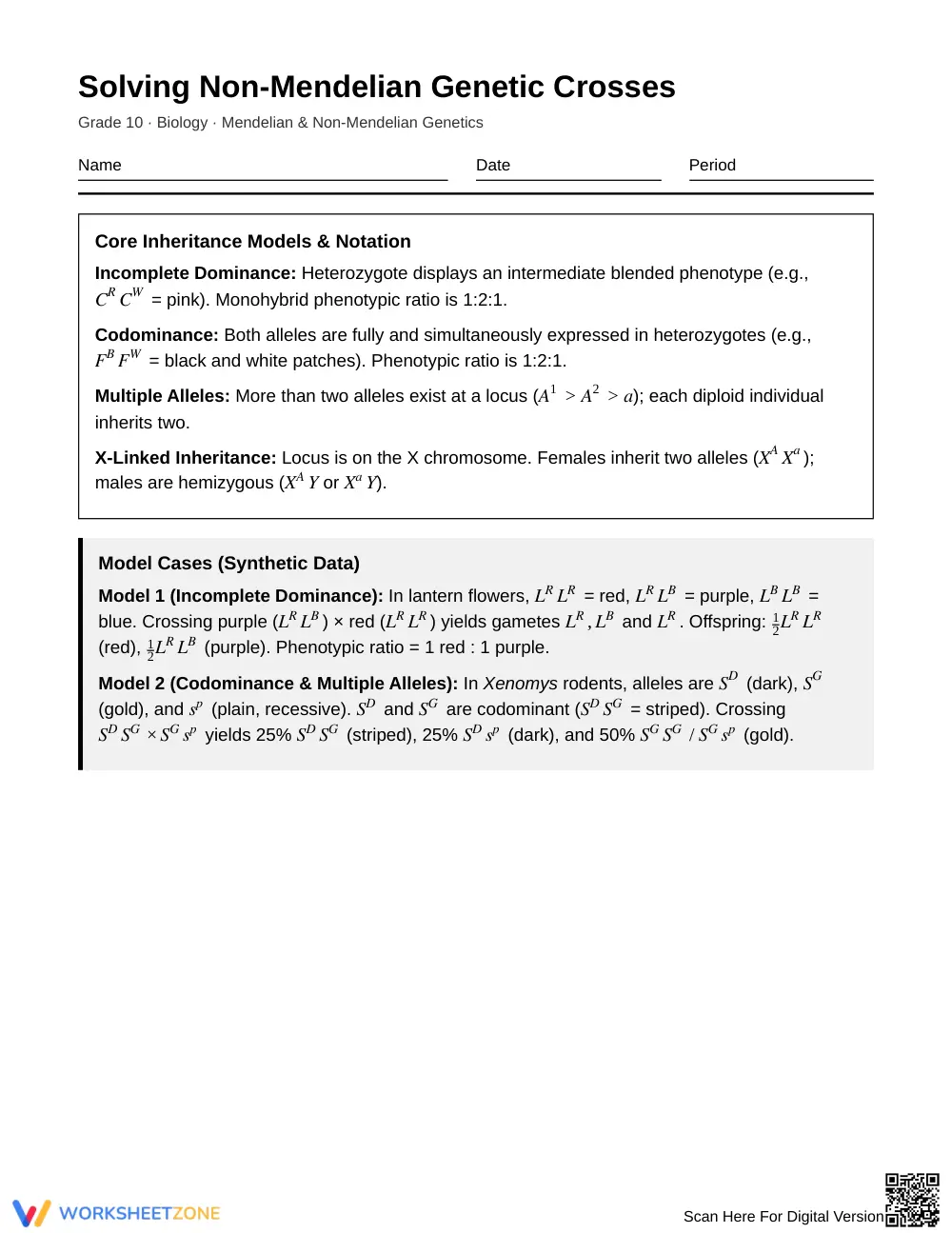
Mastering complex genetic inheritance requires precise calculation and conceptual clarity. This Grade 10 Biology worksheet guides high school students through predicting genotypic and phenotypic ratios in non-Mendelian crosses. Learners analyze incomplete dominance, codominance, multiple alleles, sex-linked traits, and dihybrid interactions, moving from structured models to evidence-based molecular explanations.
At a Glance
- Grade: 10 · Subject: Biology
- Standard: Predict phenotypic and genotypic outcomes for non-Mendelian inheritance patterns
- Skill Focus: Solving non-Mendelian genetic crosses
- Format: 5 pages · 10 problems · Answer key included · PDF
- Best For: High school biology genetics unit practice
- Time: 45–60 minutes
What's Inside
This 5-page printable resource includes reference boxes detailing core inheritance models, two worked model cases with synthetic data, and 10 multi-part student tasks. The exercises span guided 3-step Punnett square calculations, five diverse independent inheritance scenarios, and advanced mechanism-check questions. A comprehensive 2-page answer key provides step-by-step ratio derivations and complete biochemical explanations.
Skill Progression
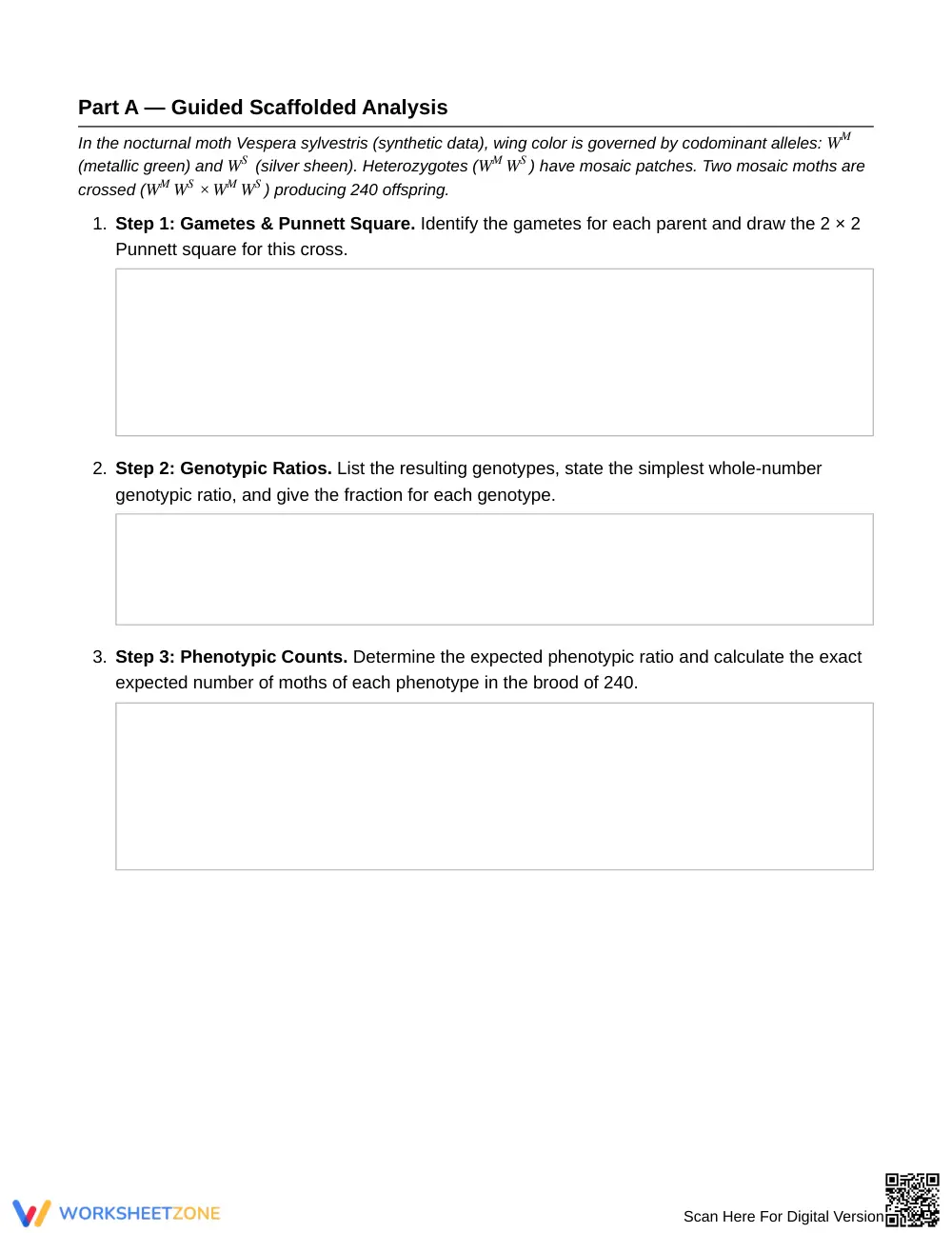
- Guided practice: Students work through a 3-step scaffold analyzing a codominant moth cross, identifying gametes, setting up a 2 × 2 Punnett square, and calculating brood counts across 240 offspring.
- Supported practice: Five application tasks require setting up independent Punnett squares across incomplete dominance, codominance, multiple-allele hierarchies, X-linked recessive traits, and dihybrid test-crosses.
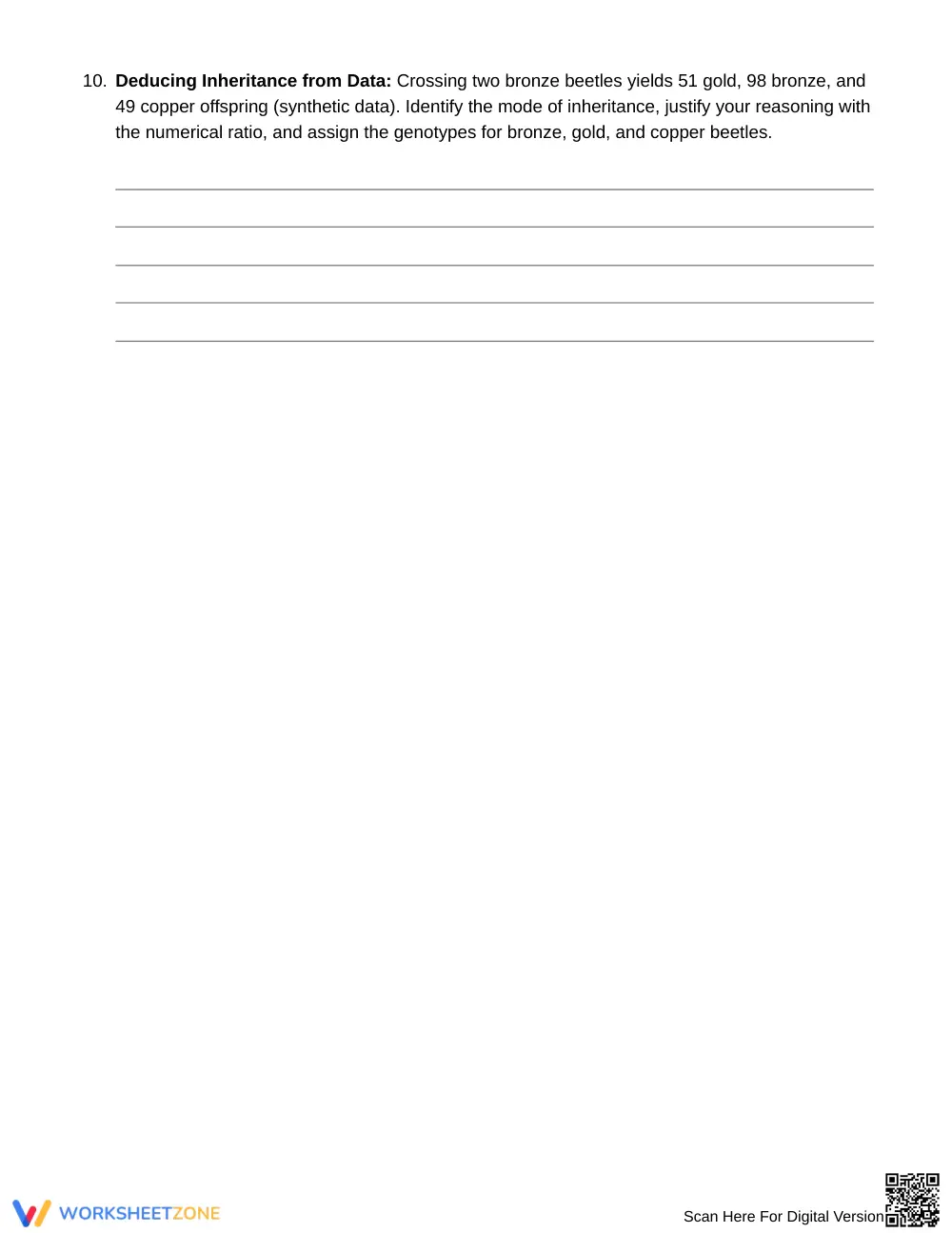
- Independent practice: Two analytical tasks prompt students to contrast dominance mechanisms at the molecular level and deduce unknown inheritance modes from empirical ratio data.
This gradual-release structure moves students purposefully from explicit modeling to flexible, independent problem-solving.
Standards Alignment
This resource aligns with high school life science standards governing inheritance and variation of traits. Students apply mathematical and computational thinking to determine the probability of expressed phenotypes resulting from complex allelic interactions. Both standard concepts and learning targets can be copied directly into lesson plans, IEP goals, or district curriculum mapping tools.
How to Use It
Use this worksheet after direct instruction on non-Mendelian inheritance patterns. As a mid-unit practice packet, have students complete Part A in collaborative pairs before transitioning to individual work on Parts B and C. Formative assessment tip: observe whether students correctly represent superscripts and sex chromosomes (X/Y) in Part B to catch notation errors early. Expected completion time is 45 to 60 minutes.
Who It's For
This activity is designed for Grade 10 general biology and honors biology students studying Mendelian and non-Mendelian genetics. Visual model summaries support developing learners, while multi-step dihybrid and biochemical mechanism questions challenge advanced students. It pairs naturally with an introductory genetics slide deck or a pedigree chart analysis lab.
High school biology instruction in non-Mendelian genetics requires students to synthesize algebraic probability with biochemical concepts of gene expression. According to research on structured STEM learning frameworks by Fisher & Frey (2014), purposeful gradual-release instructional sequences significantly enhance high school students' ability to transfer foundational problem-solving routines to novel multi-allele, sex-linked, and dihybrid inheritance scenarios. By structuring 10 rigorous tasks across guided modeling, independent application, and molecular justification, this 5-page curriculum resource systematically builds deep conceptual understanding alongside procedural Punnett square fluency. Students not only calculate standard phenotypic ratios accurately across diverse model organisms but also explain the underlying protein-level differences between incomplete dominance and codominance mechanisms. The accompanying 2-page answer key ensures secondary science educators can reliably assess student mastery and address specific allele notation misconceptions during formative checks.


