































Proven Newton's Second Law Worksheet | Grades 8-12 Science

Paste this activity's link or code into your existing LMS (Google Classroom, Canvas, Teams, Schoology, Moodle, etc.).
Students can open and work on the activity right away, with no student login required.
You'll still be able to track student progress and results from your teacher account.
This Newton's Second Law worksheet equips middle and high school physical science students to interpret experimental graphs, calculate ratios, and analyze free-body diagrams. Learners evaluate how changing force or mass alters acceleration through structured quantitative data analysis, reinforcing core physics principles across 20 focused items.
At a Glance
- Grade: Grades 8–12 · Subject: Science
- Standard: Newton's Second Law — Analyze data and graphs to relate net force, mass, and acceleration
- Skill Focus: Graph and evidence interpretation
- Format: 4 pages · 20 problems · Answer key included · PDF
- Best For: Physics practice or review
- Time: 45–60 minutes
What's Inside
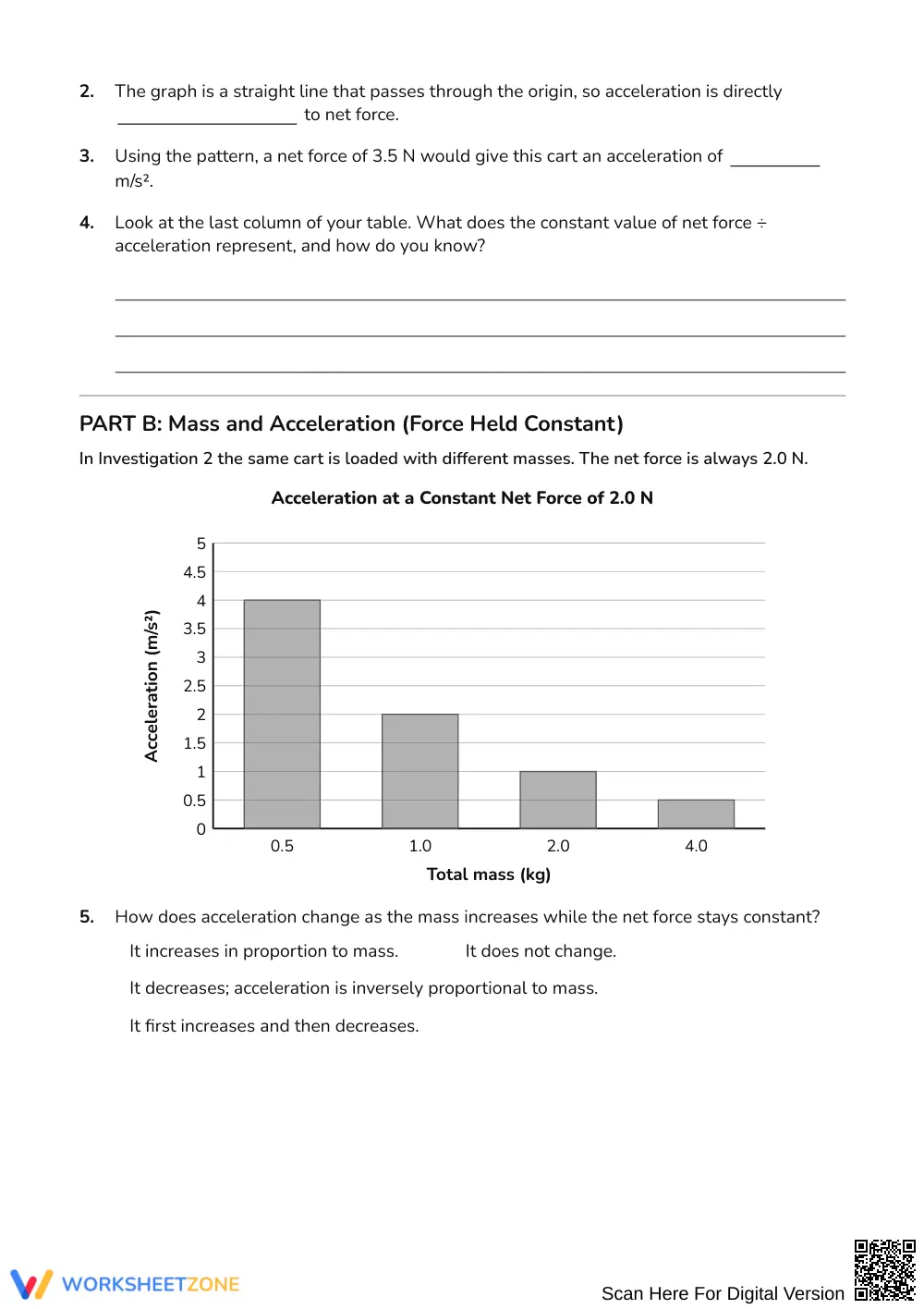
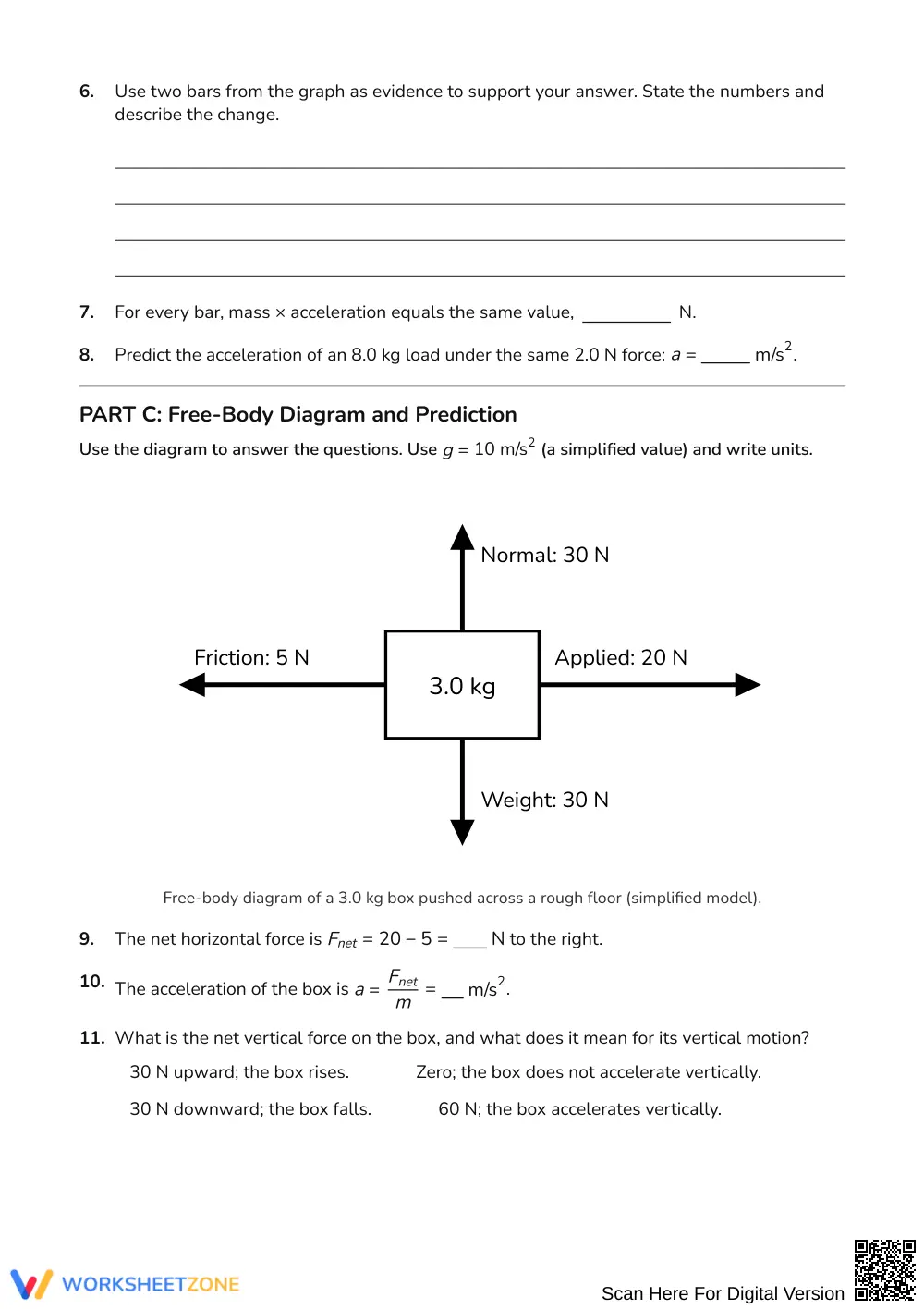
The 4-page worksheet contains 20 items spanning two controlled investigations and a free-body diagram analysis. Students analyze structured data tables, calculate force-to-acceleration ratios, interpret inverse graphs, and evaluate student claims using claim-evidence-reasoning prompts. A full 4-page answer key provides complete calculations, numerical predictions, and sample explanations for immediate scoring.
Skill Progression
- Guided Practice (Part A, 7 items): Students analyze linear graph data where mass remains constant at 0.50 kg, calculate net force to acceleration ratios, and identify direct proportionality.
- Supported Practice (Part B, 6 items): Learners evaluate an inverse relationship where net force is fixed at 2.0 N, using comparative data points to explain how doubling mass halves acceleration.
- Independent Practice (Part C, 7 items): Students resolve vectors on a free-body diagram, critique a claim about applied force, and calculate comparative vehicle accelerations.
This gradual release sequence guides students from foundational graph reading to complex multi-step physics predictions.
Standards Alignment
This resource aligns with secondary physical science standards addressing Newton's Second Law of Motion, requiring students to analyze data and show that acceleration depends on net force and mass. This standard expectation can be copied directly into lesson plans, IEP goals, or district curriculum mapping tools.
How to Use It
Deploy this activity following direct instruction on force diagrams. For a mid-unit checkpoint, have students complete Parts A and B in pairs over 25 minutes, then observe whether students confuse applied force with net force during Part C independent work. Expect the full 4-page worksheet to take 45 to 60 minutes.
Who It's For
This practice set serves Grades 8 through 12 physical science and physics classrooms. Built-in data tables support developing learners, while conceptual critique items challenge advanced students. Pair this worksheet directly with a cart laboratory or an interactive force simulation.
According to Fisher & Frey (2014), purposeful gradual-release structures enable secondary science students to transition successfully from guided data literacy exercises to rigorous conceptual explanations. This 4-page physics resource targets graph and evidence interpretation for Newton's Second Law of Motion across 20 sequenced problems. By organizing tasks into constant-mass direct relationships, constant-force inverse relationships, and free-body diagram calculations, the worksheet reinforces quantitative reasoning without relying on rote formula substitution. Students systematically examine how acceleration responds to changing net force and load mass, calculate constant ratios, and evaluate scientific claims using authentic evidence. Educational research emphasizes that pairing graphical data analysis with formal force diagrams builds durable mechanics comprehension across diverse learning cohorts. Both general education and intervention educators can utilize this standards-aligned resource to assess student mastery of force, mass, and acceleration interactions.


