
































Proven Genotype & Phenotype Worksheet | Grade 8-12 Science

Paste this activity's link or code into your existing LMS (Google Classroom, Canvas, Teams, Schoology, Moodle, etc.).
Students can open and work on the activity right away, with no student login required.
You'll still be able to track student progress and results from your teacher account.
This 30-task cumulative assessment helps students evaluate and solidify their understanding of genotypes and phenotypes across five rigorous domains. Learners calculate phenotypic ratios using Punnett squares, classify homozygous and heterozygous allele pairs, differentiate non-Mendelian inheritance patterns, interpret empirical offspring counts, and trace the flow of genetic information from DNA to visible organism traits.
At a Glance
- Grade: Grades 8–12 · Subject: Science
- Standard: Life Science Core Ideas — Predict trait inheritance and explain gene-to-protein expression
- Skill Focus: Genotype-phenotype distinction and inheritance mechanisms
- Format: 4 pages · 30 problems · Answer key included · PDF
- Best For: Unit assessment, review, or exam prep
- Time: 45–60 minutes
What's Inside
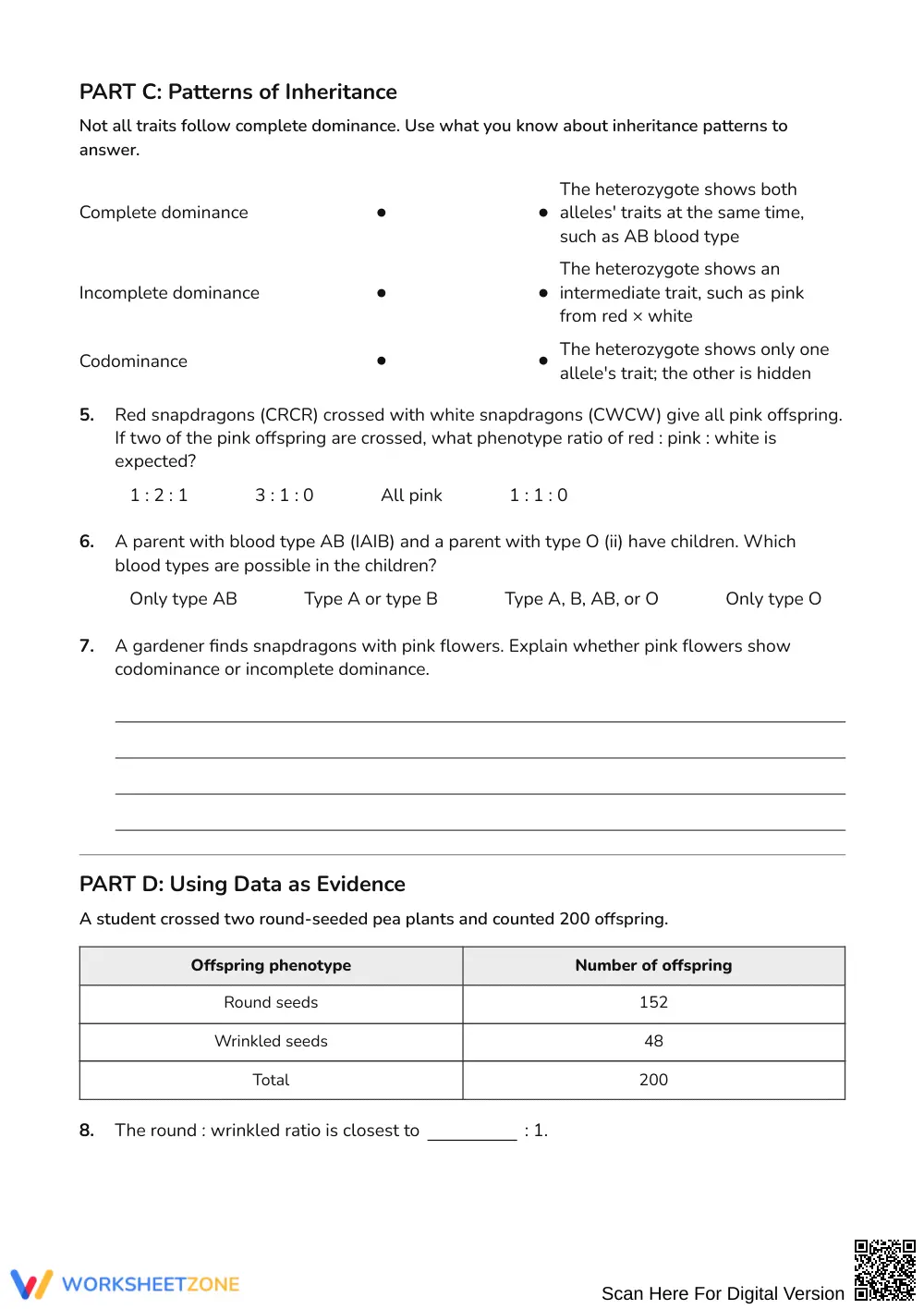
The 4-page worksheet contains 30 targeted problems arranged into five distinct sections. Students encounter completed and partially filled Punnett squares, classification tables for homozygous and heterozygous genotypes, inheritance comparison matrices, experimental data tables with 200 offspring counts, and a molecular flow diagram showing protein synthesis. A complete 4-page answer key provides worked-out explanations for every question.
Skill Progression
- Guided Practice (Part A & Part B, 10 tasks): Students analyze a visual Punnett square and complete structured reference tables with clear prompts, establishing baseline competence in allele notation and dominance rules.
- Supported Practice (Part C & Part D, 12 tasks): Learners apply core concepts to incomplete dominance, codominance, and empirical seed count ratios, interpreting evidence with moderate scaffolding.
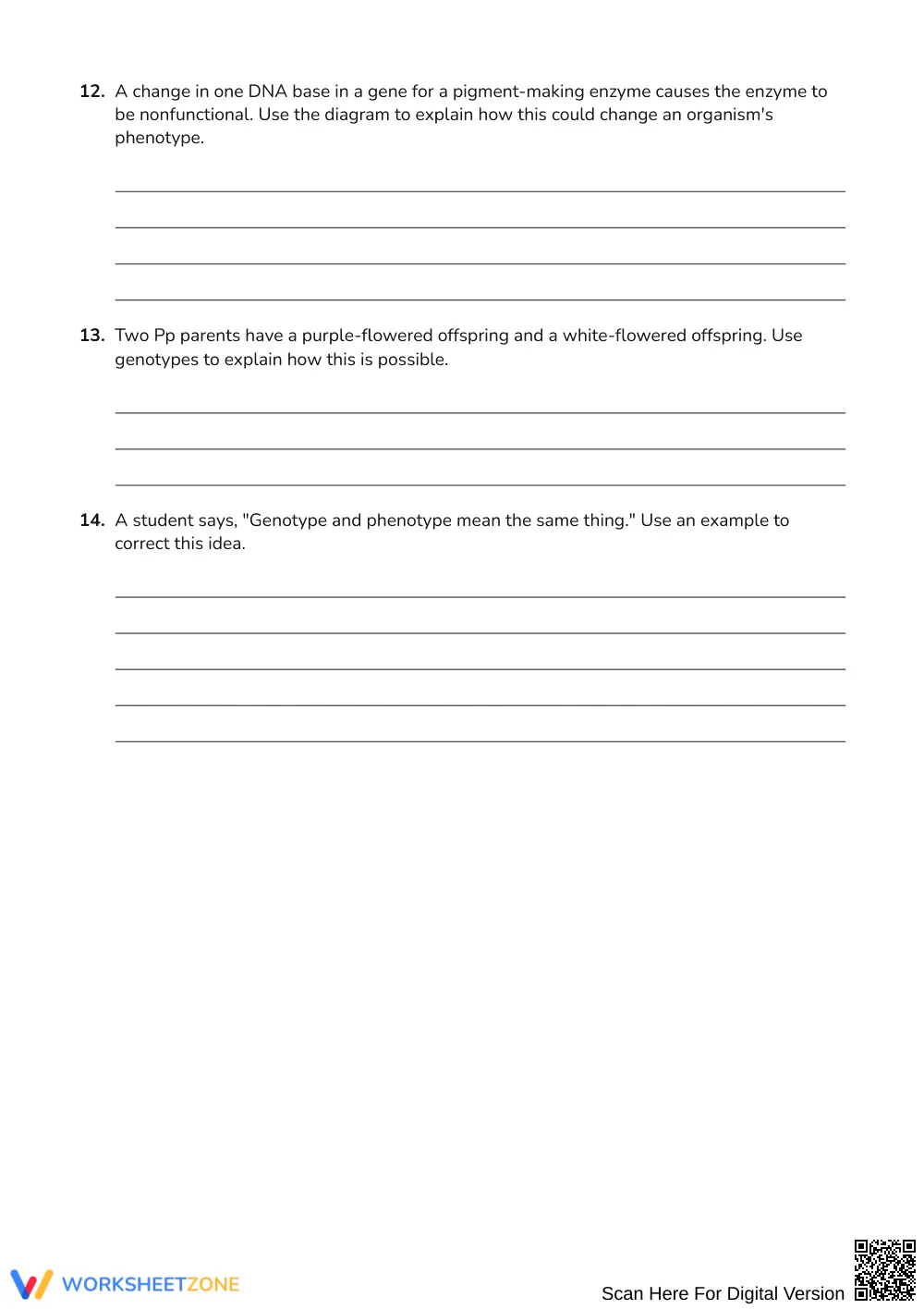
- Independent Practice (Part E, 8 tasks): Students independently explain molecular gene-to-trait pathways, justify phenotypic outcomes using genotypes, and clarify common conceptual misconceptions without cues.
This structure follows a gradual-release instructional model, moving students from guided allele recognition to rigorous independent synthesis.
Standards Alignment
This worksheet aligns directly with middle and high school life science standards for inheritance and variation of traits. Students use models to demonstrate how gene combinations produce visible characteristics, calculate probability ratios, and explain how environmental factors interact with genetic sequences. These curriculum standards can be copied directly into lesson plans, IEP goals, or district curriculum mapping tools.
How to Use It
Administer this resource as an end-of-unit summative assessment or as a collaborative review station after completing direct instruction on Mendelian genetics. During completion, observe whether students confuse heterozygous genotypes with blended phenotypes in Part C to identify lingering misconceptions before high-stakes exams. Expected completion time ranges from 45 to 60 minutes.
Who It's For
This assessment is designed for general biology, life science, and introductory genetics classes in grades 8 through 12. Teachers can support developing learners by allowing reference to the Part C pattern summary while challenging advanced students to calculate multi-generation crosses. It pairs naturally with direct instruction lectures on protein synthesis and molecular genetics.
Cumulative genetics assessments that require secondary students to connect microscopic genotypes with macroscopic phenotypes foster durable conceptual retention across biology curricula. According to Fisher & Frey (2014), structured instructional progressions that transition deliberately from visual modeling to written scientific explanations deepen student metacognition and support content mastery in complex domains. This 30-task science assessment reinforces foundational life science standards by prompting learners to differentiate alleles, calculate Punnett square probability ratios, analyze empirical offspring distributions, and trace how DNA transcription directs phenotypic expression. By purposefully integrating experimental data analysis, environmental modifications of gene traits, and non-Mendelian inheritance mechanisms like codominance and incomplete dominance, this resource provides educators with actionable diagnostic data on student proficiency. This systematic alignment ensures that secondary science learners cultivate essential empirical evaluation habits while preparing thoroughly for rigorous district and state examinations.


