

































Proven Genotype & Phenotype Worksheet | Grade 8-12 Science

Paste this activity's link or code into your existing LMS (Google Classroom, Canvas, Teams, Schoology, Moodle, etc.).
Students can open and work on the activity right away, with no student login required.
You'll still be able to track student progress and results from your teacher account.
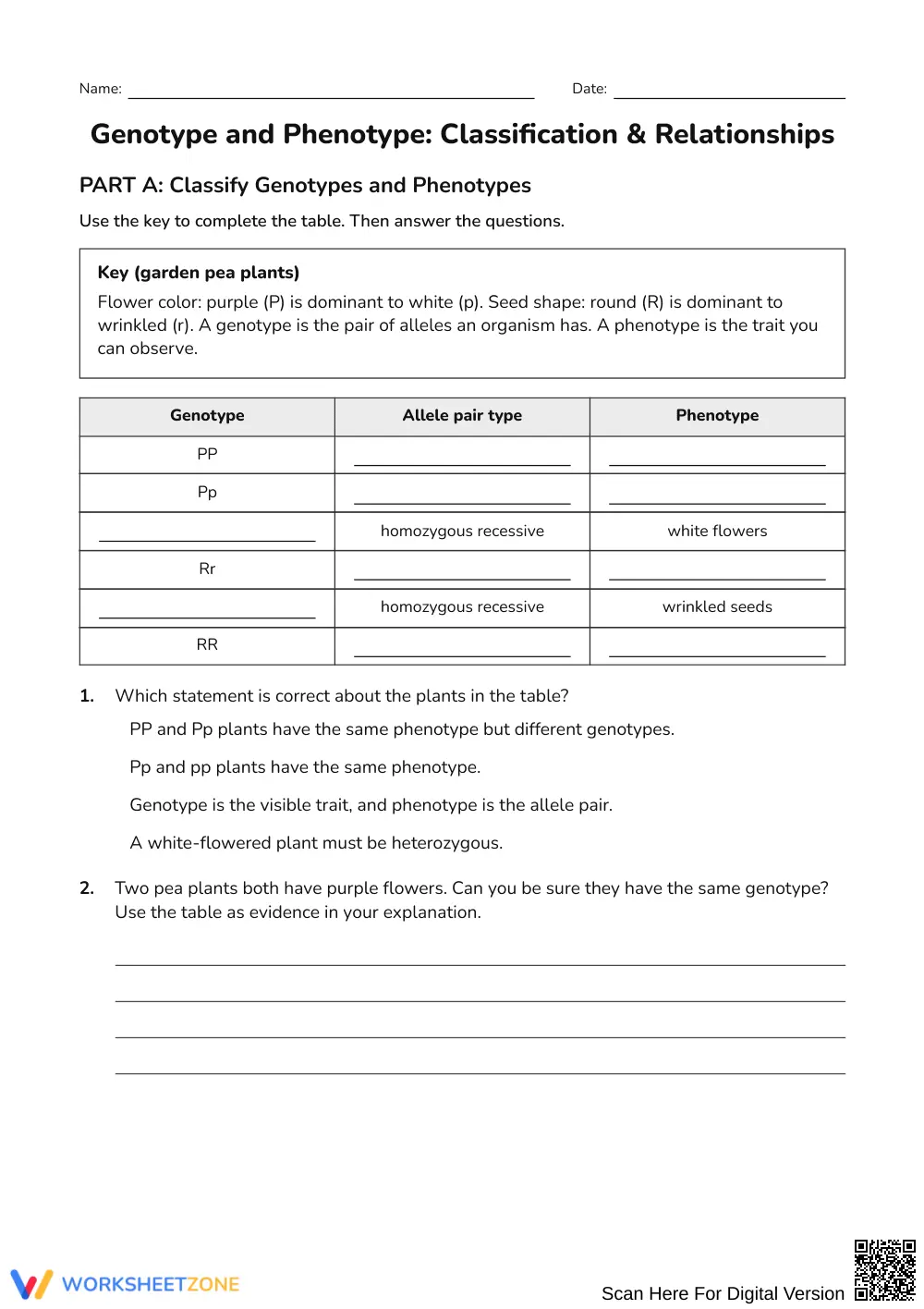
This comprehensive genetics worksheet trains secondary students to classify allele pairs, calculate Mendelian ratios, and evaluate non-Mendelian inheritance patterns. Through 38 focused tasks, high school and middle school learners examine how homozygous and heterozygous genotypes translate into observable physical traits across pea plants, snapdragons, and human blood types.
At a Glance
- Grade: Grades 8–12 · Subject: Science
- Standard: Predict phenotypic outcomes and explain how genes and environment determine organism traits
- Skill Focus: Genotype and phenotype relationships
- Format: 4 pages · 38 problems · Answer key included · PDF
- Best For: Genetics unit practice or review
- Time: 45–60 minutes
What's Inside
Spanning 4 student pages, this resource guides learners through classification tables, Punnett square construction, and evidence-based analysis questions. The resource features clear reference keys, structured monohybrid crosses, multi-allele charts for ABO blood typing, and open-ended synthesis prompts that require students to defend claims using genetic evidence. A thorough 4-page answer key provides complete model calculations and written explanations for efficient grading.
Skill Progression
- Guided Practice: Tasks 1–10 scaffold foundational terminology using reference tables for garden pea traits, prompting students to distinguish homozygous dominant, heterozygous, and recessive genotypes from physical phenotypes.
- Supported Practice: Tasks 11–24 challenge learners to model complete dominance and incomplete dominance crosses, calculate offspring probabilities, and compare genotype-to-phenotype ratios in snapdragon flowers.
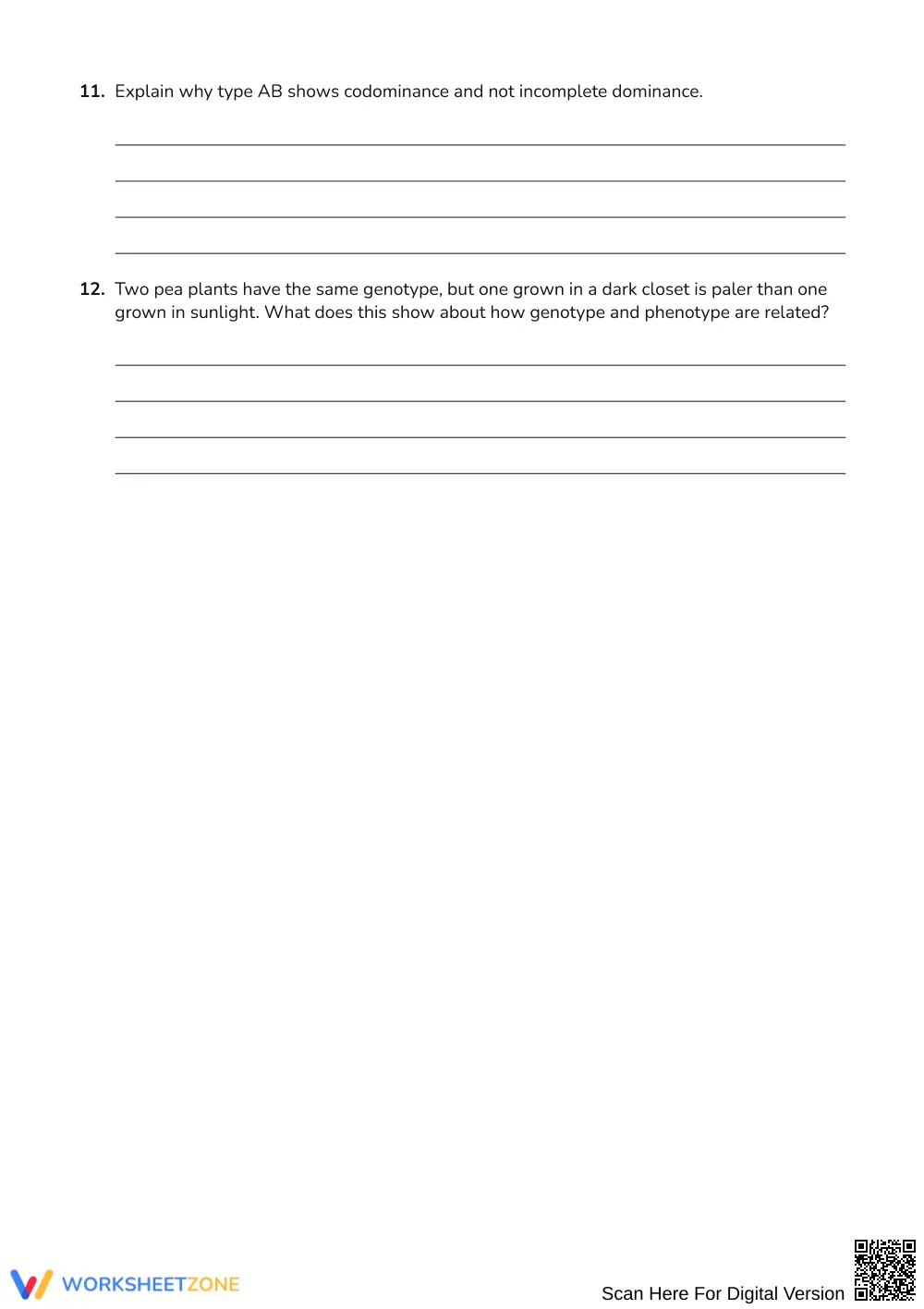
- Independent Practice: Tasks 25–38 require students to deduce parental genotypes from offspring phenotypes, analyze codominance in ABO blood groups, and explain environmental impacts on trait expression.
This structured sequence follows a gradual-release instructional model (I Do, We Do, You Do) to build conceptual fluency before requiring complex pedigree deductions.
Standards Alignment
This resource aligns with standard secondary life science objectives requiring students to apply concepts of statistics and probability to explain the variation and distribution of expressed traits in a population. Students analyze how genetic mechanisms produce predictable phenotypic distributions across generations while accounting for environmental variables. These alignment points can be copied directly into lesson plans, IEP goals, or district curriculum mapping tools.
How to Use It
Assign this resource immediately after introducing Punnett squares and basic inheritance vocabulary during direct instruction. As students complete the supported practice in Part B, circulate to monitor whether learners confuse incomplete dominance with codominance; address misunderstandings by highlighting how heterozygous snapdragons show an intermediate blend while AB blood groups express both alleles simultaneously. Plan for 45 to 60 minutes of focused seatwork, or split the four sections across consecutive class periods for targeted bell-ringer tasks.
Who It's For
This worksheet serves general biology, life science, and introductory genetics classes in grades 8 through 12. Teachers can support struggling readers by pre-highlighting the pea plant reference key, while advanced learners can tackle the environmental expression prompt as an extended lab inquiry. Pair this packet with a hands-on coin-toss genetics lab or an interactive Punnett square slide deck.
Secondary life science curricula require students to bridge microscopic gene combinations with observable organism features. According to Fisher & Frey (2014), structured scaffolds that pair explicit reference models with tiered problem sets systematically deepen conceptual transfer in secondary science contexts. This 4-page resource operationalizes that evidence-based framework across 38 targeted questions, progressing from basic terminology matching to monohybrid cross prediction and environmental trait modulation. By requiring students to calculate mathematical ratios and articulate causal explanations, the worksheet directly strengthens scientific reasoning, quantitative modeling, and biological vocabulary retention.


