


























Views
Downloads



Proven Enzyme Roles at a Fork Worksheet | Grade 10 Biology
Paste this activity's link or code into your existing LMS (Google Classroom, Canvas, Teams, Schoology, Moodle, etc.).
Students can open and work on the activity right away, with no student login required.
You'll still be able to track student progress and results from your teacher account.
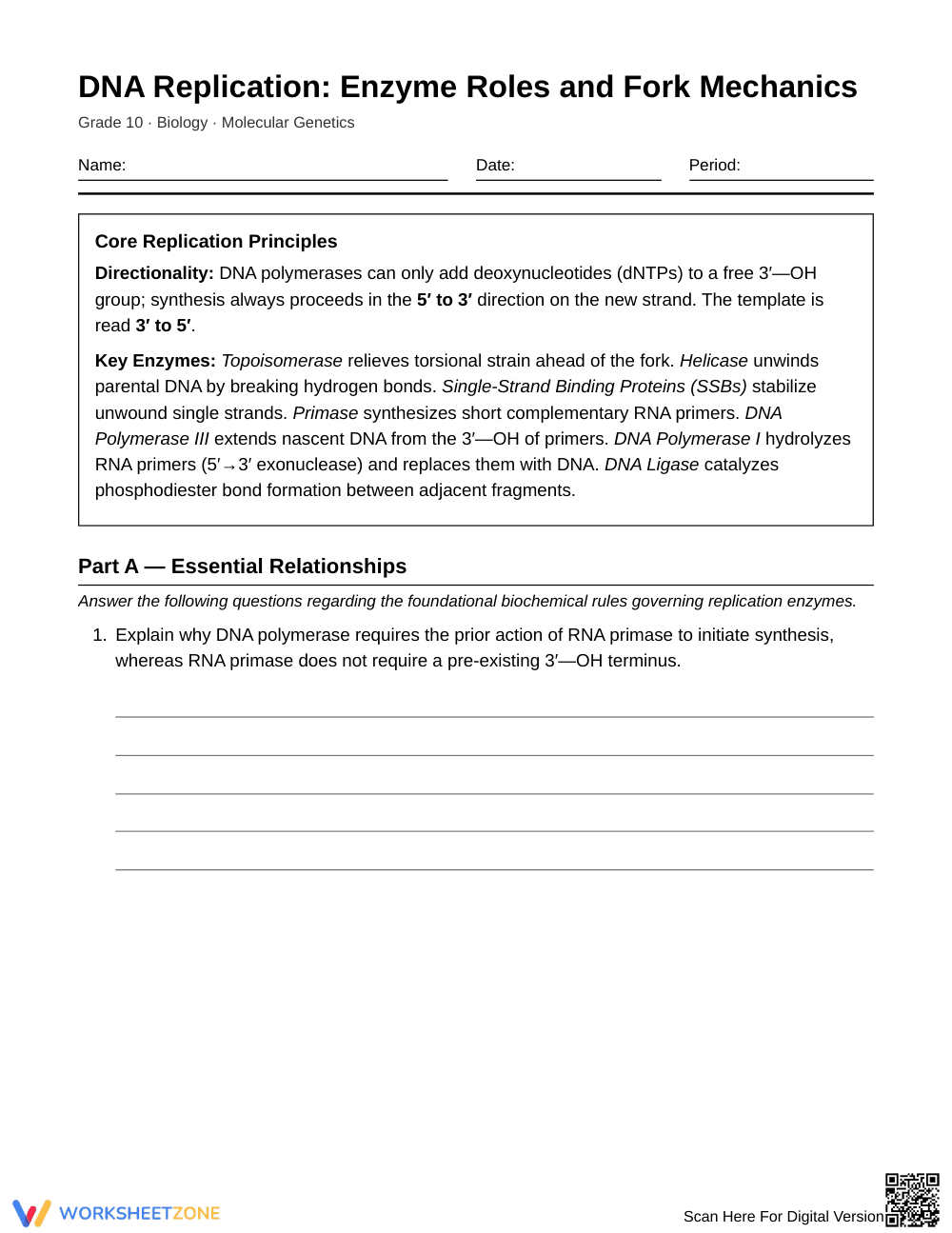
This 10th-grade biology worksheet provides rigorous, targeted practice on the molecular mechanisms of DNA replication. Students analyze enzyme functions at the replication fork, trace antiparallel sequence synthesis, and evaluate the biochemical consequences of enzymatic failures across 12 structured problems, building a thorough mechanistic understanding of molecular genetics.
At a Glance
- Grade: 10 · Subject: Biology
- Standard: Molecular Genetics — Explain how coordinated enzymes synthesize DNA strands at a replication fork
- Skill Focus: Explain Enzyme Roles at a Fork
- Format: 5 pages · 12 problems · Answer key included · PDF
- Best For: High school molecular genetics practice
- Time: 40–50 minutes
What's Inside
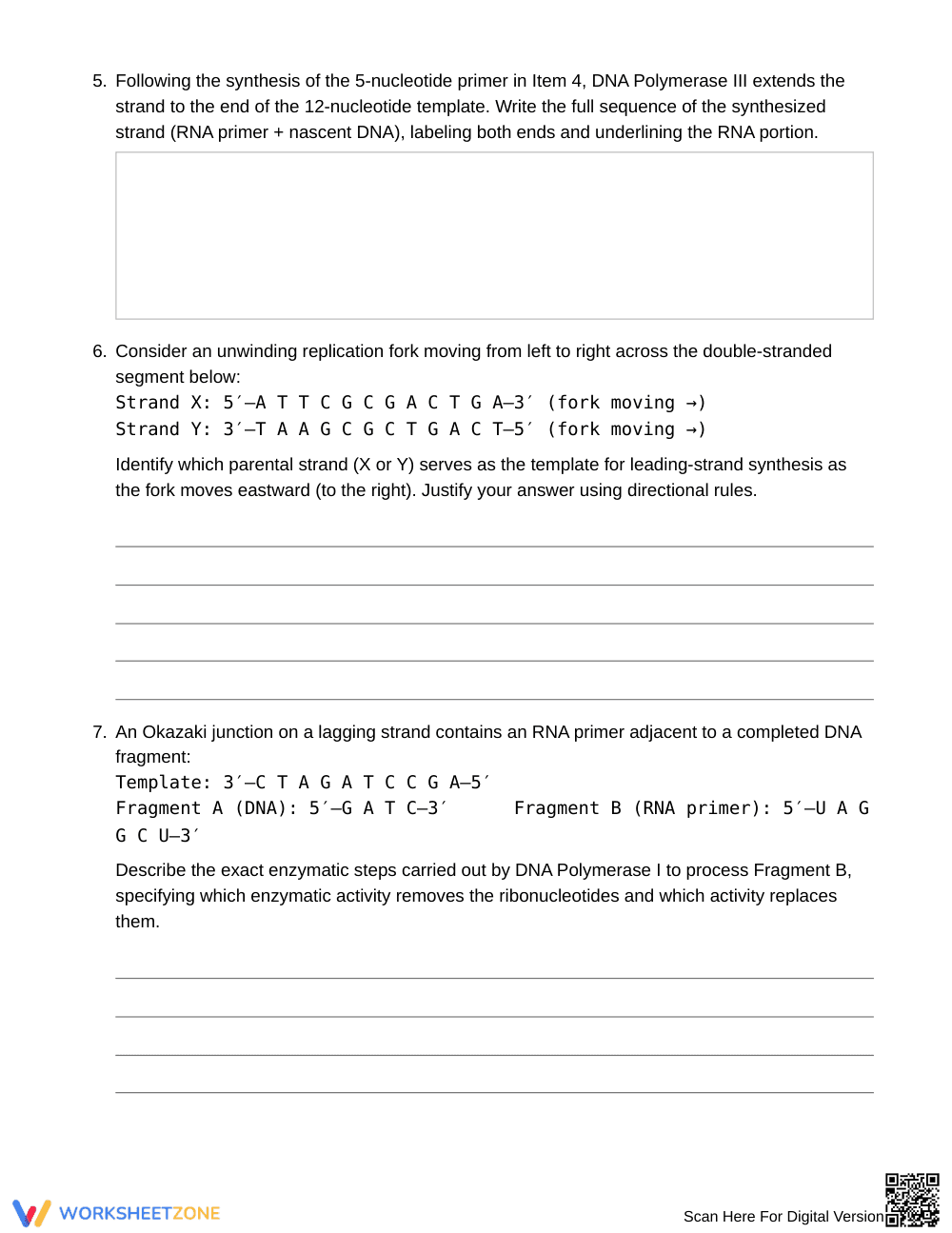
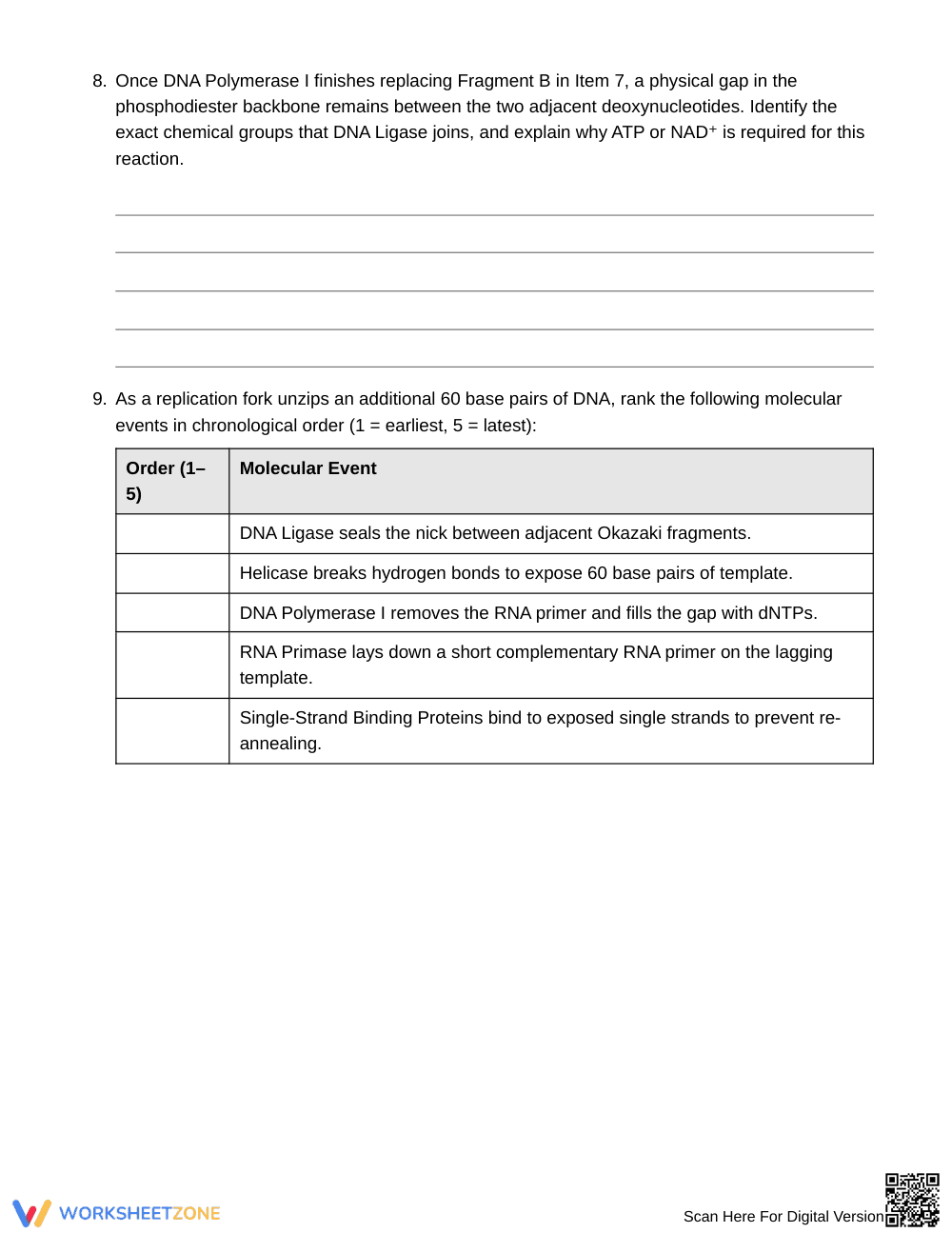
The 5-page printable PDF features a foundational reference box covering core replication principles, enzyme functions, and directional rules. Students complete short-response explanations, sequence-generation tasks, Okazaki maturation pathway analyses, a 5-step chronological ordering table, and experimental prediction scenarios. A thorough 3-page answer key provides complete model responses, biochemical rationales, and labeled nucleotide sequences.
Skill Progression
- Guided practice (Problems 1–3): Students establish foundational relationships by explaining primase requirements, leading versus lagging strand polarity, and the functional partnership between DNA Polymerase I and Ligase using the reference box.
- Supported practice (Problems 4–9): Learners apply biochemical mechanics to synthesize labeled sequences, identify template strands, detail Okazaki fragment processing, and order unzipping events chronologically.
- Independent practice (Problems 10–12): Students formulate mechanistic predictions regarding topoisomerase inhibition, exonuclease-deficient polymerase mutants, and single-strand binding protein depletion.
This structure follows a gradual-release instructional model that transitions learners from conceptual definitions to complex experimental reasoning.
Standards Alignment
This resource aligns with high school molecular biology standards addressing the structures and functional mechanisms of cellular division, genetic replication, and macromolecular synthesis. Both standard codes can be copied directly into lesson plans, IEP goals, or district curriculum mapping tools.
How to Use It
Deploy this worksheet immediately after direct instruction on replication fork enzymes as an in-class cooperative task or independent formative assessment. During work time, check Part B sequence orientations to verify whether students correctly synthesize 5′ to 3′ while reading 3′ to 5′. Students typically complete the 12 tasks in 40 to 50 minutes.
Who It's For
This activity is designed for Grade 10 general and honors biology students mastering molecular genetics. The clear reference summary supports emerging learners, while the experimental mutation problems challenge advanced students. Pair this worksheet with an interactive replication fork animation or molecular model kit for maximal conceptual retention.
High school biology curricula require students to explain enzyme roles at a replication fork by connecting macromolecular structures to biochemical functions. According to research by Fisher & Frey (2014) on scaffolded instructional design, student mastery of complex molecular pathways increases significantly when direct instruction transitions systematically into structured problem-solving and mechanistic prediction tasks. This 12-task DNA replication worksheet operationalizes that framework by moving students from foundational enzyme identification (Helicase, Primase, Topoisomerase, Polymerases, and Ligase) to sequence-level modeling and mutation impact analysis. By pairing clear directional rules with high-level experimental scenarios, this resource strengthens procedural accuracy and conceptual transfer in molecular genetics. High school educators can reliably implement this 5-page worksheet during unit practice, lab follow-up, or assessment preparation to secure deep biological comprehension and measurable standards mastery across diverse secondary classrooms.


