

































Proven Competing Proposals Worksheet | Grade 10 English II

Paste this activity's link or code into your existing LMS (Google Classroom, Canvas, Teams, Schoology, Moodle, etc.).
Students can open and work on the activity right away, with no student login required.
You'll still be able to track student progress and results from your teacher account.
Equip sophomore readers to evaluate argumentative claims across competing real-world criteria. This high school English II worksheet challenges students to analyze policy trade-offs, identify rhetorical fallacies, and synthesize opposing viewpoints regarding school start times. Students examine authentic operational constraints to assess whether an author’s reasoning is logically valid and practically feasible.
At a Glance
- Grade: 10 · Subject: English II
- Standard:
RI.9-10.8— Evaluate argument reasoning and evidence sufficiency across competing criteria- Skill Focus: Evaluate a Proposal Against Competing Criteria
- Format: 6 pages · 10 problems · Answer key included · PDF
- Best For: Argumentative text analysis practice
- Time: 45–60 minutes
What's Inside
This 6-page resource features two competing policy briefings detailing the high school start-time debate alongside 10 analytical tasks. It includes a core concepts reference chart, text-dependent analysis questions, multiple-choice validity checks, a reasoning revision prompt, and a thorough 3-page explanatory answer key.
Skill Progression
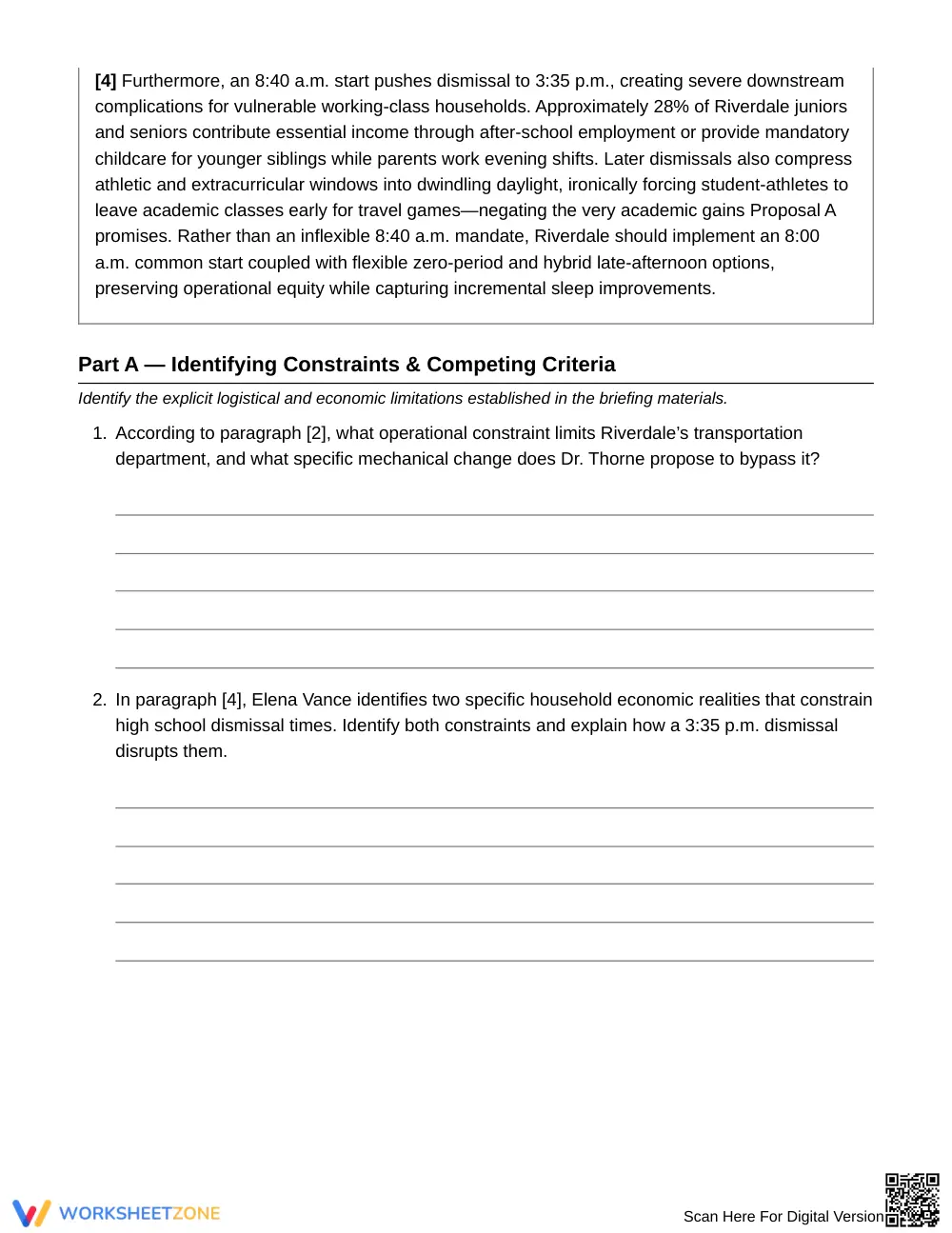
- Guided practice (Tasks 1–2): Students examine foundational policy constraints, identifying explicit logistical and economic limitations using targeted reference questions.
- Supported practice (Tasks 3–8): Learners evaluate evidence sufficiency and detect false dilemmas across six analytical items combining multiple-choice checks with structured comparative analysis.
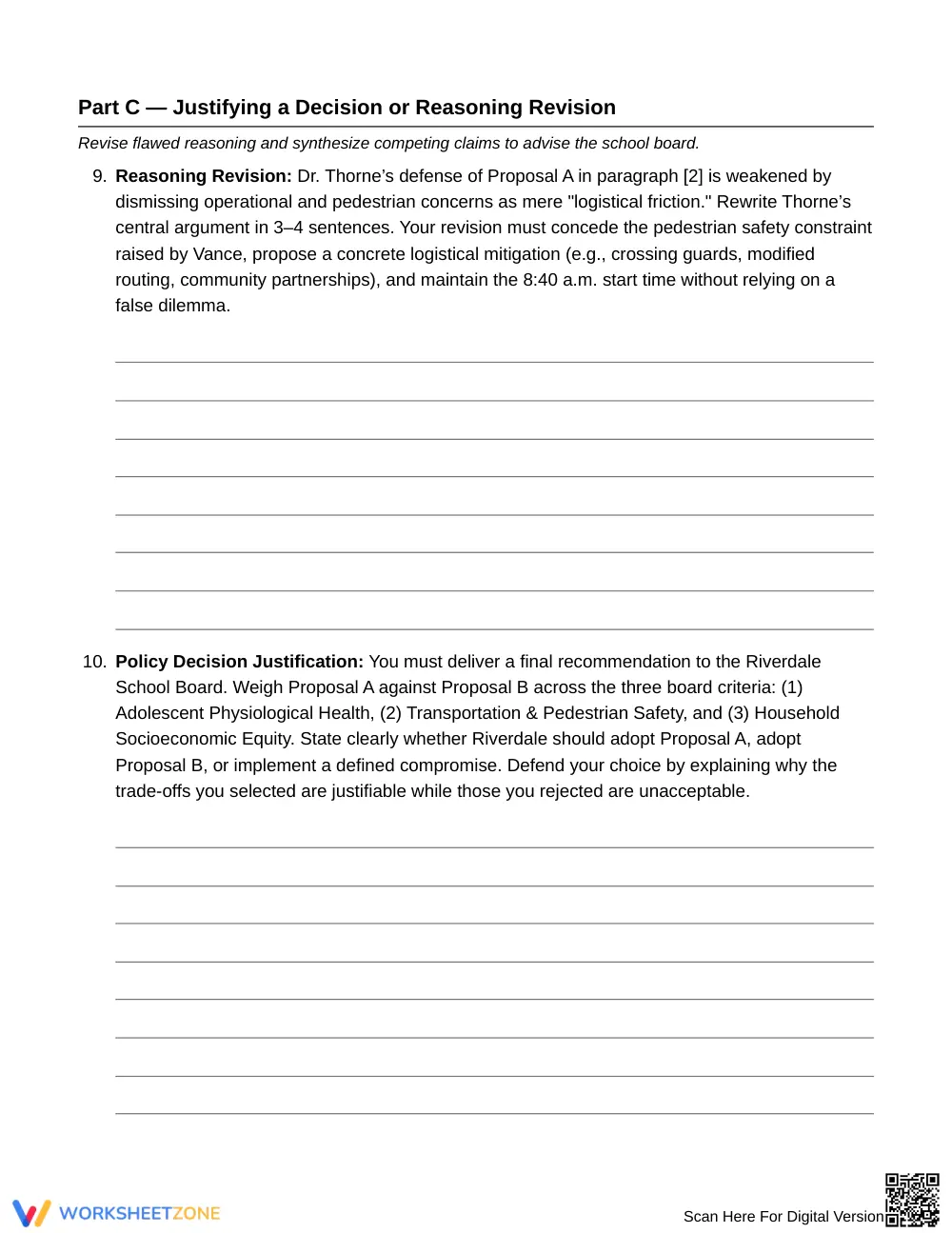
- Independent practice (Tasks 9–10): Students revise a flawed argument to eliminate logical fallacies and draft a comprehensive policy recommendation defending their chosen trade-offs across three criteria.
This sequence mirrors a gradual-release model, moving students from guided extraction to independent argumentative synthesis.
Standards Alignment
The primary focus aligns to `RI.9-10.8`: Delineate and evaluate the argument and specific claims in a text, assessing whether the reasoning is valid and the evidence is relevant and sufficient. Additionally, the policy justification task supports `W.9-10.1` through written argumentative defense. Both standard codes can be copied directly into lesson plans, IEP goals, or district curriculum mapping tools.
How to Use It
Deploy this worksheet after direct instruction on logical fallacies. Use the core concepts table for whole-class framing before students analyze the competing proposals in pairs. Alternatively, assign it as an independent assessment of evidence evaluation. Formatively observe whether students catch the false dilemma in Dr. Thorne's argument. Expect completion within 45 to 60 minutes.
Who It's For
This worksheet serves Grade 10 English Language Arts students developing analytical reading stamina and policy literacy. Built-in reference tables support developing analysts, while synthesis tasks stretch advanced thinkers. Pair this printable with a targeted lesson on evaluating rhetorical appeals.
According to research on adolescent literacy by Fisher & Frey (2014), structured opportunities to delineate and evaluate complex arguments scaffold students toward mature analytical independence. This instructional resource operationalizes standard RI.9-10.8 by requiring Grade 10 learners to evaluate an argumentative proposal against competing criteria, assessing whether an author’s claims withstand scrutiny across conflicting logistical, health, and economic priorities. Rather than treating claims in isolation, students examine how operational constraints and false dilemmas undermine argumentative validity. By engaging with 10 structured tasks—including evidence critique, fallacy identification, and independent policy defense—students develop the critical evaluation habits necessary to dissect competing real-world viewpoints. The embedded progression provides the cognitive scaffolding emphasized in contemporary reading research, ensuring students transition from isolating textual details to producing rigorous, evidence-based policy justifications. Consequently, this resource delivers measurable support for secondary English language arts programs targeting standards-based mastery.


