


























Views
Downloads




Proven Cell Structure-Function Worksheet | Grade 6 Science
Paste this activity's link or code into your existing LMS (Google Classroom, Canvas, Teams, Schoology, Moodle, etc.).
Students can open and work on the activity right away, with no student login required.
You'll still be able to track student progress and results from your teacher account.
This Grade 6 science worksheet trains students to defend structure-function explanations for cell organelles. Learners examine synthetic experimental data, evaluate biological mechanisms like turgor pressure and selective permeability, and refute common misconceptions. By linking empirical evidence directly to cellular roles, students build rigorous scientific reasoning skills.
At a Glance
- Grade: 6 · Subject: Science
- Standard:
Cell Structure & Function— Defend explanations of how organelle parts support cellular function and life processes- Skill Focus: Defending structure-function explanations with evidence
- Format: 5 pages · 8 problems · Answer key included · PDF
- Best For: Argument-driven cell biology practice
- Time: 40–50 minutes
What's Inside
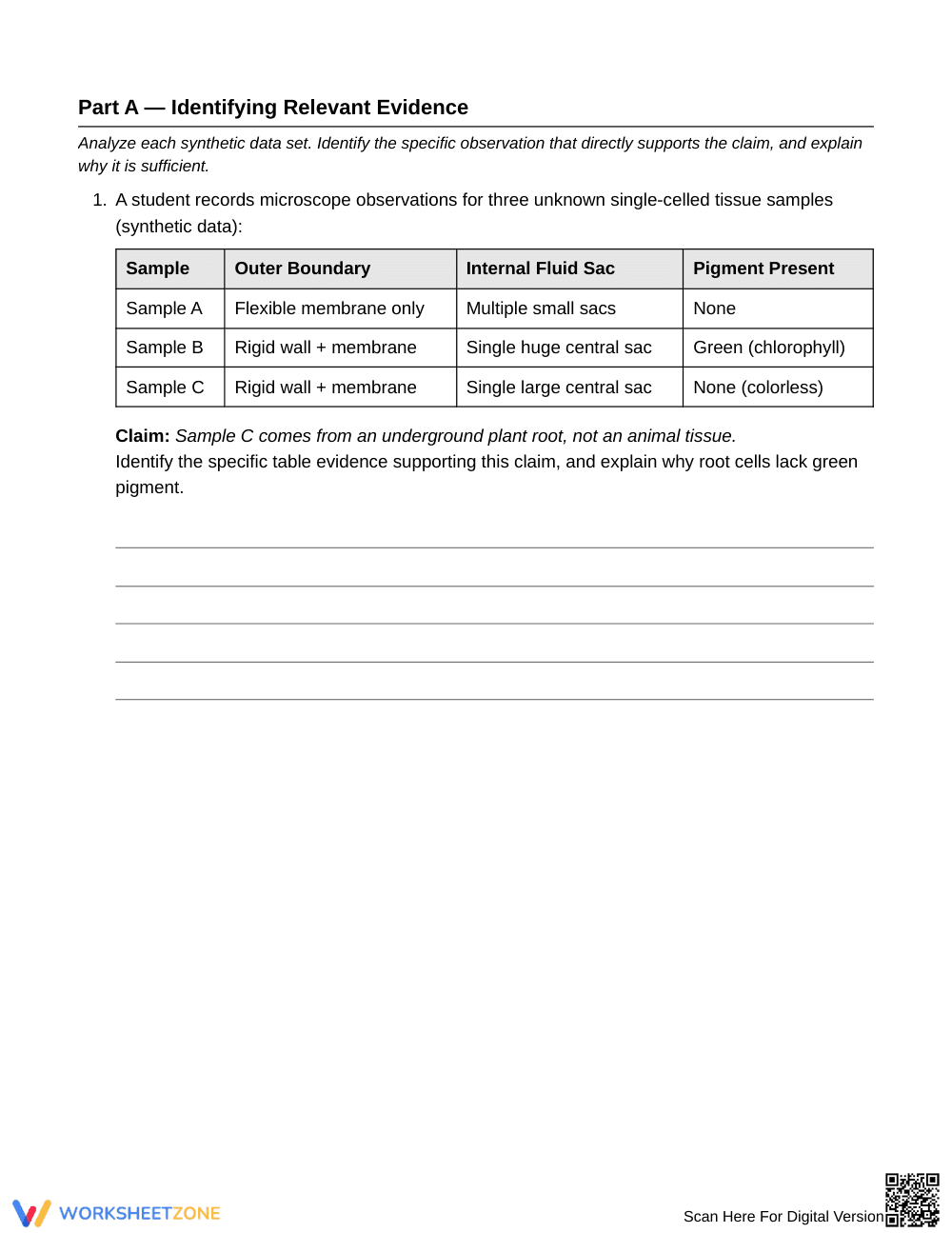
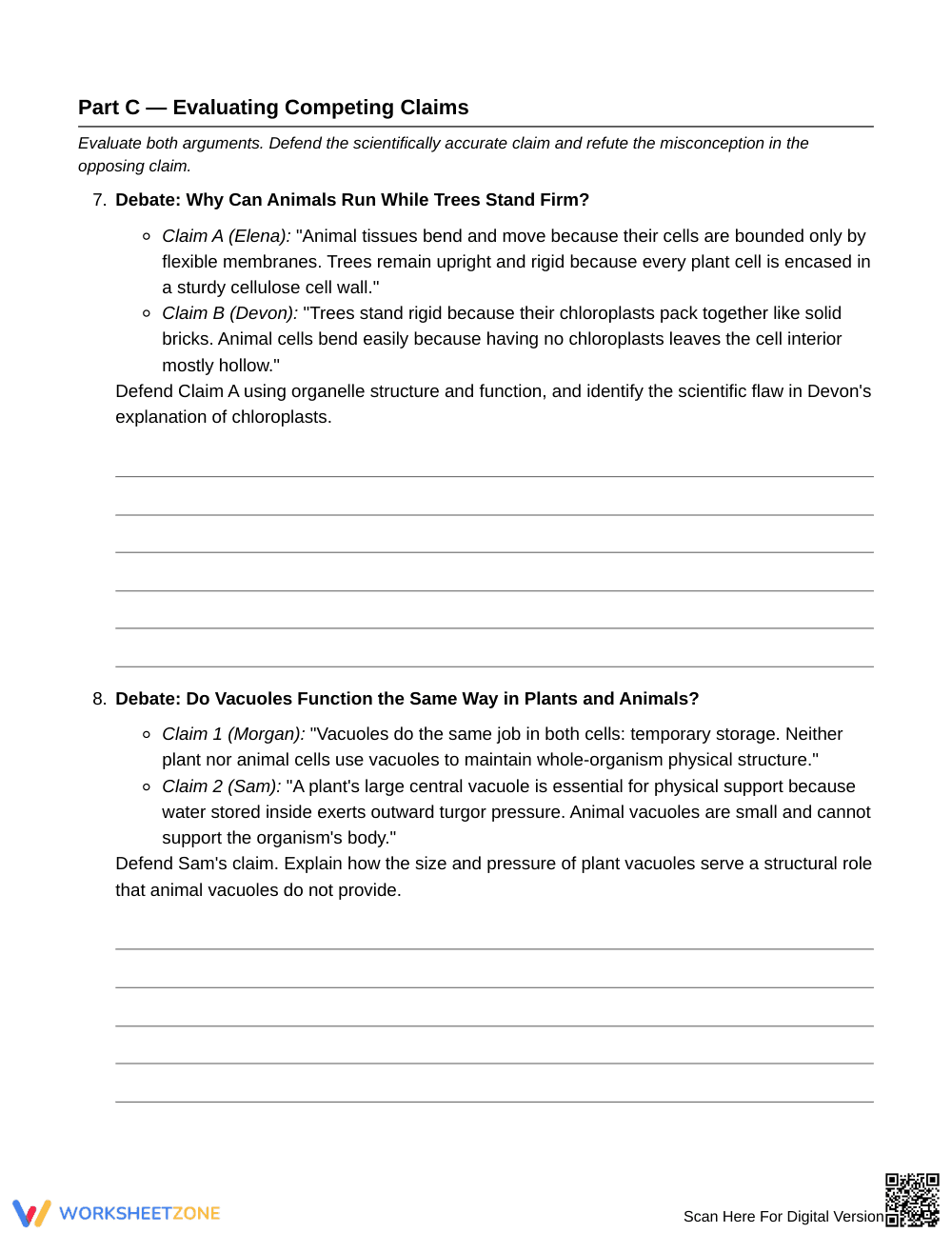
The worksheet opens with a core organelle function reference table summarizing cell membranes, nuclei, cytoplasm, cell walls, chloroplasts, and vacuoles. Across 8 complex analysis tasks, students interpret synthetic microscope data tables, pressure probe readings, and gas exchange trials. A 3-page detailed answer key provides complete evidence-based justifications.
Skill Progression
- Guided practice (Tasks 1–2): Students analyze synthetic data tables to isolate specific evidence supporting claims about tissue identity and cell wall pressure resistance.
- Supported practice (Tasks 3–6): Learners construct mechanism explanations linking observed real-world phenomena to specific organelle functions.
- Independent practice (Tasks 7–8): Students evaluate competing peer debate claims, defending scientifically accurate arguments while refuting structural misconceptions.
This structured sequence applies the gradual release of responsibility model, guiding learners from data identification to high-level scientific critique.
Standards Alignment
This activity aligns with middle school life science standards focusing on cellular systems and evidence-based argumentation. Students describe the function of a cell as a whole and the ways individual parts contribute to cellular functions. The tasks emphasize constructing written explanations based on valid and reliable evidence. Both standard codes can be copied directly into lesson plans, IEP goals, or district curriculum mapping tools.
How to Use It
Deploy this worksheet after direct instruction on cell organelles during a formative practice session. Have students work in pairs to analyze the synthetic data sets before drafting independent written arguments for the debate tasks. For formative assessment, check whether students cite numerical pressure values in Task 2 to confirm that they ground claims in quantitative data. Expected completion time is 40 to 50 minutes.
Who It's For
This resource serves general education 6th-grade science classes, introductory life science courses, and students preparing for district assessments. For differentiation, provide sentence frames for the claim-evidence-reasoning prompts in Part B to assist developing writers. Pair this worksheet directly with a compound microscope lab or an interactive cell organelle diagram.
Defending scientific explanations through evidence-based analysis is essential for establishing deep conceptual mastery in middle school science. According to research synthesized by Fisher & Frey (2014) on the gradual release of responsibility, structured instructional progression from guided data interpretation to independent argument evaluation significantly increases academic discourse, conceptual clarity, and long-term content retention. By requiring 6th-grade learners to analyze specific empirical data points, trace cellular mechanisms such as turgor pressure and selective permeability, and explicitly refute common peer misconceptions regarding cell walls and vacuoles, this resource develops the exact critical reasoning required for rigorous scientific inquiry. Grounding organelle function in quantitative probe measurements and controlled trials transforms rote memorization into active scientific argumentation, ensuring students thoroughly understand how internal cellular structures sustain complex living organisms. This structured approach builds durable scientific literacy across all achievement levels.


