
































Proven Argument Evaluation Worksheet | Grade 11 English III

Paste this activity's link or code into your existing LMS (Google Classroom, Canvas, Teams, Schoology, Moodle, etc.).
Students can open and work on the activity right away, with no student login required.
You'll still be able to track student progress and results from your teacher account.
This Grade 11 English III worksheet prepares students to evaluate opposing arguments and make defensible policy decisions. Using a realistic municipal algorithmic governance scenario, learners analyze constitutional claims, assess evidentiary validity, and synthesize competing perspectives into an actionable regulatory standard.
At a Glance
- Grade: 11 · Subject: English III
- Standard:
RI.11-12.8— Evaluate the argument and specific claims in texts, assessing reasoning and evidentiary validity- Skill Focus: Evaluate Arguments for a Specific Decision
- Format: 6 pages · 10 problems · Answer key included · PDF
- Best For: Collaborative argument analysis and policy evaluation
- Time: 45–60 minutes
What's Inside
The 6-page worksheet presents two opposing policy briefs debating public algorithm disclosure. Across 10 tasks, students answer targeted text questions, identify underlying premises, and draft regulatory compromises. A 4-page answer key provides complete model responses and legal rationales.
Skill Progression
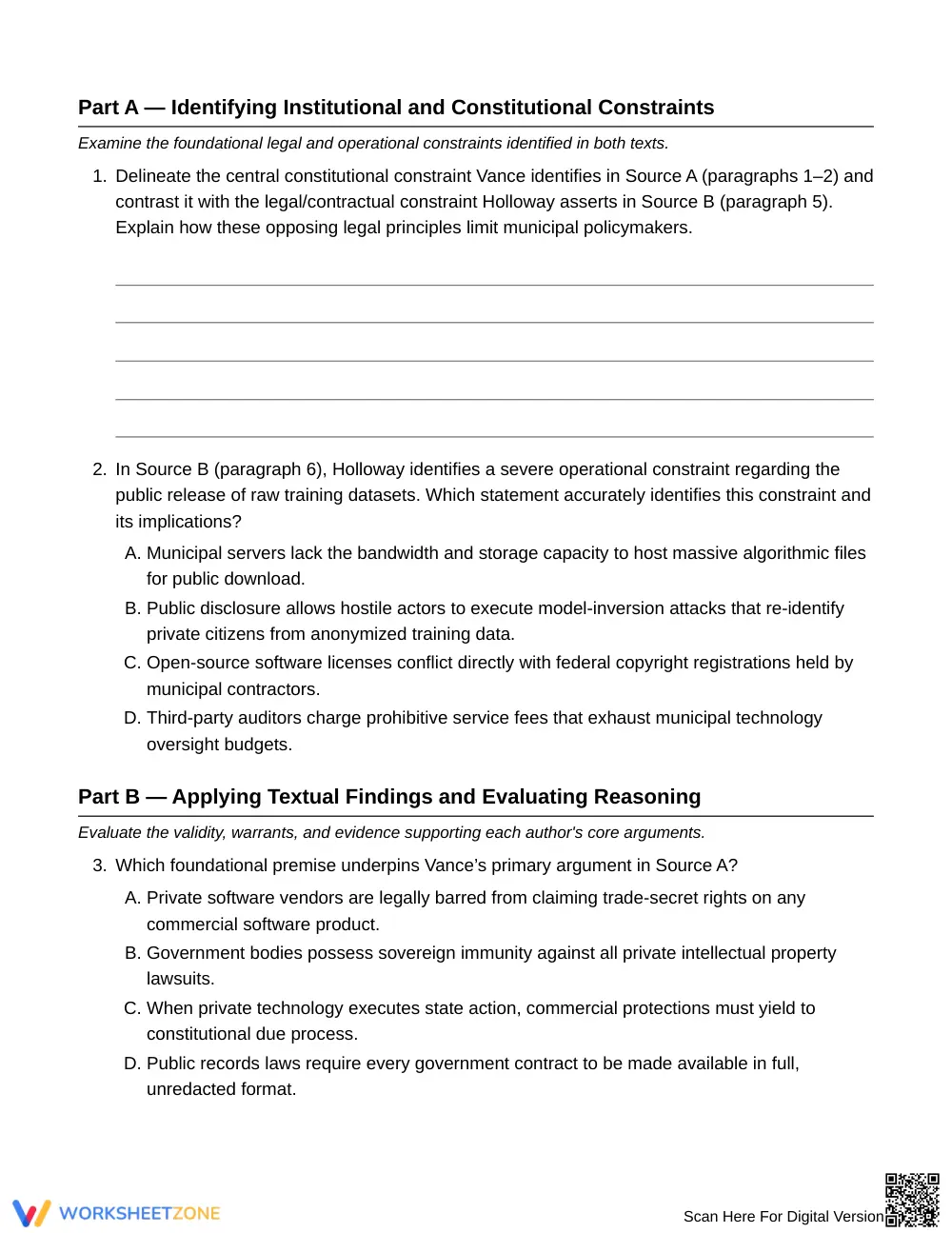
- Guided practice (Tasks 1–2): Students examine foundational legal and operational constraints, contrasting First Amendment and due process claims against commercial trade secrets.
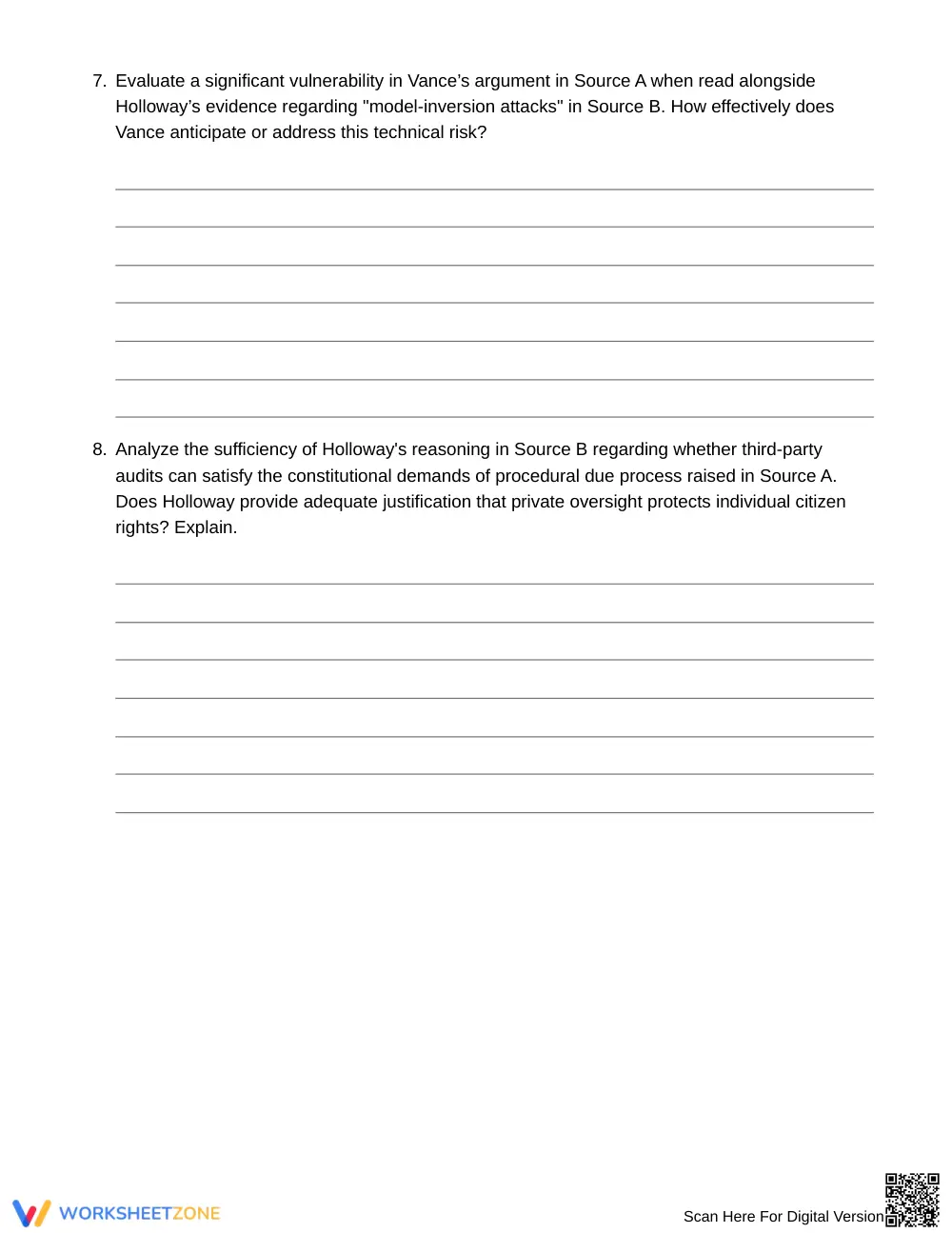
- Supported practice (Tasks 3–8): Learners evaluate premise validity, unstated assumptions, and technical vulnerabilities across both texts, comparing oversight models and reporting benchmarks.
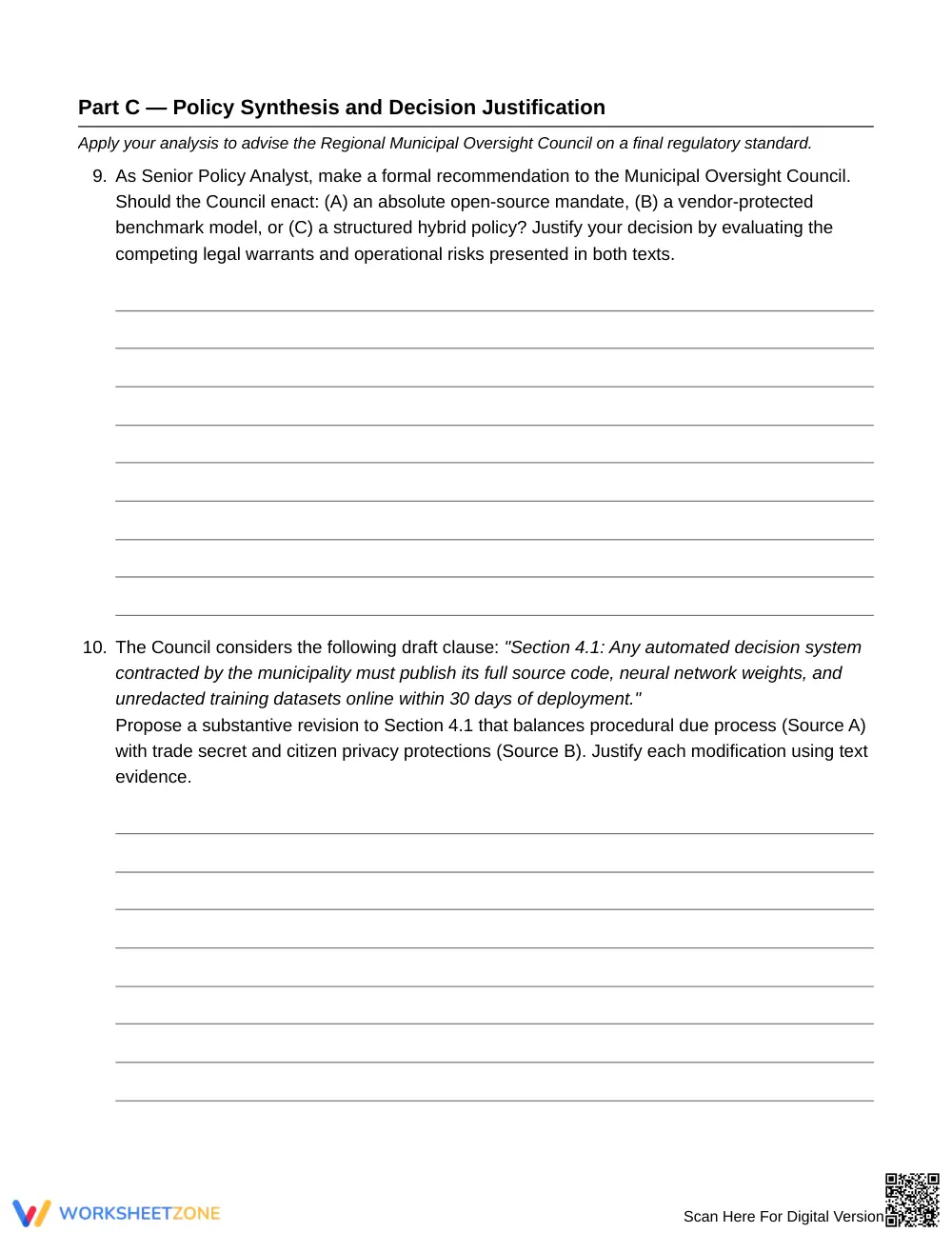
- Independent practice (Tasks 9–10): Students synthesize conflicting warrants to recommend a binding municipal policy and draft revised regulatory statutory language.
This sequence implements gradual release, moving learners from identifying explicit claims to independently resolving policy dilemmas.
Standards Alignment
This resource aligns with primary standard `RI.11-12.8`: Delineate and evaluate the reasoning in seminal texts and authoritative public documents, assessing premise validity and fallacies. It also supports `RI.11-12.1` through rigorous textual evidence citation. Both standard codes can be copied directly into lesson plans, IEP goals, or district curriculum mapping tools.
How to Use It
Assign this worksheet after direct instruction on argument evaluation and policy claims. In paired workshops, students analyze Sources A and B together before completing Part C individually. Formative-assessment tip: review Task 7 to check whether students identify technical vulnerabilities rather than merely summarizing text. Estimated completion time is 45 to 60 minutes.
Who It's For
Ideal for Grade 11 English III and Advanced Placement Language students tackling college-level rhetoric. Structured prompts support developing readers, while policy synthesis challenges advanced thinkers. Pair this activity with direct instruction on Toulmin argument structures or landmark constitutional due process cases.
Rigorous argument evaluation requires students to engage critically with authentic textual complexity rather than isolated rhetorical terms. According to Fisher & Frey (2014), gradual release frameworks that guide high school readers from structural analysis to independent synthesis significantly strengthen disciplinary literacy and critical reasoning. This Grade 11 English III resource directly operationalizes standard RI.11-12.8 by requiring students to evaluate the reasoning and evidentiary sufficiency in paired policy texts regarding algorithmic governance. Through 10 focused tasks, students identify constitutional due process claims, probe unstated market assumptions, analyze technical vulnerabilities such as model-inversion attacks, and author a balanced regulatory compromise. By shifting instructional focus from basic comprehension to actionable policy evaluation, this 6-page resource ensures learners substantiate theoretical critique with precise textual evidence, fostering the higher-order critical thinking and civic argumentation competencies demanded in collegiate coursework and professional civic environments.


