
































Proven Argument Analysis Worksheet | Grade 11 English III

Paste this activity's link or code into your existing LMS (Google Classroom, Canvas, Teams, Schoology, Moodle, etc.).
Students can open and work on the activity right away, with no student login required.
You'll still be able to track student progress and results from your teacher account.
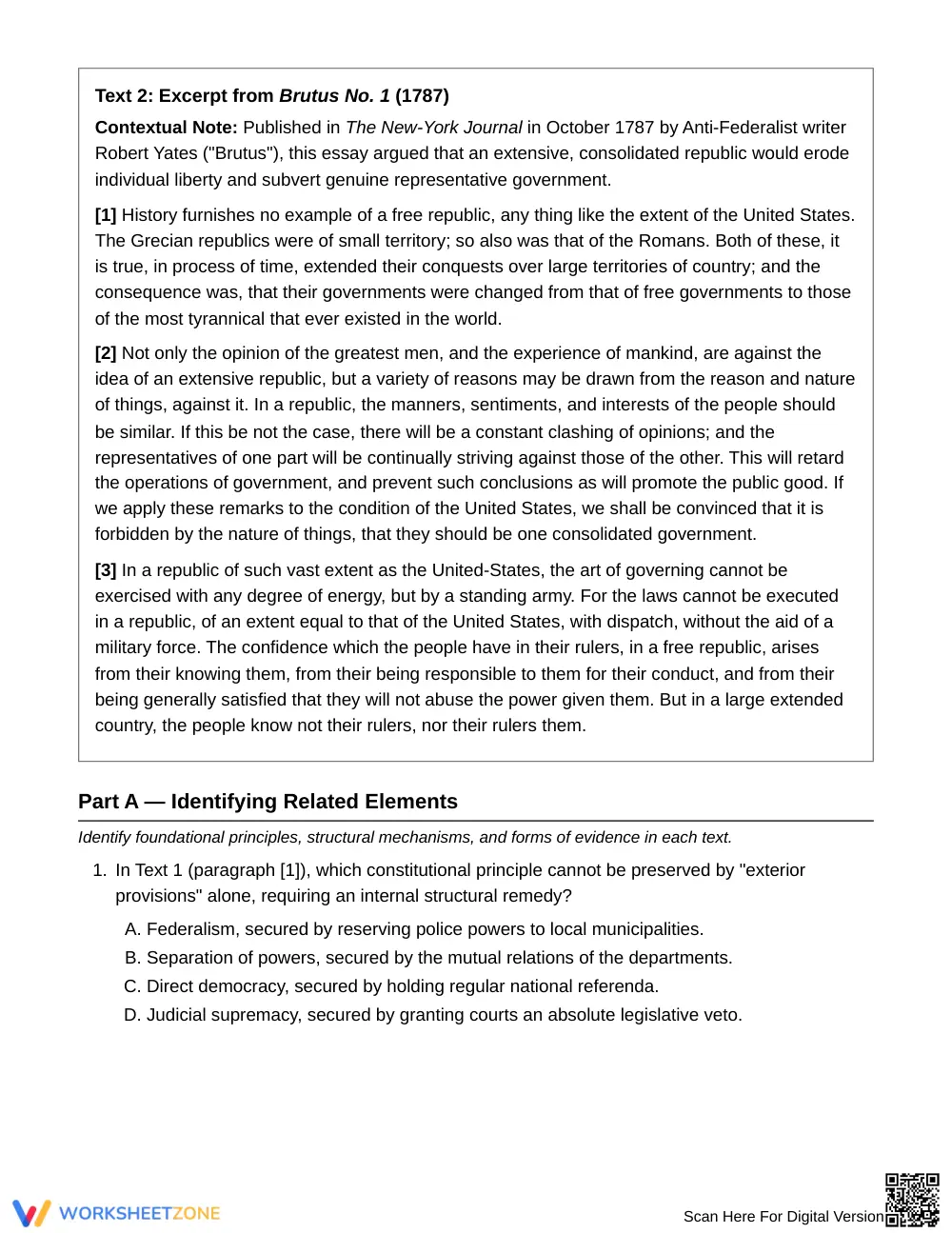
This Grade 11 English III worksheet trains students to analyze foundational political texts by connecting institutional structures to underlying philosophical principles and evidence. Learners evaluate paired excerpts from Madison's Federalist No. 51 and Yates's Brutus No. 1 to critique competing constitutional arguments.
At a Glance
- Grade: 11 · Subject: English III
- Standard:
RI.11-12.8— Evaluate reasoning and premises in seminal United States foundational texts- Skill Focus: Connect Structure, Principle, and Evidence
- Format: 6 pages · 12 problems · Answer key included · PDF
- Best For: Paired seminal text rhetorical analysis
- Time: 45–60 minutes
What's Inside: The resource provides paired primary texts alongside an analytical checklist outlining principles, structures, and evidence. Across 6 pages, students complete 12 structured tasks spanning multiple-choice questions, targeted analytical items, and comparative synthesis prompts. A detailed 3-page answer key provides model rationales and evidence citations.
Skill Progression
- Guided Practice: Part A (Tasks 1–3) uses an orienting checklist and multiple-choice questions to identify structural mechanisms and historical evidence.
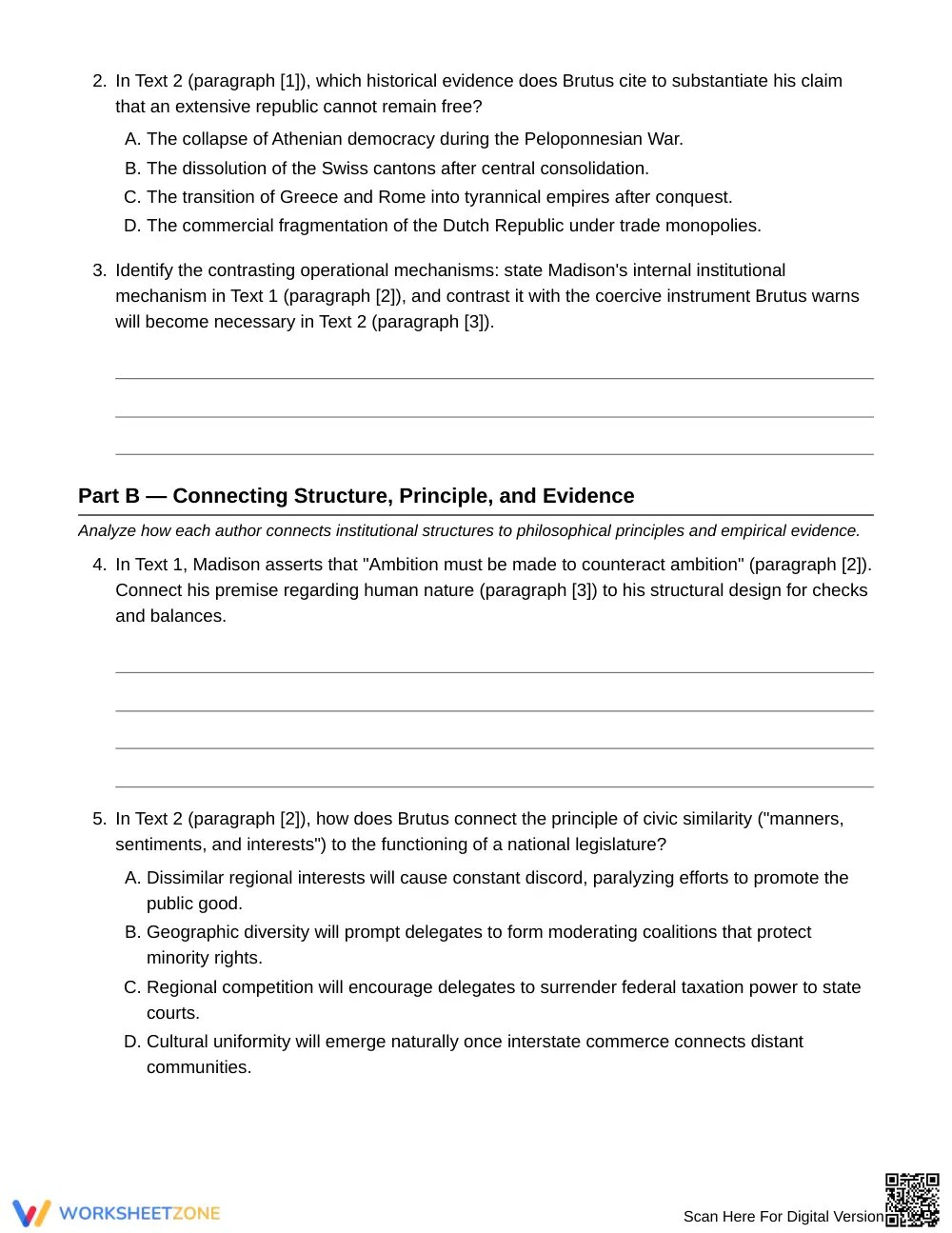
- Supported Practice: Part B (Tasks 4–9) provides focused constructed-response prompts connecting human nature premises to checks, balances, and military coercion.
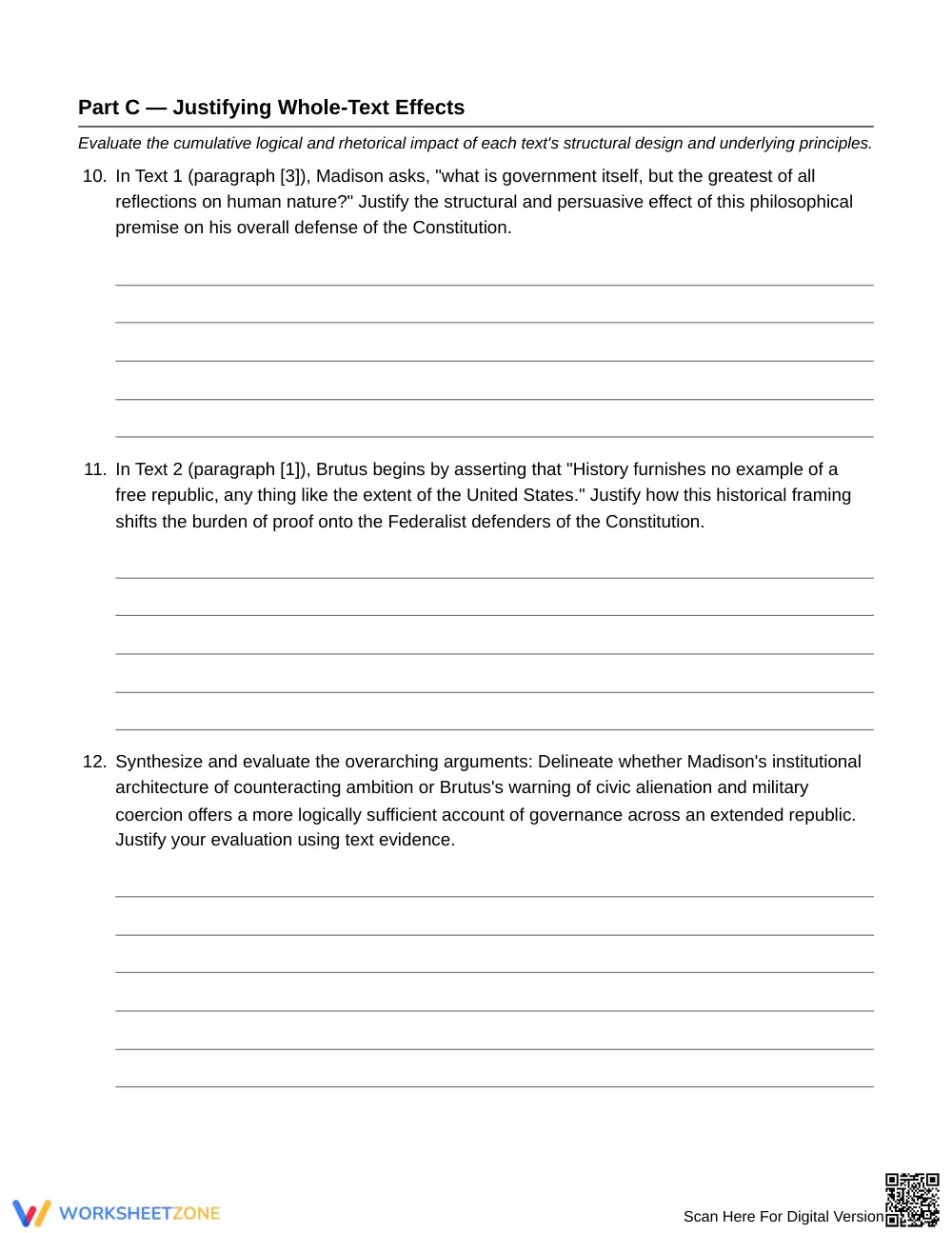
- Independent Practice: Part C (Tasks 10–12) requires open evaluative synthesis to judge the overall logical sufficiency of each author's constitutional framework.
This sequence mirrors the gradual release of responsibility model, guiding students toward independent text evaluation.
Standards Alignment
This worksheet aligns with RI.11-12.8: Delineate and evaluate the reasoning in seminal U.S. texts, including constitutional principles and legal reasoning. It supports RI.11-12.1 through rigorous text-based evidence citation. Both standard codes can be copied directly into lesson plans, IEP goals, or district curriculum mapping tools.
How to Use It
Use this resource after direct instruction on early American constitutional debates. For in-class practice, assign Parts A and B for collaborative partner work before students complete Part C independently within a 45–60 minute block. For formative assessment, check Part B to confirm students distinguish deductive axioms from empirical claims.
Who It's For
This worksheet suits Grade 11 English III and AP Language students reading complex eighteenth-century prose. Differentiate by using the text checklist for scaffolding or prompting advanced students to evaluate unspoken counterarguments. Pair this activity with a primary source reading of the U.S. Constitution.
Standard RI.11-12.8 requires eleventh-grade students to evaluate reasoning and premises in seminal United States informational texts. Educational research by Fisher & Frey (2014) demonstrates that adolescent readers master complex historical arguments when explicit instructional scaffolds connect abstract philosophical claims to operational evidence. This 6-page worksheet accomplishes this through 12 structured tasks analyzing James Madison's Federalist No. 51 and Robert Yates's Brutus No. 1. Students examine how underlying views of human nature dictate constitutional structures, such as institutional checks versus standing armies. By advancing from targeted element identification to rigorous comparative synthesis, learners develop the analytical capacity necessary to evaluate logical sufficiency and rhetorical effectiveness. A thorough 3-page answer key establishes clear mastery criteria, making this rigorous, standards-aligned instructional resource an essential asset for secondary English language arts educators fostering critical analytical literacy.


