




























Views
Downloads

Essential Grade 5 Properties of Light Printable Worksheet

Paste this activity's link or code into your existing LMS (Google Classroom, Canvas, Teams, Schoology, Moodle, etc.).
Students can open and work on the activity right away, with no student login required.
You'll still be able to track student progress and results from your teacher account.
Exploring the Properties of Light
Exploring the Properties of Light. This Grade 5 science worksheet provides a structured way for students to explore how light travels and reflects. By investigating the speed of light compared to sound and performing a hands-on mirror task, learners build a concrete understanding of physical science phenomena. It ensures immediate engagement and concept mastery.
At a Glance
- Grade: 5 · Subject: Science
- Standard:
4-PS4-2— Describe how light reflecting from objects allows them to be seen by the eye- Skill Focus: Properties of Light (Reflection, Speed)
- Format: 2 pages · 3 tasks · Answer key included · PDF
- Best For: Independent practice or a science sub plan
- Time: 15–25 minutes
What's Inside
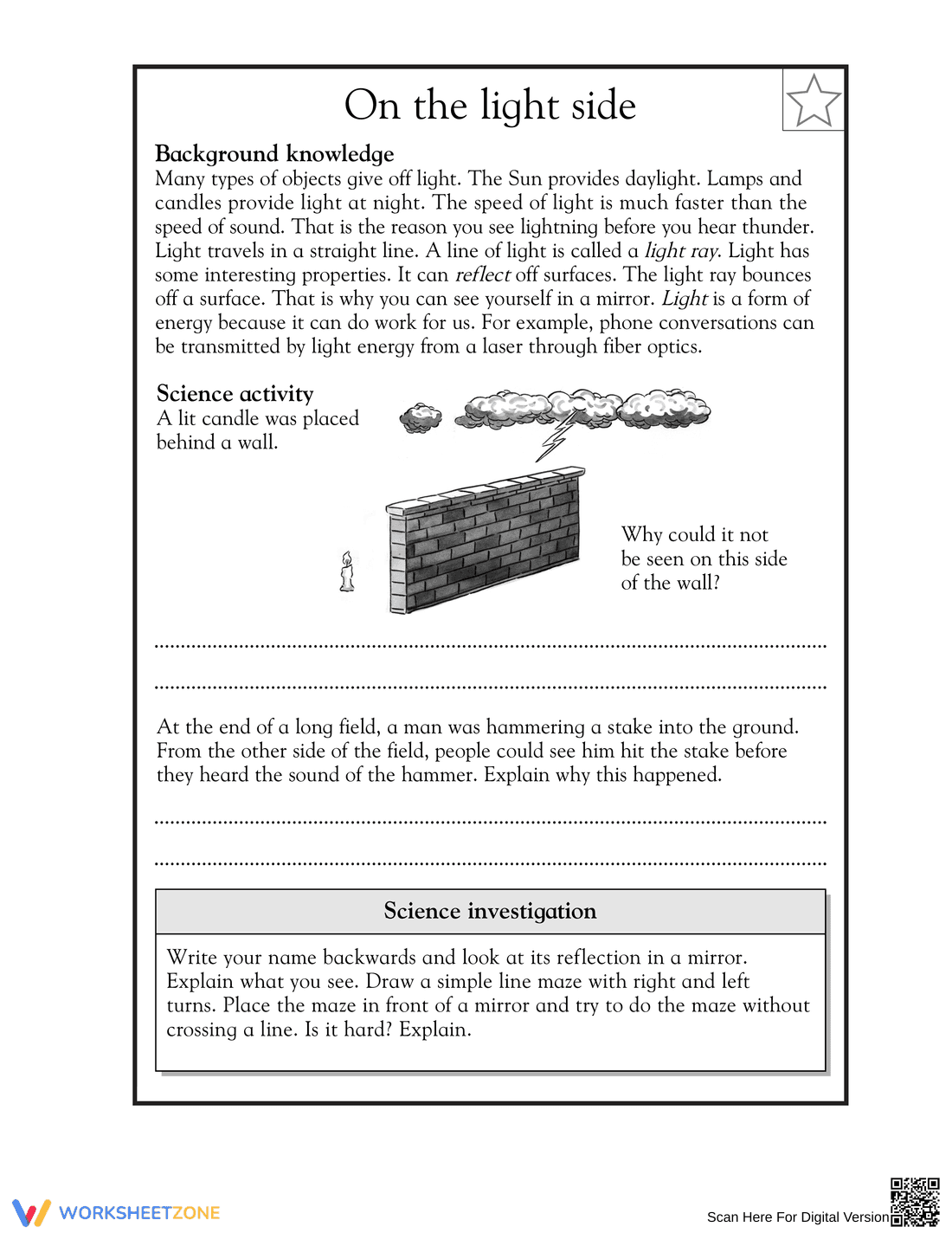
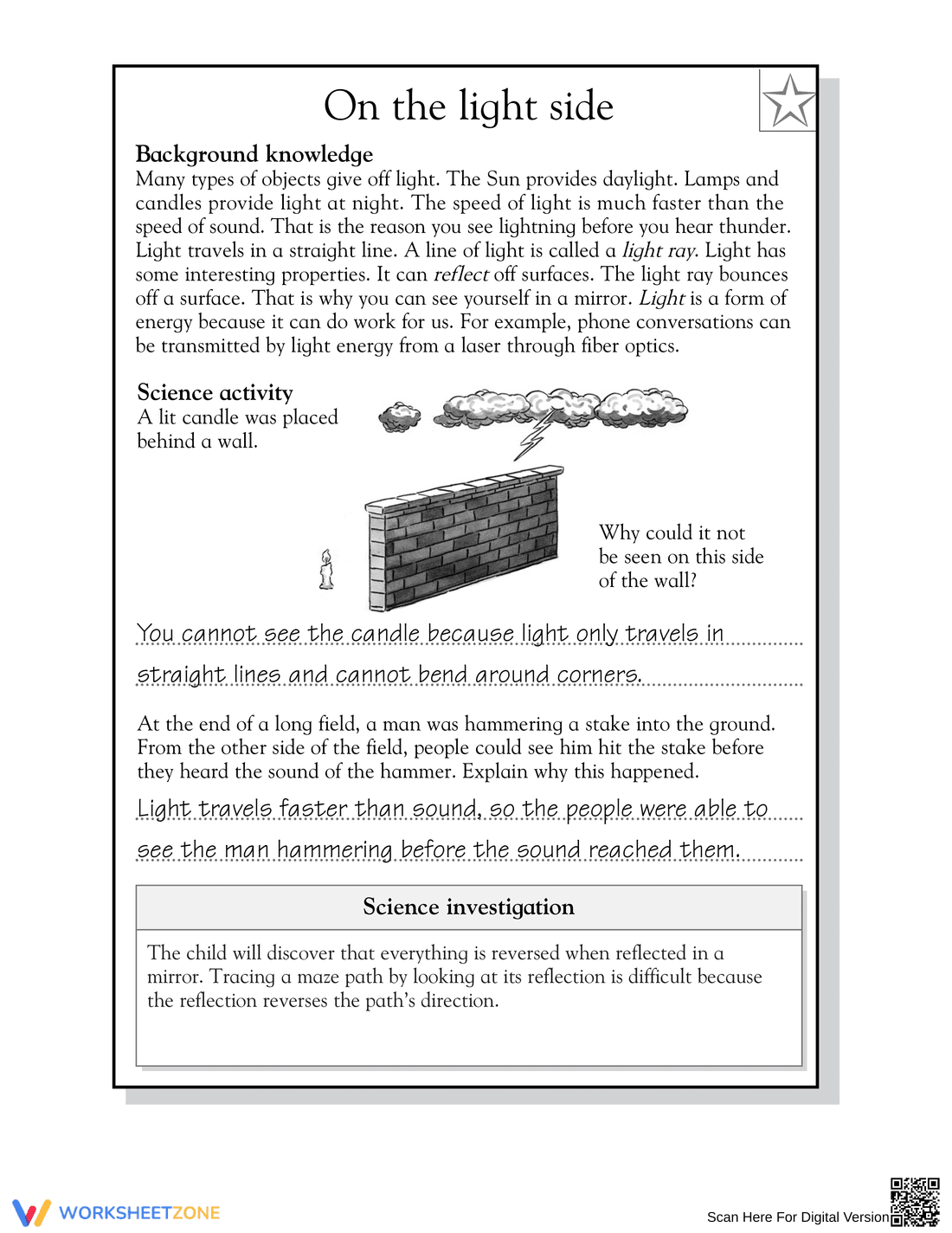
This two-page resource is designed for efficiency. Page one contains "Background knowledge" defining light rays and energy, followed by three tasks: a problem regarding light blocked by a wall, a comparative analysis of light versus sound speed, and a hands-on mirror investigation. Page two features a comprehensive answer key with sample responses.
A Zero-Prep Workflow for Teachers
Designed for busy classrooms, this print-and-go worksheet minimizes teacher preparation while maximizing student learning time. The workflow follows three efficient steps:
- Print (1 minute): Generate one copy per student of the activity sheet and the included teacher answer key for reference.
- Distribute (1 minute): Hand out the sheets; the embedded background text allows students to begin immediately without a long lecture.
- Review (5-10 minutes): Use the answer key to facilitate a class discussion on the mirror investigation findings.
Standards Alignment
This resource is explicitly aligned with NGSS 4-PS4-2: "Develop a model to describe that light reflecting from objects and entering the eye allows objects to be seen." By asking students to explain why a candle cannot be seen behind a wall and how mirrors reverse images, the worksheet forces students to model the path of light rays. This standard code can be copied directly into lesson plans, IEP goals, or district curriculum mapping tools.
How to Use It
This versatile worksheet serves as an excellent formative assessment after an initial lesson on energy. Teachers should observe students during the mirror maze investigation to identify misconceptions about reflection and light paths. The activity is also ideal for a zero-prep sub plan, as the self-contained text provides all necessary information for successful completion within a standard 25-minute science block.
Who It's For
This worksheet is tailored for Grade 5 students but remains accessible for younger learners or those needing extra literacy support in science. The inclusion of a background knowledge section provides a necessary scaffold for students who may have missed previous instruction. It pairs naturally with a classroom demonstration using a flashlight and various reflective surfaces to reinforce observations.
According to EdReports 2024, high-quality science instruction must bridge the gap between abstract theory and observable phenomena. This Grade 5 science worksheet achieves this by integrating a hands-on mirror investigation directly into the practice set. By requiring students to explain the physics of image reversal and the difference between light and sound propagation, the resource supports deep conceptual shifts. The focus on NGSS 4-PS4-2 ensures that learners are not just reading about light, but are actively describing the mechanism of vision through reflection. This evidence-based approach to scientific literacy provides teachers with a reliable tool for gauging student progress in physical science. The inclusion of an answer key ensures that feedback is immediate, which is critical for correcting misconceptions about how light energy interacts with matter. This resource provides an essential solution for standards-based classroom practice.


