


























Views
Downloads

Essential Grade 2 Properties and Uses Science Worksheet
Paste this activity's link or code into your existing LMS (Google Classroom, Canvas, Teams, Schoology, Moodle, etc.).
Students can open and work on the activity right away, with no student login required.
You'll still be able to track student progress and results from your teacher account.
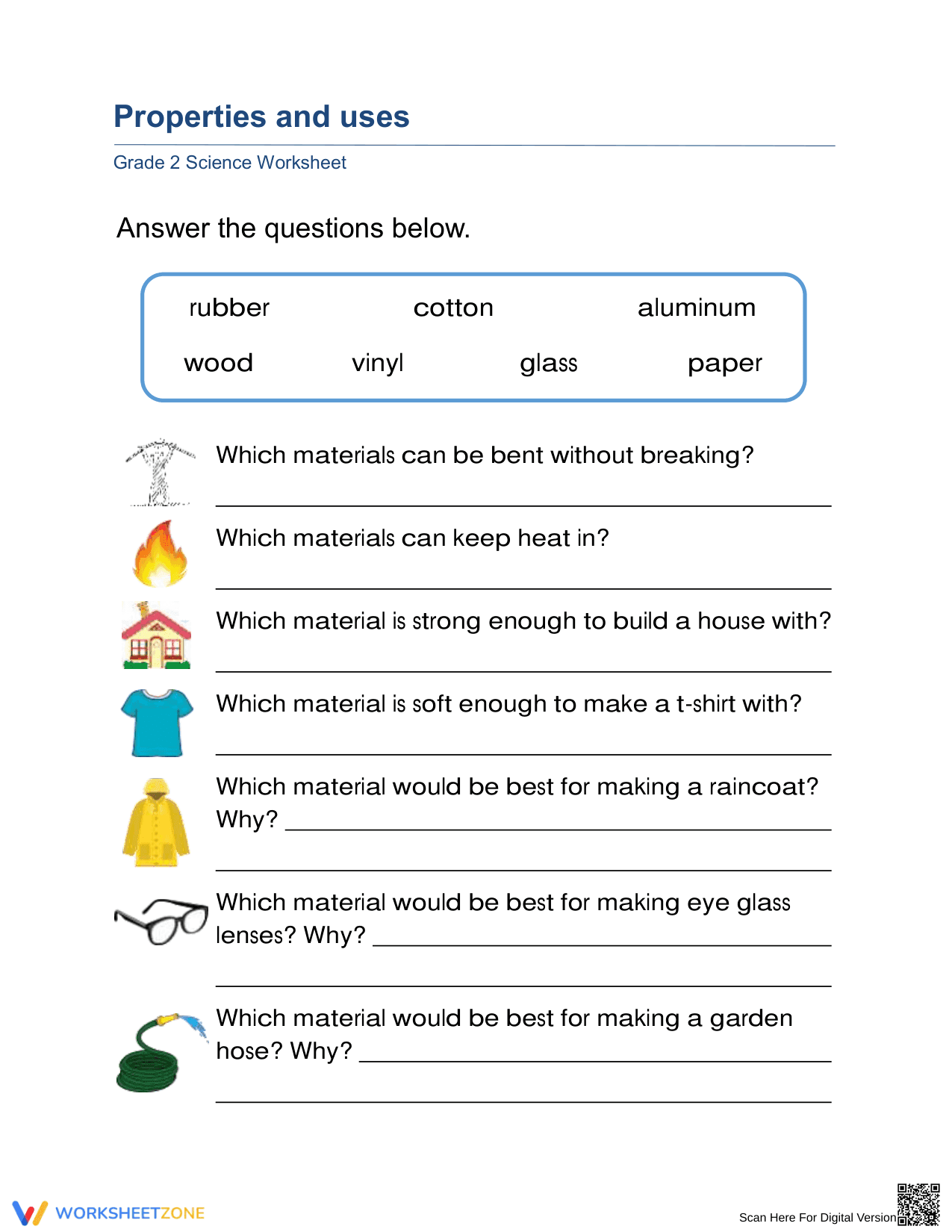
This Grade 2 science worksheet helps students connect the physical properties of materials to their practical real-world applications. By analyzing a word bank of common substances like rubber, cotton, and wood, learners determine which materials are best suited for specific tasks. This exercise builds foundational scientific reasoning and critical thinking skills regarding the world around us.
At a Glance
- Grade: 2 · Subject: Science
- Standard:
2-PS1-2— Analyze material properties to determine which are best suited for an intended purpose- Skill Focus: Properties and Uses of Materials
- Format: 1 page · 7 problems · Answer key included · PDF
- Best For: Introduction to matter or formative assessment
- Time: 15–20 minutes
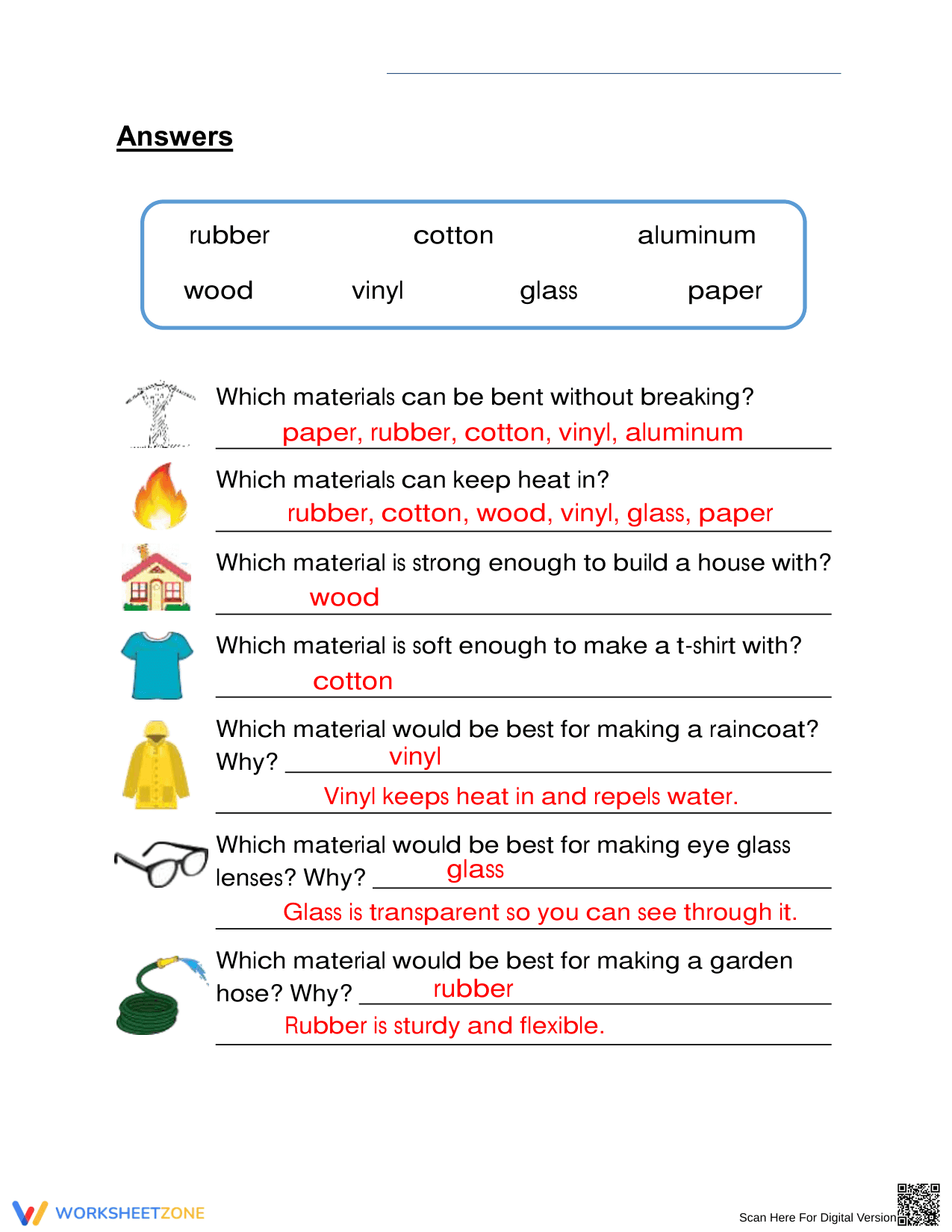
The worksheet features a focused layout containing a word bank of seven distinct materials: rubber, cotton, aluminum, wood, vinyl, glass, and paper. Students are presented with seven investigative questions ranging from simple identification to justifications for more complex uses like raincoats and eyeglass lenses. The single-page PDF format includes a comprehensive answer key for quick grading and feedback.
Zero-Prep Workflow
Teachers can implement this resource in under two minutes with a simple three-step workflow. First, print the single-page document for your entire class (1 minute). Second, distribute the sheets for independent work or as part of a science center rotation (30 seconds). Finally, review student answers using the included answer key for immediate assessment (30 seconds).
Standards Alignment
This resource is directly aligned with NGSS 2-PS1-2: "Analyze data obtained from testing different materials to determine which materials have the properties that are best suited for an intended purpose." It requires students to look at the characteristics of matter and apply that data to solve design problems. This code can be copied directly into lesson plans or curriculum mapping tools.
How to Use It
Use this worksheet as a concluding activity after a hands-on exploration of material textures. It serves as an excellent formative assessment to check if students understand why we choose specific materials for building or clothing. Teachers should observe if students can explain the reasons for their choices, as this indicates a mastery of material science principles. Completion typically takes 20 minutes.
Who It's For
This printable is designed for Grade 2 students but is also appropriate for Grade 1 enrichment or Grade 3 review. It supports diverse learners through a clear word bank and visual icons for each prompt. It pairs naturally with a physical "materials bin" where students can touch the items listed in the word bank before starting the written task.
The NGSS 2-PS1-2 standard emphasizes that students must move beyond simple identification of materials to understanding the relationship between physical properties and functional utility. According to NAEP, early exposure to material science through structured classification and application tasks significantly improves a student's ability to engage in engineering design later in their academic career. This worksheet facilitates that bridge by asking students to justify their selections for items like hoses and lenses, moving them from rote recall to evidence-based reasoning. By requiring students to analyze seven different materials against specific constraints, the resource aligns with best practices in the ScienceDirect TpT Analysis regarding high-quality elementary science instruction. Teachers can use these findings to support the inclusion of properties-based lessons in their core curriculum, ensuring that Grade 2 learners meet the rigorous demands of national standards while developing a practical understanding of the physical world.


