































Printable Water Cycle Word Search | Grades 7–8 Science

Paste this activity's link or code into your existing LMS (Google Classroom, Canvas, Teams, Schoology, Moodle, etc.).
Students can open and work on the activity right away, with no student login required.
You'll still be able to track student progress and results from your teacher account.
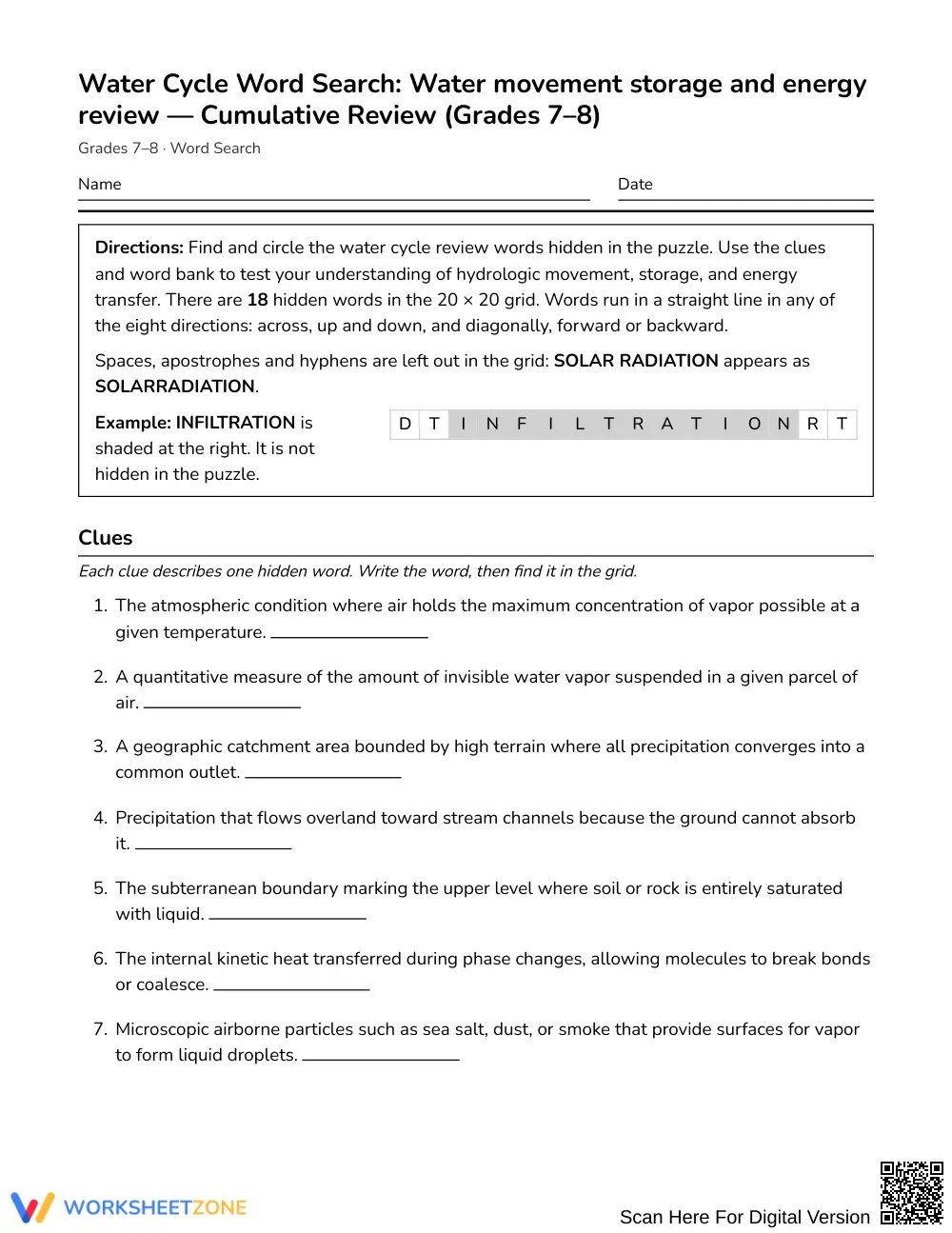
This water cycle review word search reinforces critical Earth science vocabulary across hydrologic movement, reservoir storage, and thermal energy transfer. Students review foundational terms by connecting definitions to targeted search terms, consolidating their grasp of complex planetary processes while actively building content-area retention for Grades 7–8 science classrooms.
At a Glance
- Grade: Grades 7–8 · Subject: Science
- Standard: Not standards-assessed — vocabulary enrichment
- Skill Focus: Water movement storage and energy transfer review
- Format: 3 pages · 18 words · Full answer key included · Printable PDF
- Best For: Cumulative vocabulary review, station work, and unit consolidation
- Time: 20–35 minutes of focused student work
What's Inside
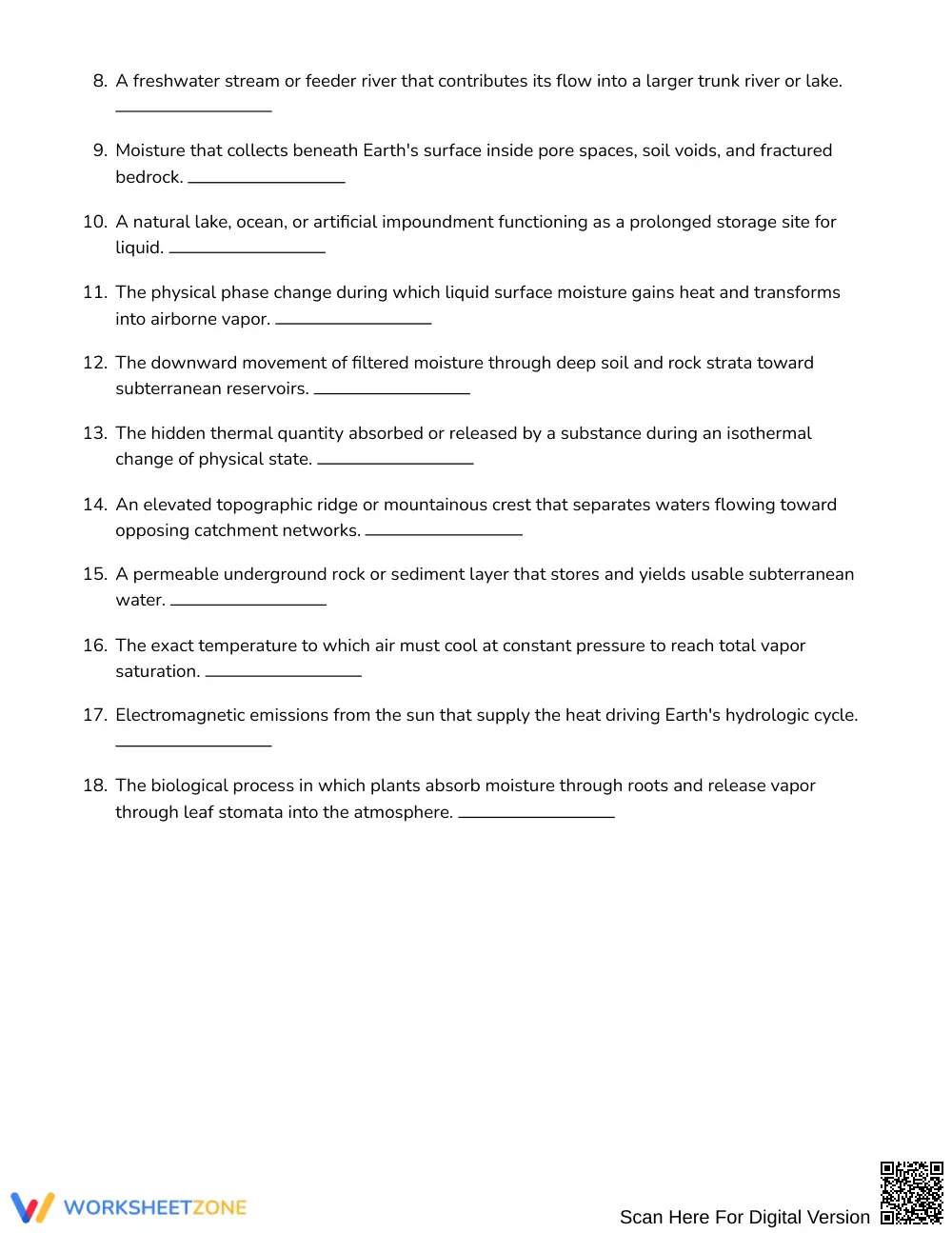
This 3-page science resource features a comprehensive 20 by 20 letter grid containing 18 hidden vocabulary terms related to the hydrologic cycle. Accompanying the grid is a complete set of scientific clues defining essential concepts like percolation, transpiration, and latent heat alongside a shuffled word bank. A 4-page answer key provides clear solution paths for quick verification.
Puzzle Mechanics
The activity delivers engaging vocabulary reinforcement through a carefully arranged puzzle structure:
- Grid Dimensions: A spacious 20 by 20 letter grid accommodates multi-word terms and provides substantial visual scanning practice.
- Search Orientations: Words run in all 8 compass directions—north, northeast, east, southeast, south, southwest, west, and northwest—offering an appropriate cognitive challenge.
- Clues and Word Bank: Students utilize a shuffled word bank supported by content-rich definitions that require learners to pair scientific descriptions with hydrologic vocabulary.
Standards Alignment
This word search serves as targeted vocabulary enrichment rather than direct standards assessment. While not formally aligned to an individual state standard code, it supports cumulative literacy and terminology recall across middle school Earth and space science curricula by reinforcing the academic language of hydrologic cycles.
How to Use It
Deploy this word search as an engaging mid-unit checkpoint after direct instruction on phase changes and groundwater systems, or assign it as an independent station during cumulative review week. During completion, conduct formative observation by noting whether students identify terms directly from memory or refer back to the contextual clues to confirm scientific definitions. Learners typically finish the activity within 20 to 35 minutes.
Who It's For
This puzzle is designed for Grades 7–8 science students reviewing hydrologic systems. It offers accessible entry for struggling readers through structured definitional clues while challenging advanced students to scan dense 8-directional paths. Pair this word search with a diagram labeling activity or an interactive water cycle anchor chart for comprehensive reinforcement.
Vocabulary acquisition forms the bedrock of conceptual mastery in middle school Earth science, particularly when students must connect abstract energy mechanisms to observable physical phenomena. As highlighted in research by Fisher & Frey (2014), purposeful vocabulary reinforcement that pairs explicit definitions with interactive retrieval tasks significantly enhances domain-specific reading comprehension and long-term memory consolidation. This water cycle review word search targets 18 essential scientific terms covering subterranean water movement, atmospheric storage, and thermal phase changes. Because the resource functions as vocabulary enrichment rather than formal standards-based testing, it gives middle school learners a low-stakes environment to decode complex terminology, recognize multi-word scientific expressions, and solidify technical language. Incorporating structured word banks alongside definitional clues bridges the gap between passive recognition and active recall, ensuring students develop the robust scientific lexicon necessary for rigorous downstream inquiry and disciplinary literacy.


