































Printable Water Cycle Word Search | Grades 7–8 Science

Paste this activity's link or code into your existing LMS (Google Classroom, Canvas, Teams, Schoology, Moodle, etc.).
Students can open and work on the activity right away, with no student login required.
You'll still be able to track student progress and results from your teacher account.
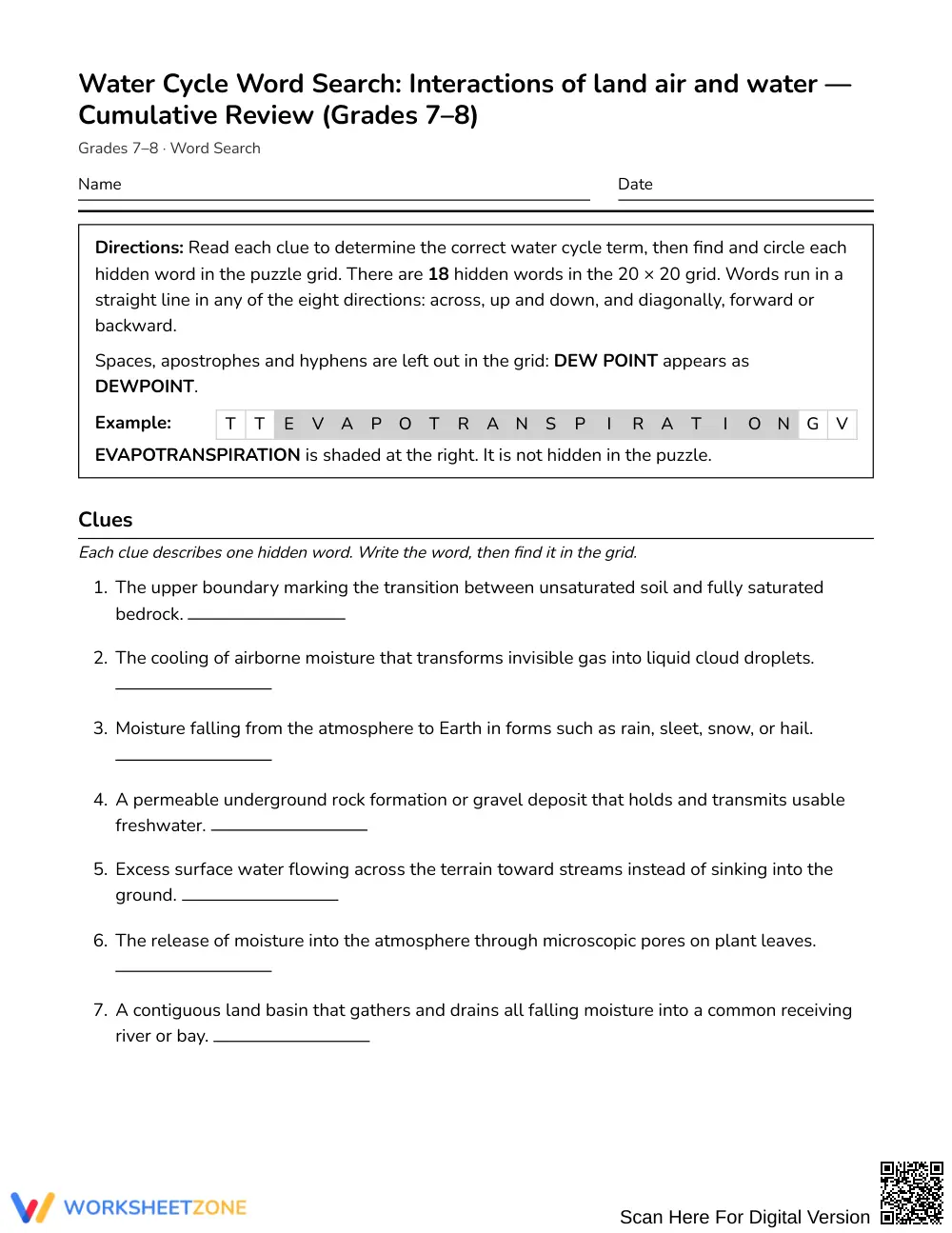
Boost learners’ mastery of water‑cycle vocabulary with this printable word search. Eighteen key terms describing the interactions of land, air, and water are hidden in a 20 × 20 grid, giving Grades 7–8 Science students a focused, engaging way to reinforce concepts while having fun.
At a Glance
- Grade: Grades 7–8 · Subject: Science
- Standard:
Not standards-assessed — vocabulary enrichment— students locate and label water‑cycle terms- Skill Focus: interactions of land, air, and water · key ecosystem processes
- Format: 3 pages · 18 hidden words · Answer key included · PDF printable
- Best For: quick review, cumulative assessment, or independent practice
- Time: 10–15 minutes · suitable for a single class period
The activity spans three PDF pages: a cover with instructions, the 20 × 20 puzzle grid, and a separate answer key page. Each of the 18 vocabulary words appears once, placed horizontally, vertically, or diagonally in any of the eight compass directions. A shuffled word bank and detailed clues guide learners toward each term.
Students work individually to scan the 20 × 20 grid, searching for each term in the eight possible directions—north, northeast, east, southeast, south, southwest, west, and northwest. The shuffled word bank lists all 18 target words, and the accompanying clues provide definitions that help locate the correct entries. Once a word is found, learners circle it and then verify their selections against the answer key.
The content serves as pure vocabulary enrichment and is not aligned to any state or national standard. Its purpose is to deepen learners’ understanding of water‑cycle terminology without the constraints of formal assessment criteria.
Use the word search as a warm‑up activity before a lesson on the water cycle, allowing students to activate prior knowledge while you introduce new concepts. Alternatively, assign it as an independent practice at the end of a unit; quickly scan the completed grids to gauge vocabulary retention and note any misconceptions for immediate feedback.
This resource targets Grades 7–8 Science learners studying the water cycle, offering a self‑contained vocabulary drill that supports both remedial review and enrichment. No differentiation levels are required, but teachers can pair the activity with a visual water‑cycle diagram or an anchor‑chart of the terms for added context.
Research shows that focused vocabulary activities, such as word searches, improve retention of scientific terminology, especially when learners connect terms to real‑world processes (Fisher & Frey, 2014). This Water Cycle Word Search reinforces the essential skill of describing interactions of land, air, and water by requiring students to locate and label each concept within a challenging grid. The inclusion of clear, definition‑based clues aligns with evidence‑based practices that support deeper semantic processing. Moreover, the eight‑direction search format challenges spatial reasoning, reinforcing the interdisciplinary nature of earth‑science learning. While the activity is not tied to a formal standard, it serves as an effective enrichment tool that can be smoothly integrated into any Grade 7–8 Science curriculum. Teachers report increased engagement and quicker mastery of key water‑cycle vocabulary when such interactive puzzles are used as a review or assessment‑free practice.


