





























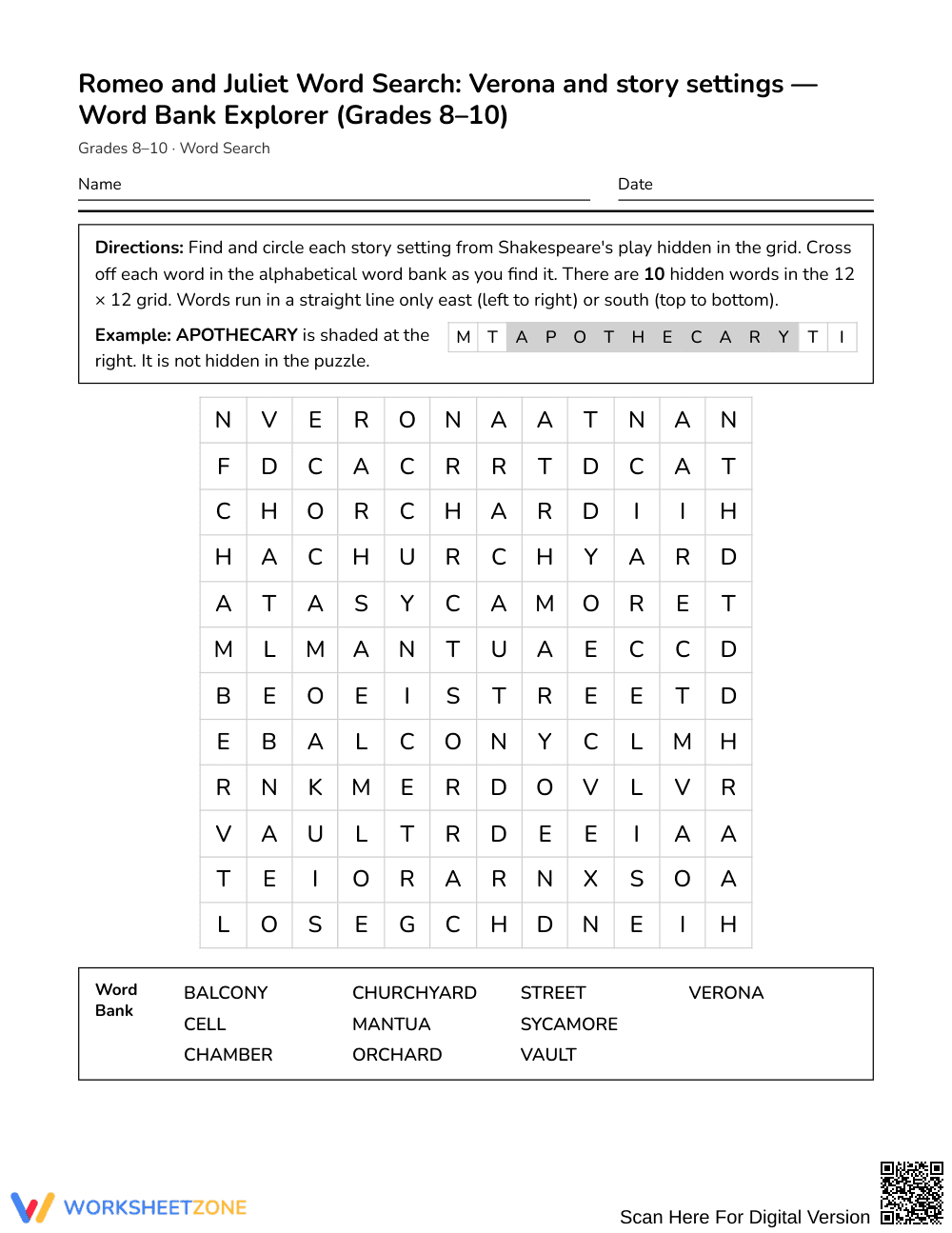


Printable Verona Settings Word Search | Grades 8–10 ELA

Paste this activity's link or code into your existing LMS (Google Classroom, Canvas, Teams, Schoology, Moodle, etc.).
Students can open and work on the activity right away, with no student login required.
You'll still be able to track student progress and results from your teacher account.
This Grades 8–10 English Language Arts word search builds foundational familiarity with the central locations of William Shakespeare's Romeo and Juliet. Students locate key setting terms across Verona and Mantua, reinforcing spatial and dramatic contexts that anchor pivotal plot points and thematic developments throughout the tragic play.
At a Glance
- Grade: Grades 8–10 · Subject: ELA
- Standard: Not standards-assessed — vocabulary enrichment
- Skill Focus: Verona and story settings
- Format: 1 page · 10 words · Answer key included · PDF
- Best For: Shakespeare setting vocabulary introduction
- Time: 15–20 minutes
What's Inside
This single-page puzzle delivers a focused literacy activity containing 10 hidden vocabulary words drawn directly from Shakespearean settings. The layout features an organized alphabetical word bank at the top for easy tracking and reference. A comprehensive 3-page answer key provides clear solution overlays showing exact letter coordinates for quick checking.
Puzzle Mechanics
The activity utilizes an accessible 12 by 12 letter grid designed for targeted visual scanning. All 10 vocabulary terms run strictly in two primary directions: East (horizontally from left to right) and South (vertically from top to bottom). Students scan the grid systematically to cross off each location from the alphabetical word bank.
Standards Alignment
This supplementary resource is designed specifically for thematic vocabulary enrichment and is not aligned to a formal standard. It supports secondary literature comprehension by reinforcing crucial dramatic environments—such as the Capulet orchard, Friar Laurence's cell, and the Verona streets—before students analyze complex textual scenes.
How to Use It
Deploy this activity before direct instruction as a pre-reading hook to introduce key story locations, or use it immediately after Act I to consolidate geographical awareness. As students scan the letter grid, conduct a brief formative assessment walk to verify that learners connect each term to its dramatic role. Typical student completion requires 15 to 20 minutes.
Who It's For
This word search is designed for Grades 8–10 secondary students studying introductory Shakespearean drama. It offers low-floor engagement for developing readers while providing concise contextual reinforcement for general English classrooms. For maximum instructional impact, pair this puzzle directly with a Verona map anchor chart or an introductory background slideshow.
According to research highlighted in Fisher & Frey (2014), intentional exposure to setting-specific vocabulary establishes cognitive anchors that enhance reading comprehension during complex literary study. When secondary students encounter unfamiliar archaic texts like Shakespeare's tragedies, pre-teaching core environmental nouns reduces extraneous cognitive load. This focused word search builds recognition of ten pivotal dramatic settings across Verona and Mantua, including the orchard, churchyard, and cell. By visually scanning an organized 12 by 12 grid and cross-referencing an alphabetical bank, students internalize the spatial vocabulary required to trace character movements and conflict escalation. Grounding readers in physical place prior to intensive scene analysis bridges basic recall and higher-level textual synthesis. The single-page format provides efficient, low-barrier vocabulary practice that reinforces literary study without replacing rigorous textual interrogation.


