


























Views
Downloads

Printable Tracing Alleles Worksheet | Grade 9 Biology
Paste this activity's link or code into your existing LMS (Google Classroom, Canvas, Teams, Schoology, Moodle, etc.).
Students can open and work on the activity right away, with no student login required.
You'll still be able to track student progress and results from your teacher account.
This worksheet teaches Grade 9 Biology students to trace alleles from parents to offspring and from offspring back to parents. Students reason through gametes, fertilization, and dominance using fictional organisms, so they predict possible genotypes and justify conclusions in terms of alleles rather than memorized patterns.
At a Glance
- Grade: 9 · Subject: Biology
- Standard: Genetics and heredity — trace alleles through gametes and fertilization to explain offspring traits.
- Skill Focus: Tracing alleles from parents to offspring
- Format: 5 pages · 10 problems · Answer key included · PDF
- Best For: Genetics practice after introducing inheritance
- Time: 35–45 minutes
What's Inside
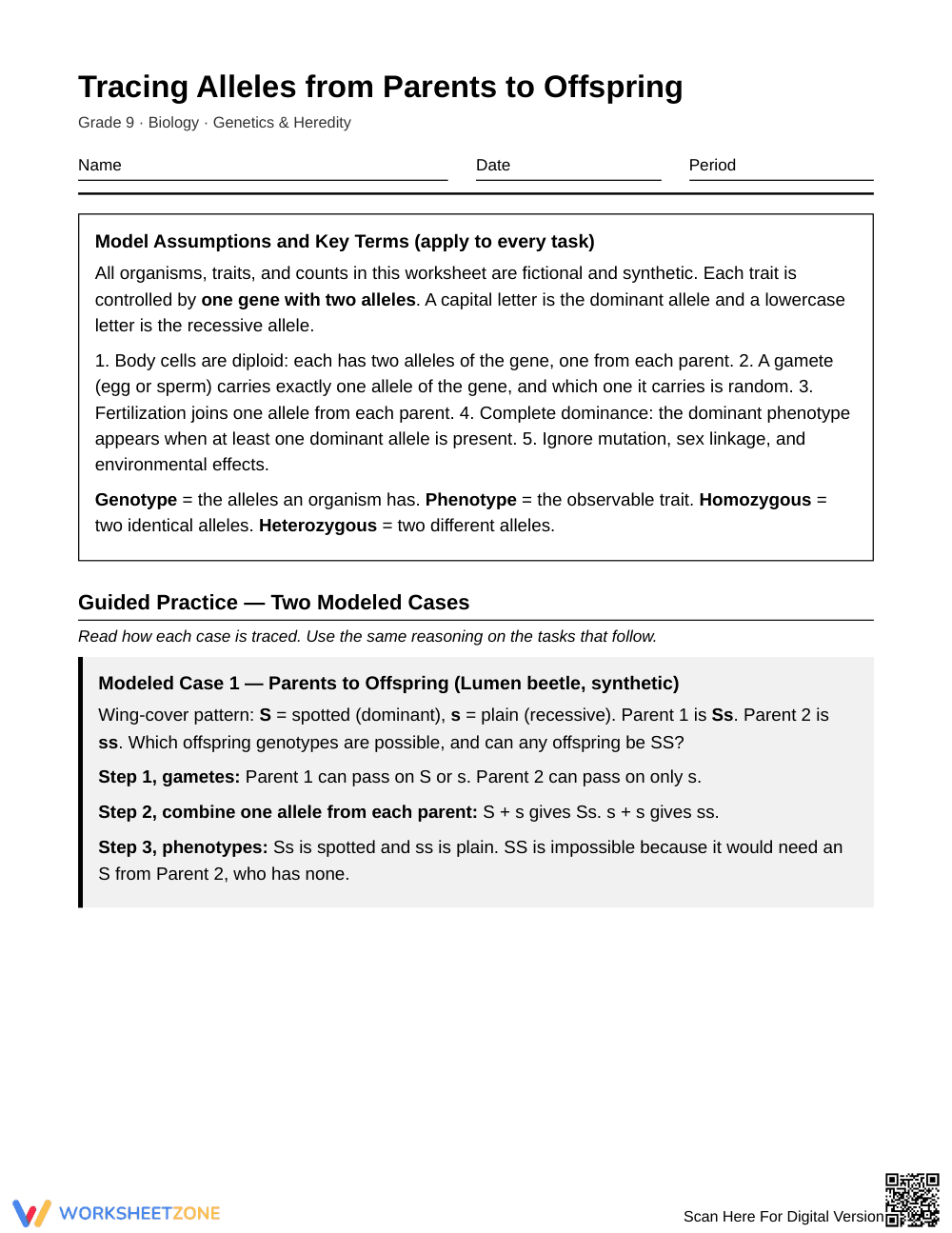
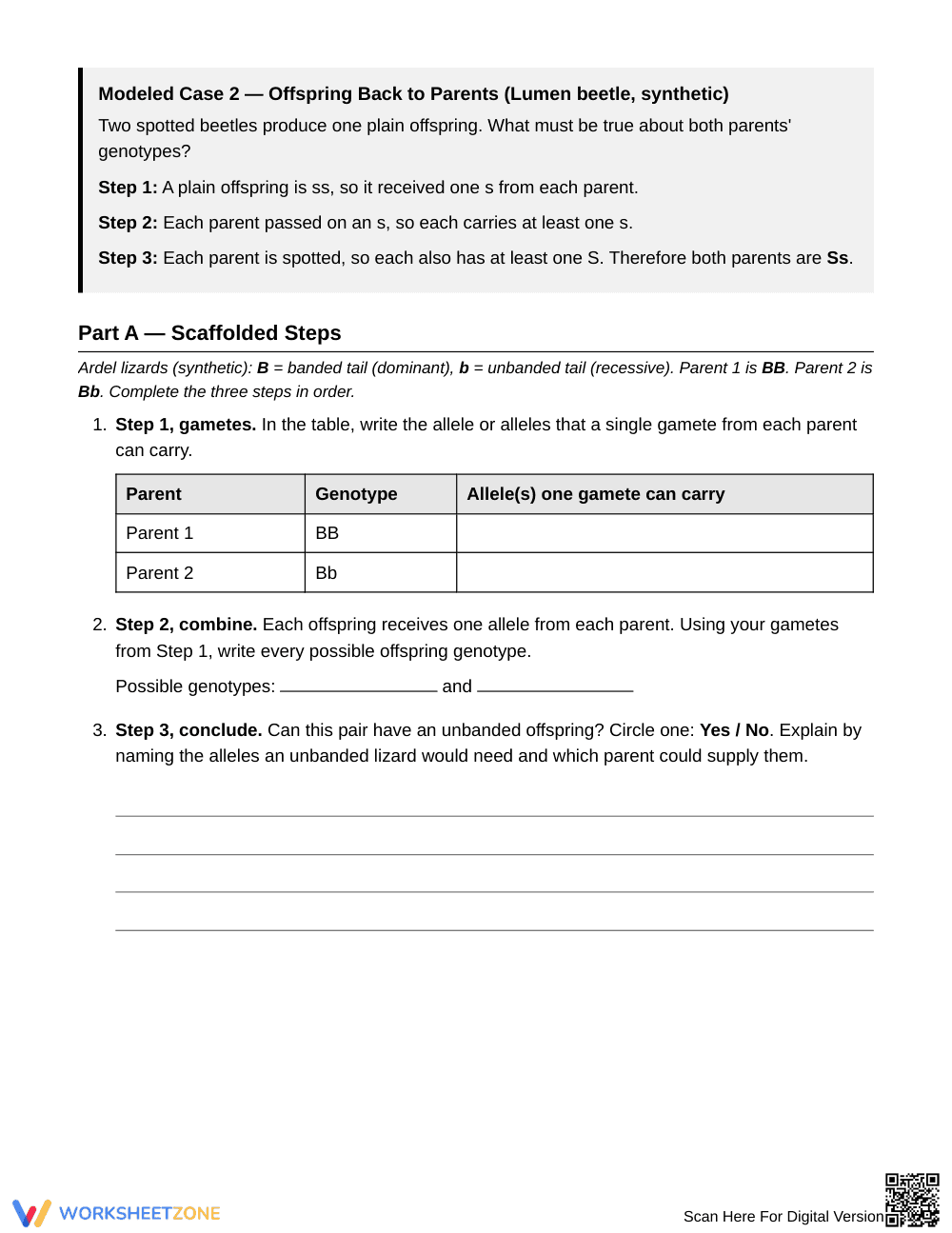
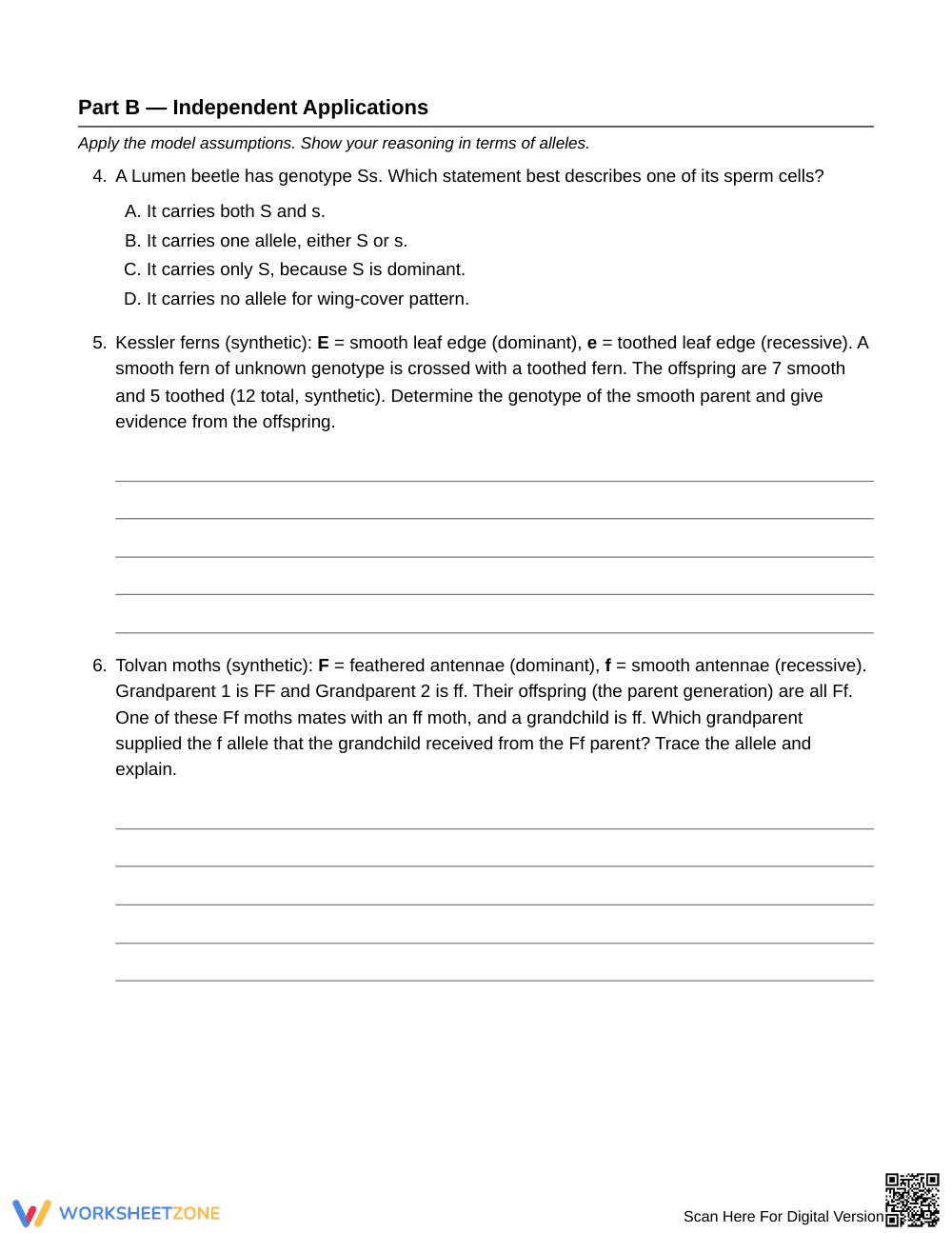
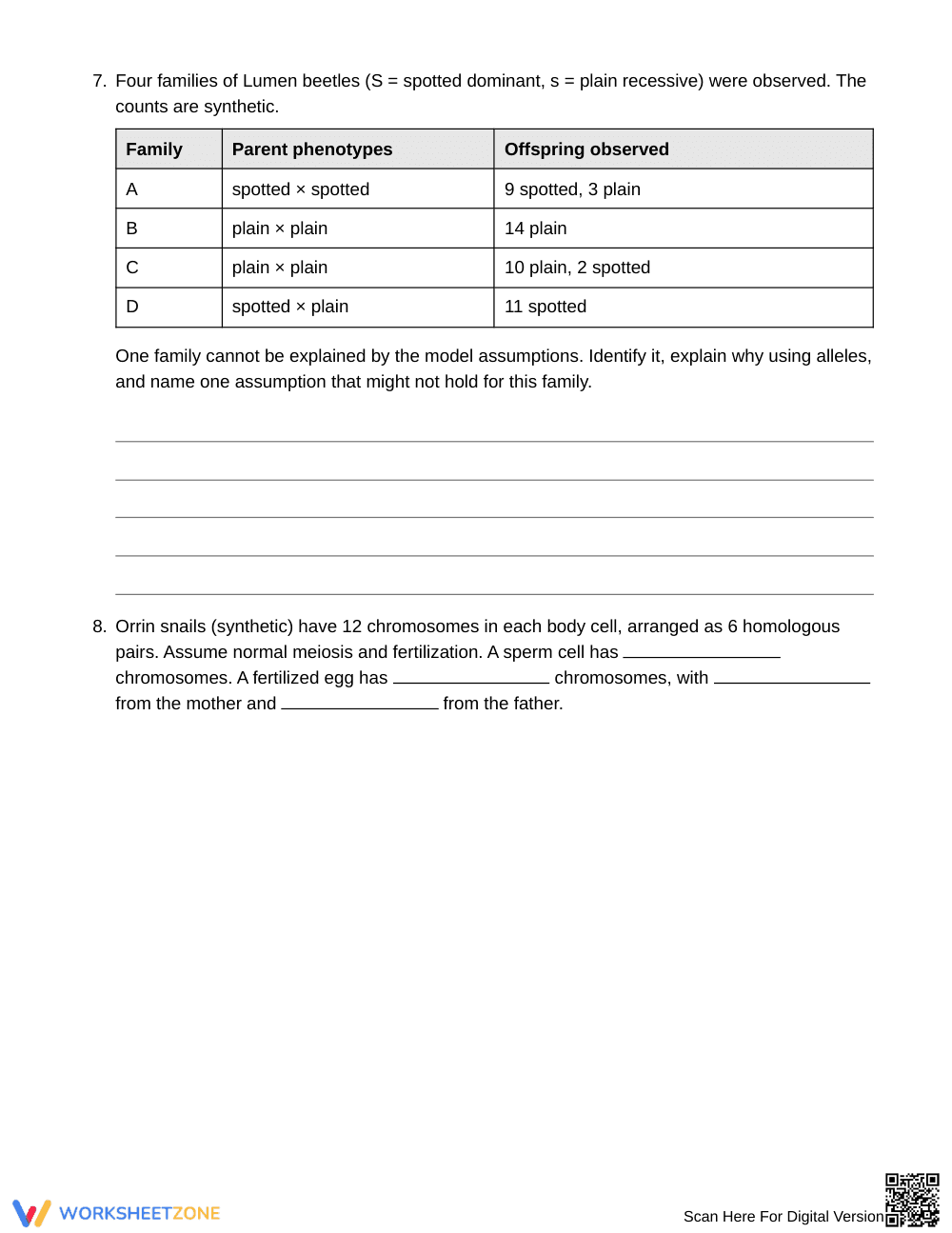
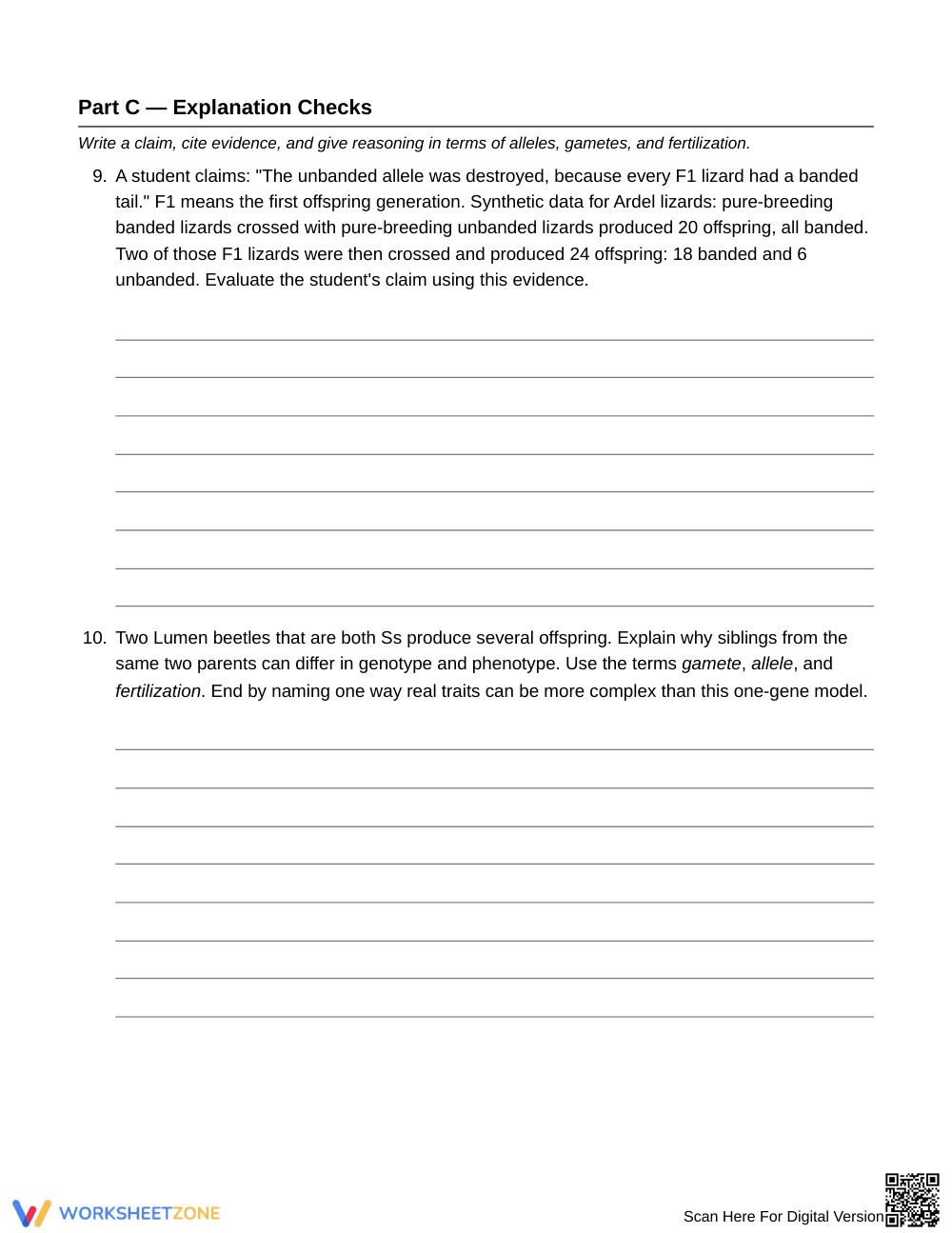
The packet runs 5 pages and opens with a box of model assumptions and key terms: diploid cells, one-allele gametes, complete dominance, and no mutation or sex linkage. Two modeled cases follow. Students then complete a scaffolded gamete table, multiple-choice, data-table, and short-response tasks, and finish with claim-evidence-reasoning explanations. A 2-page answer key is included. All organisms and counts are fictional.
Skill Progression
- Guided practice: Two modeled cases (parents to offspring, then offspring back to parents) and Part A, which breaks one cross into gametes, combination, and conclusion with a fill-in table.
- Supported practice: Part B applies the model to a gamete question, a test-cross, a three-generation trace, a four-family data table, and a chromosome-count item.
- Independent practice: Part C asks students to evaluate a student claim using F1 and F2 data, and to explain why siblings differ.
The sequence follows a gradual-release model: I Do, We Do, You Do.
Standards Alignment
This worksheet supports high school life science expectations that students use models of inheritance to explain how genetic information passes from parents to offspring through gametes and fertilization, and how that produces variation among siblings. Students also use evidence to evaluate claims about dominant and recessive alleles. Add your local standard code when copying this into lesson plans, IEP goals, or district curriculum mapping tools.
How to Use It
- During instruction: Work through the two modeled cases together, then have students complete Part A in pairs. While they work, watch whether each student lists one allele per gamete rather than two.
- After instruction: Assign Parts B and C as independent practice or a formative check. Look for answers that name specific alleles and the parent who supplied them.
Expect 35–45 minutes for the full packet, or split it across two shorter sessions.
Who It's For
This worksheet suits Grade 9 Biology students in a genetics and heredity unit, including those meeting Punnett-style reasoning for the first time. The scaffolded Part A supports students who need structure, while the data-table and explanation tasks challenge those ready for more. Pair it with a short direct-instruction lesson on meiosis and gametes, or an allele vocabulary anchor chart.
Tracing Alleles from Parents to Offspring is a Grade 9 Biology worksheet in which students use a one-gene, two-allele model to explain how alleles pass through gametes and fertilization. Its 10 problems move from two modeled cases to a scaffolded cross, independent applications, and claim-evidence-reasoning explanations, with a 2-page answer key. The structure reflects the gradual release of responsibility described by Fisher & Frey (2014), in which teachers model thinking, guide shared practice, and then release students to work independently. Fictional organisms keep attention on reasoning with alleles rather than recalling real species facts. Students decide which genotypes are possible, infer unknown parent genotypes from offspring evidence, identify data that break the model's assumptions, and explain why siblings differ. The worksheet works well as classroom practice, homework, or a formative check during a genetics unit.


