





























Printable Text Structure Worksheet | Grade 6 ELA
Paste this activity's link or code into your existing LMS (Google Classroom, Canvas, Teams, Schoology, Moodle, etc.).
Students can open and work on the activity right away, with no student login required.
You'll still be able to track student progress and results from your teacher account.
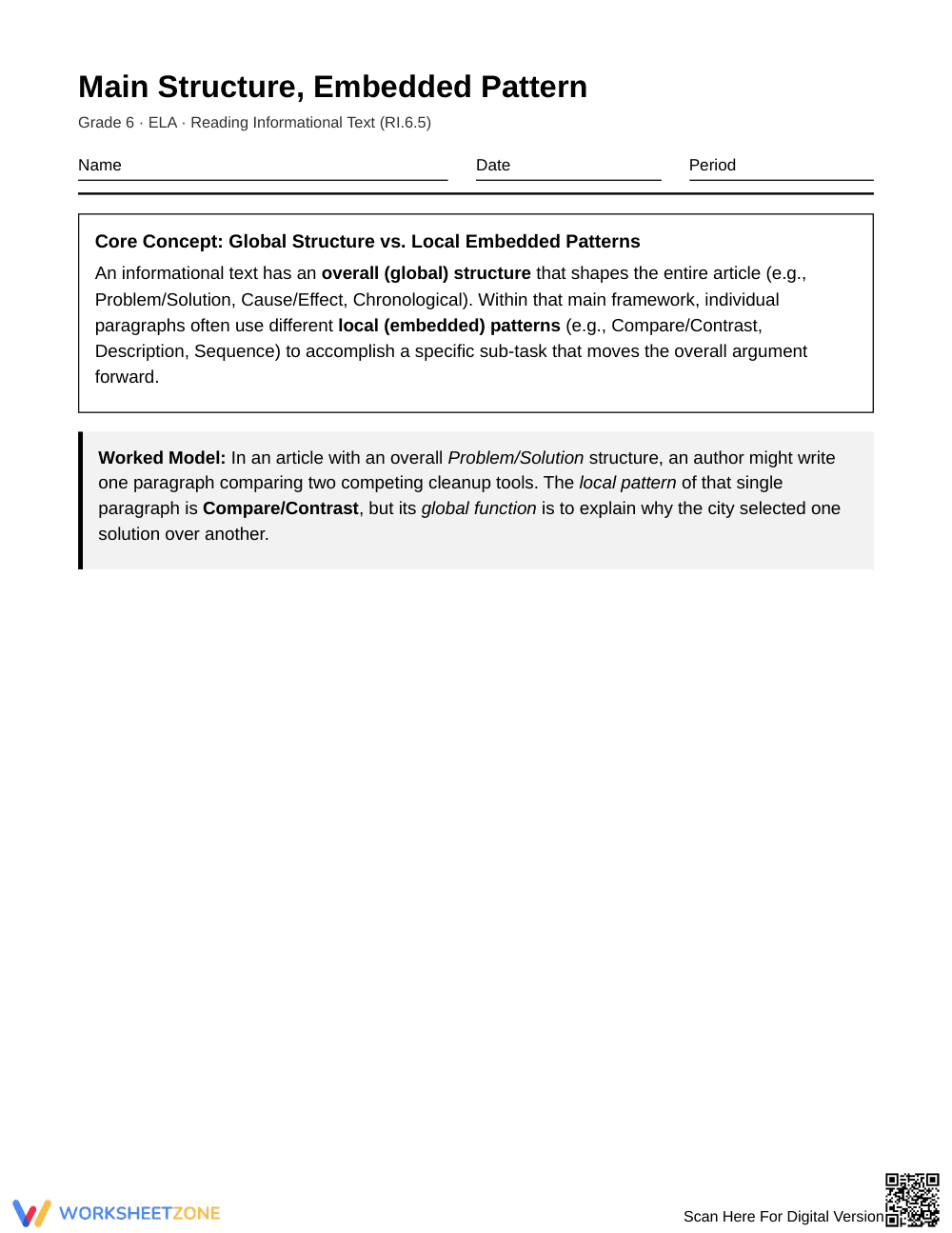
This Grade 6 ELA worksheet builds students' ability to distinguish an informational text's overall organizational structure from the local patterns embedded within individual paragraphs. Working through a five-paragraph informational article about creek restoration, students complete 12 structured tasks that move purposefully from pattern identification to paragraph-function analysis and full structural synthesis, preparing them to apply standard RI.6.5 across diverse informational texts.
At a Glance
- Grade: 6 · Subject: ELA
- Standard:
RI.6.5— Analyze how a sentence, paragraph, or section fits into the overall structure of a text- Skill Focus: Identifying global text structure and embedded local paragraph patterns
- Format: 5 pages · 12 problems · Answer key included · PDF
- Best For: Guided or independent close-reading practice
- Time: 35–50 minutes
Skill Progression & Structure
The worksheet spans five student pages organized into three distinct parts following a gradual-release instructional model:
- Part A (Guided Practice, 4 tasks): A worked model at the top of the page demonstrates how to distinguish a local Compare/Contrast paragraph from the overarching Problem/Solution structure. Multiple-choice and short-answer prompts ask students to identify local patterns and cite signal words as textual evidence.
- Part B (Supported Practice, 6 tasks): Students shift from pattern identification to functional analysis, explaining how specific paragraphs advance the author's central message. Sentence-level anchors support students without removing the interpretive challenge.
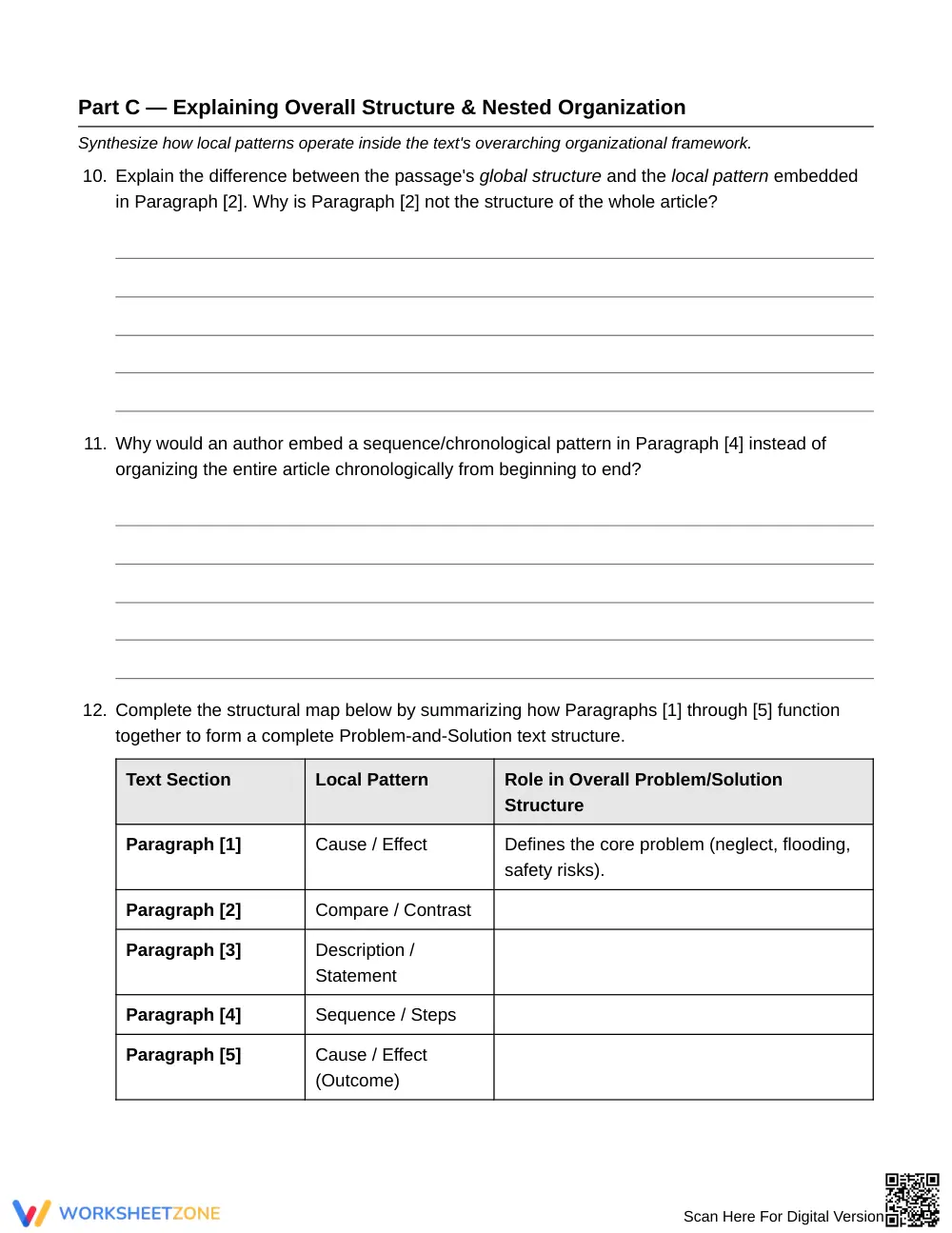
- Part C (Independent Synthesis, 2 tasks + map): Students synthesize their understanding by explaining why authors embed local patterns and completing a five-row structural map of the full article.
Standards Alignment & Classroom Use
This resource focuses squarely on standard RI.6.5, requiring students to analyze how individual paragraphs contribute to overall text development, while also reinforcing RI.6.1 through required textual evidence. Educators can use Parts A and B during direct instruction as a guided check, or assign the full 12-task packet for independent practice, partner work, or formative assessment. The included three-page answer key provides complete model responses for every item, making grading and review efficient.
This five-page, 12-task worksheet targets RI.6.5, the Grade 6 Reading Informational Text standard requiring students to analyze how individual sentences and paragraphs fit into and contribute to a text's overall structure. Students read a cohesive problem-and-solution article and then identify embedded local patterns such as compare and contrast, sequence, and cause and effect while explaining how each paragraph advances the global framework. This dual-level structural analysis reflects what Fisher & Frey (2014) identify as a core component of close reading: moving students from surface-level comprehension to rigorous analysis of how authors craft meaning through organizational choices. Structured practice of this kind, anchored in an authentic text with scaffolded and independent tasks, builds the analytical reading skills measured on state assessments and prepares students for the increasingly complex informational texts they encounter across middle school content-area courses.


