




























Views
Downloads



Printable Teeth & Chewing Word Search | Grades 6–7 Science

Paste this activity's link or code into your existing LMS (Google Classroom, Canvas, Teams, Schoology, Moodle, etc.).
Students can open and work on the activity right away, with no student login required.
You'll still be able to track student progress and results from your teacher account.
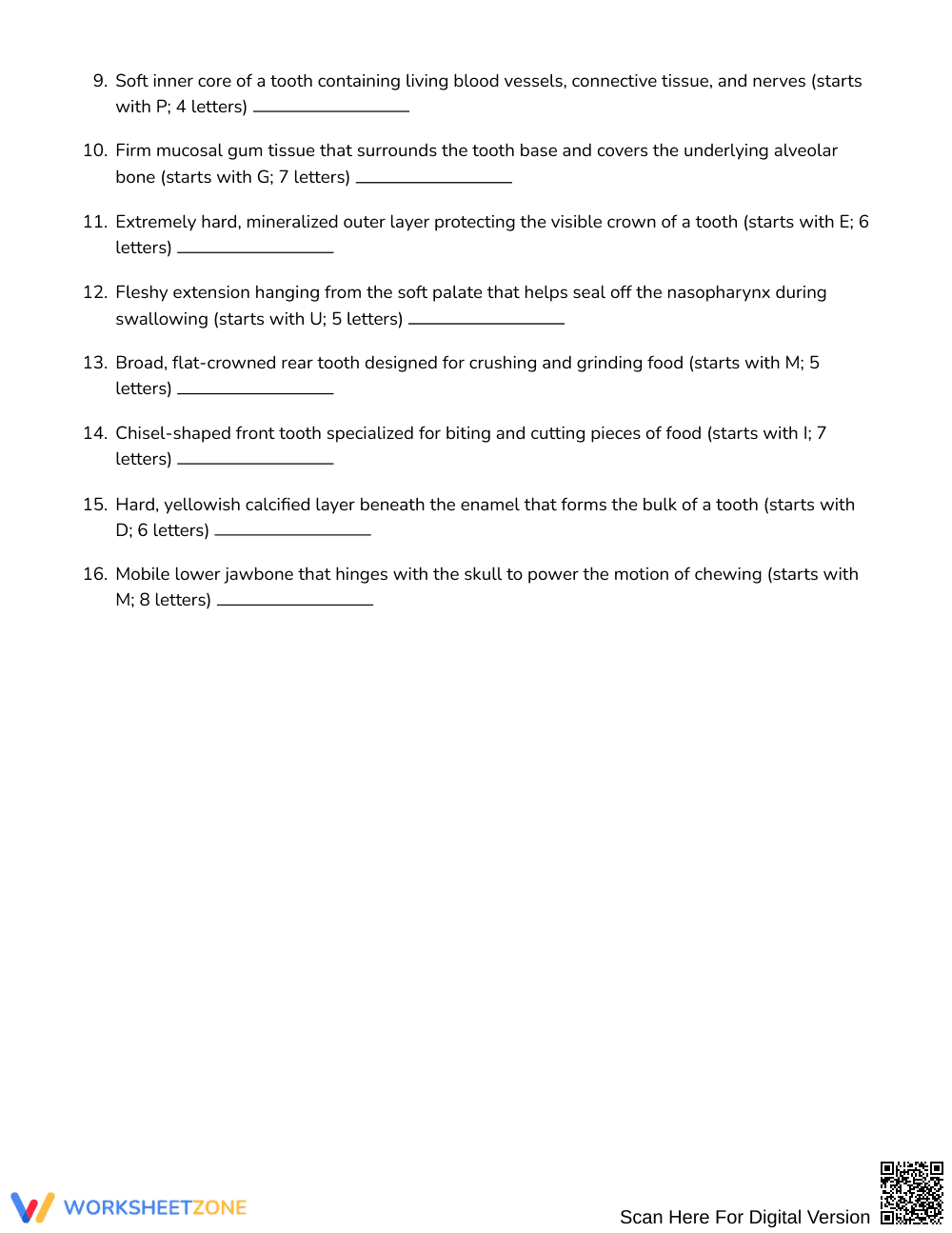
This Grades 6–7 digestive system word search reinforces key vocabulary surrounding teeth, the tongue, and the mechanical process of mastication. Students analyze anatomical definitions to identify target terms before locating them across the grid, strengthening retention of critical digestive structures and functions through active vocabulary recall.
At a Glance
- Grade: Grades 6–7 · Subject: Science
- Standard: Not standards-assessed — vocabulary enrichment
- Skill Focus: Teeth, tongue, and chewing vocabulary
- Format: 3 pages · 16 words · Answer key included · PDF
- Best For: Vocabulary review and fast-finisher work
- Time: 20–30 minutes
The printable set spans three student and reference pages featuring 16 vocabulary clues without a visible word bank, requiring students to retrieve terminology independently. Target terms span tooth layers such as enamel and dentin, muscle and bone structures like the masseter and mandible, and oral digestive secretions including amylase and saliva. A full 3-page answer key provides clear grid solutions for rapid verification.
Puzzle Structure and Mechanics
This challenge operates on a dense 18 x 18 letter grid designed without an open word list. Words can run in all eight possible directions: north, northeast, east, southeast, south, southwest, west, and northwest. To find each of the 16 hidden terms, students must first read the precise physiological clue, deduce the scientific term, and scan the grid across horizontal, vertical, and diagonal orientations.
Standards Alignment
This resource serves as targeted vocabulary enrichment and is not aligned to a formal state or national content standard. It reinforces essential life science terminology related to the human digestive system, supporting reading comprehension in scientific texts and solidifying anatomical vocabulary through contextual definitions.
How to Use It
Deploy this activity after introducing the mechanical digestion unit to reinforce technical terminology. During independent practice, circulate to observe whether students deduce terms directly from physiological definitions or struggle with specific anatomical concepts like salivary enzymes or tooth morphology. Alternatively, assign the puzzle as a low-stress review station or emergency sub plan. Most students will complete the puzzle in 20 to 30 minutes.
Who It's For
This activity is designed for Grades 6–7 science students studying the human digestive system. To support emerging readers, provide a separate reference sheet of terms or allow peer collaboration. Pair this puzzle with a labeled anatomical diagram of oral structures or a guided reading passage detailing mechanical and chemical digestion in the mouth.
Domain-specific vocabulary acquisition forms the cornerstone of scientific literacy in upper elementary and middle grades. According to Fisher & Frey (2014), purposeful word-learning strategies that require students to retrieve definitions and manipulate technical language directly enhance conceptual understanding in content-area disciplines. This Grades 6–7 science word search targets 16 terms vital to understanding oral digestion, such as mastication, dentin, and amylase. By withholding a visible word bank and requiring learners to solve functional anatomical clues, the activity transforms passive visual searching into active cognitive retrieval. Students process biological structures, sensory functions, and chemical processes across an 18 x 18 grid, reinforcing memory pathways through multi-directional spatial scanning. The puzzle functions effectively for formative review, vocabulary consolidation, and reinforcement of digestive physiology, providing an accessible yet rigorous complement to core life science curricula without unnecessary instructional prep.


