


























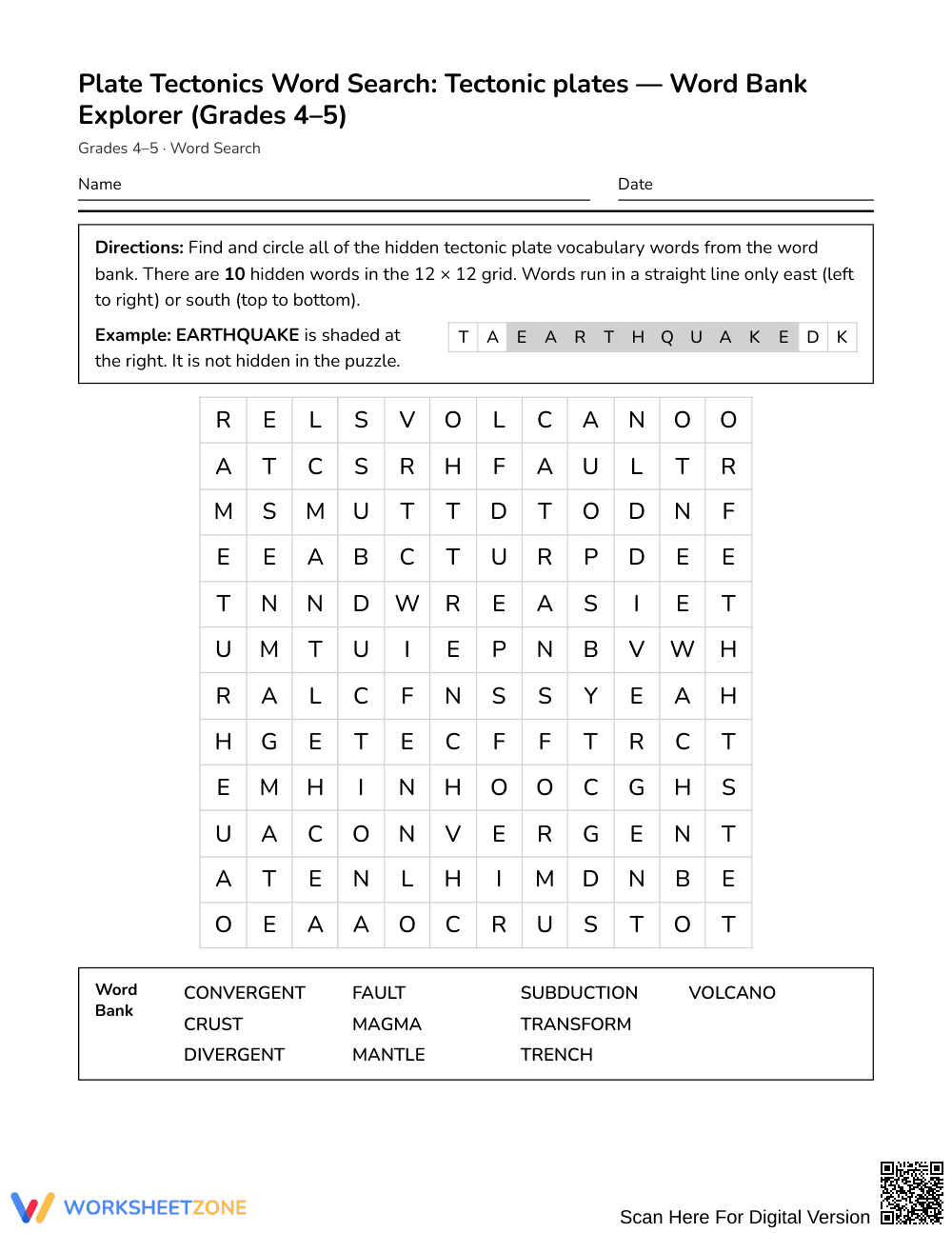

Printable Tectonic Plates Word Search | Grades 4–5 Science
Paste this activity's link or code into your existing LMS (Google Classroom, Canvas, Teams, Schoology, Moodle, etc.).
Students can open and work on the activity right away, with no student login required.
You'll still be able to track student progress and results from your teacher account.
This Grades 4–5 plate tectonics word search reinforces key Earth science vocabulary by challenging students to locate 10 foundational geological terms. By identifying essential terminology in an engaging visual format, students strengthen their scientific literacy, improve orthographic recognition, and consolidate their understanding of Earth's dynamic crustal processes during independent or partner learning.
At a Glance
- Grade: Grades 4–5 · Subject: Science
- Standard: Not standards-assessed — vocabulary enrichment for geological plate concepts
- Skill Focus: Tectonic plates and Earth surface features
- Format: 1 student page · 10 vocabulary words · Complete answer key included · PDF
- Best For: Earth science unit vocabulary review, lesson warm-ups, or emergency sub plans
- Time: 15–20 minutes
This printable activity features a clean 1-page puzzle grid paired with an alphabetical word bank containing 10 core tectonic terms. Students scan the grid to identify target science vocabulary, reinforcing spelling and recognition of key Earth science terminology. A comprehensive multi-page answer key displays exact word placements for quick grading or student self-checking.
Puzzle Structure and Mechanics
The activity is built on an accessible 12 × 12 letter grid tailored specifically for upper elementary learners. All 10 hidden terms run in two primary orientations: horizontally from left to right (East) and vertically from top to bottom (South), eliminating backwards or diagonal placements to keep search strategies focused and developmentally appropriate. Learners refer to an organized alphabetical word bank to track their progress as they locate each term across the grid.
Standards Alignment
This resource serves as targeted vocabulary enrichment and is not aligned to a specific academic content standard. It provides supplementary term exposure that reinforces foundational Earth science concepts, helping upper elementary students build familiarity with plate tectonics vocabulary alongside core instructional units.
How to Use It
Deploy this word search during direct instruction as an engaging mid-lesson transition, or after direct instruction as an independent consolidation activity. For a collaborative review, have student pairs complete the search together and then define each discovered term aloud. During independent seatwork, observe scanning behaviors: note whether students track letter patterns methodically or check words off the alphabetical list. The full puzzle requires approximately 15 to 20 minutes to complete.
Who It's For
This activity is designed for Grades 4–5 science students learning plate boundaries, faults, and crustal movements. For students needing visual support, provide highlighters to trace found letters; advanced learners can write original sentences connecting two found terms. Pair this puzzle directly with an illustrated plate boundaries diagram or a hands-on tectonic plates fault-line model.
Developing domain-specific vocabulary is essential for upper elementary students mastering complex Earth science concepts, such as tectonic plates and crustal interactions. According to Fisher & Frey (2014), intentional word exposure and repeated visual engagement with specialized academic terminology significantly improve conceptual retention and reading comprehension across informational science texts. Although this word search is designed as vocabulary enrichment rather than a standards-assessed task, it strengthens students' orthographic processing and morphological familiarity with key geological terms like convergent, subduction, and fault. Engaging students in structured word-finding exercises enables them to identify letter sequences and retrieve academic language more readily during subsequent inquiry-based science lessons. By isolating critical Earth science terms within a supportive puzzle format, this resource provides an effective, low-stakes entry point for learners to solidify foundational vocabulary before engaging in complex analytical discussions about planetary processes.


