




























Views
Downloads




Printable Strongest Evidence Sets Worksheet | Grade 8 ELA

Paste this activity's link or code into your existing LMS (Google Classroom, Canvas, Teams, Schoology, Moodle, etc.).
Students can open and work on the activity right away, with no student login required.
You'll still be able to track student progress and results from your teacher account.
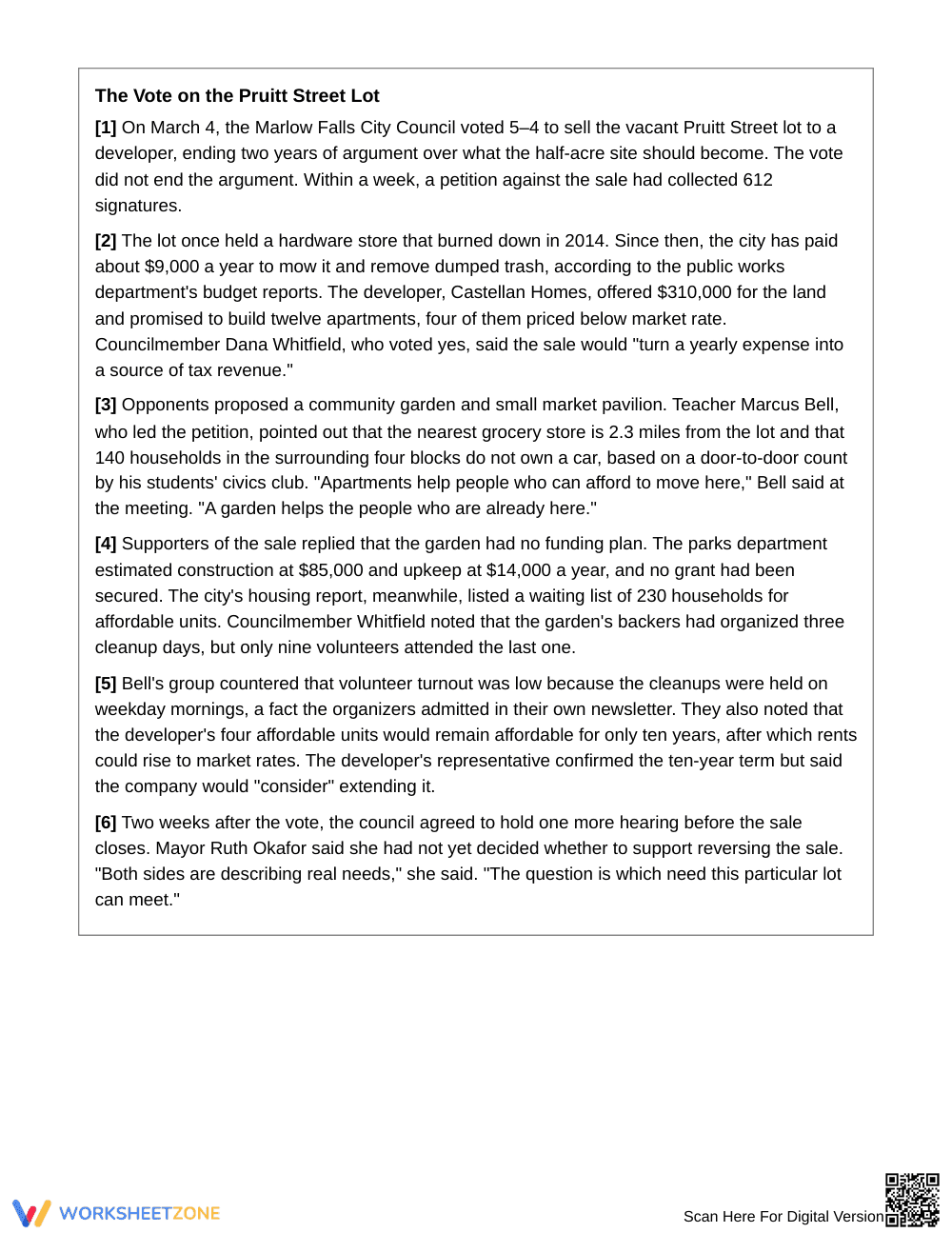
This Grade 8 ELA worksheet teaches students to choose, combine, and defend the strongest textual evidence for a claim. Using a nonfiction article about a city council land dispute, students cite paragraph numbers, separate stated from inferred ideas, and test their arguments against counterevidence.
At a Glance
- Grade: 8 · Subject: ELA
- Standard:
RI.8.1— Cite the strongest evidence for stated ideas and inferences in a text- Skill Focus: Defending the strongest evidence set against counterevidence
- Format: 6 pages · 8 problems · Answer key included · PDF
- Best For: Evidence-based argument practice after direct instruction
- Time: 45–60 minutes
What's Inside
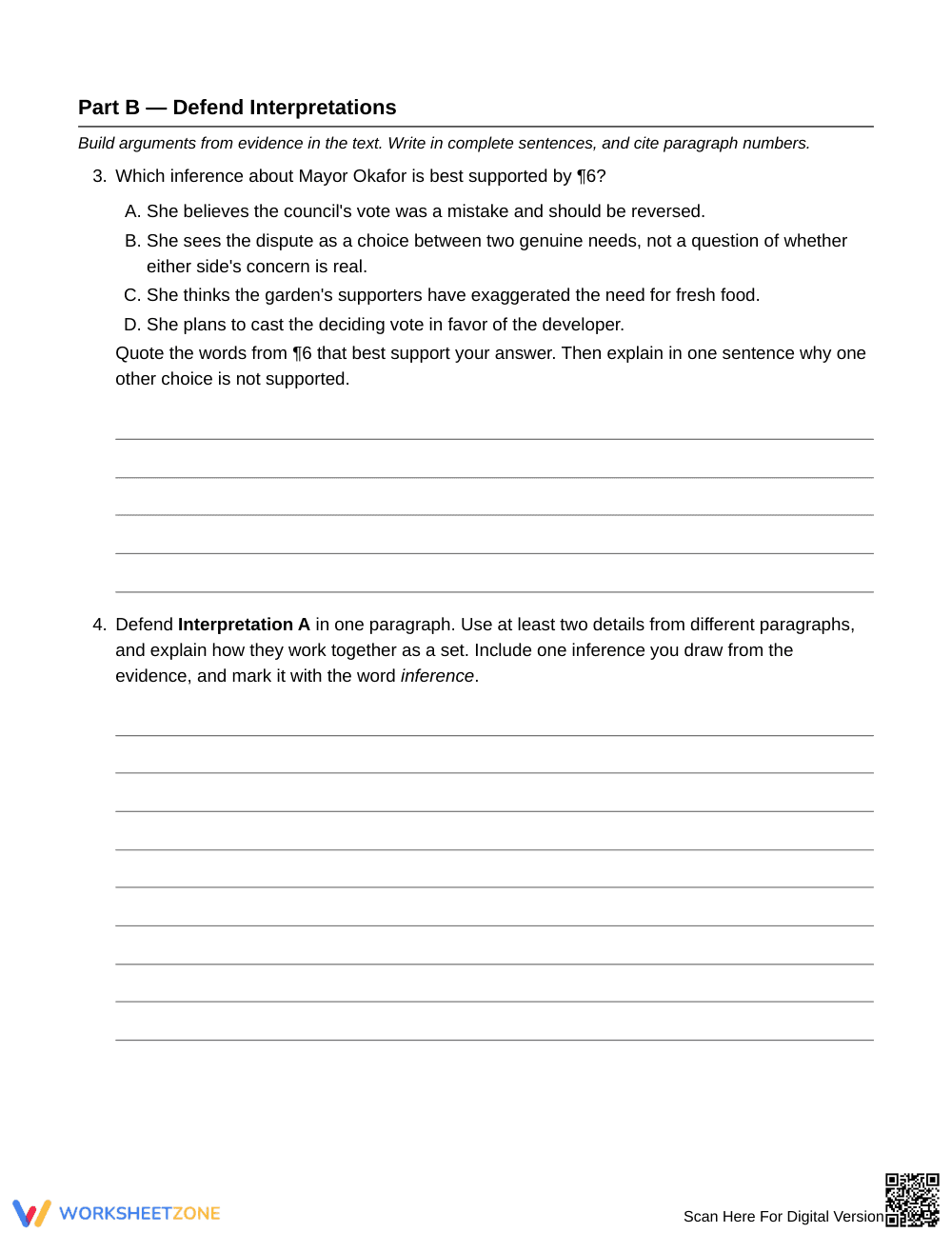
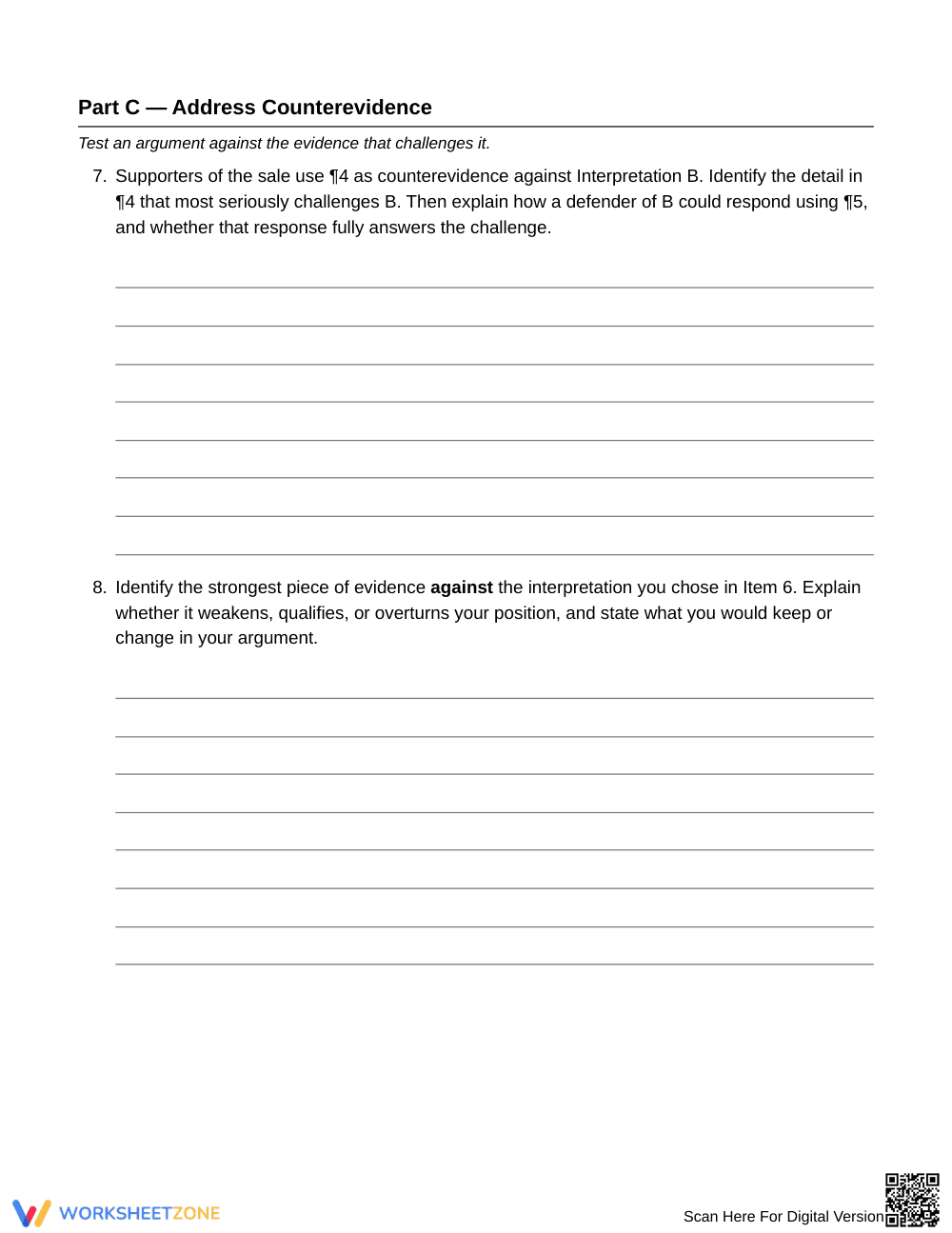
The 6-page PDF opens with a Reasoning Reminder box, then a six-paragraph article, The Vote on the Pruitt Street Lot. Students complete multiple-choice items with written justification, two paragraph defenses of competing interpretations, a comparison paragraph, and two counterevidence tasks. A 4-page answer key models strong responses and explains why weaker details fall short.
Skill Progression
- Guided practice (2 problems, Part A): students pick and justify the most relevant details, with the Reasoning Reminder box in view.
- Supported practice (4 problems, Part B): students make an inference about the mayor, then build and compare arguments for two interpretations using cited details.
- Independent practice (2 problems, Part C): students weigh counterevidence and revise their own position.
This sequence follows a gradual-release model: I Do, We Do, You Do.
Standards Alignment
RI.8.1: Cite the textual evidence that most strongly supports an analysis of what the text says explicitly as well as inferences drawn from the text. Every task requires paragraph citations, and Part B asks students to label their inferences. The standard code can be copied directly into lesson plans, IEP goals, or district curriculum mapping tools.
How to Use It
- After direct instruction on evidence: assign Parts A and B as in-class practice, about 30 minutes.
- As a formative check: assign Part C the next day. Watch whether students cite paragraph numbers and label inferences without prompting.
Expect 45–60 minutes in total.
Who It's For
Built for Grade 8 ELA students ready to move beyond quoting a single line. Support students with the Reasoning Reminder box and by completing Part A together; extend with Part C revisions. Pair it with an anchor chart on stated versus inferred ideas.
RI.8.1 asks Grade 8 students to cite the textual evidence that most strongly supports what a text says and the inferences drawn from it. This worksheet, Defend the Strongest Evidence Set, turns that skill into eight tasks built on one nonfiction article about a city council land sale. Students judge evidence as relevant, specific, and documented, combine details into sets, label stated versus inferred ideas, and answer counterevidence. Fisher & Frey (2014) describe gradual release of responsibility, moving from modeled work to guided practice to independent application, as a reliable way to build such reasoning, and the worksheet follows that sequence across its three parts. The 6-page PDF includes a 4-page answer key with model responses, making it useful for formative assessment of argument and evidence skills in middle school ELA classrooms and intervention groups.


