




























Views
Downloads


Printable Star-Gazing Word Search | Grades 6–7 Science

Paste this activity's link or code into your existing LMS (Google Classroom, Canvas, Teams, Schoology, Moodle, etc.).
Students can open and work on the activity right away, with no student login required.
You'll still be able to track student progress and results from your teacher account.
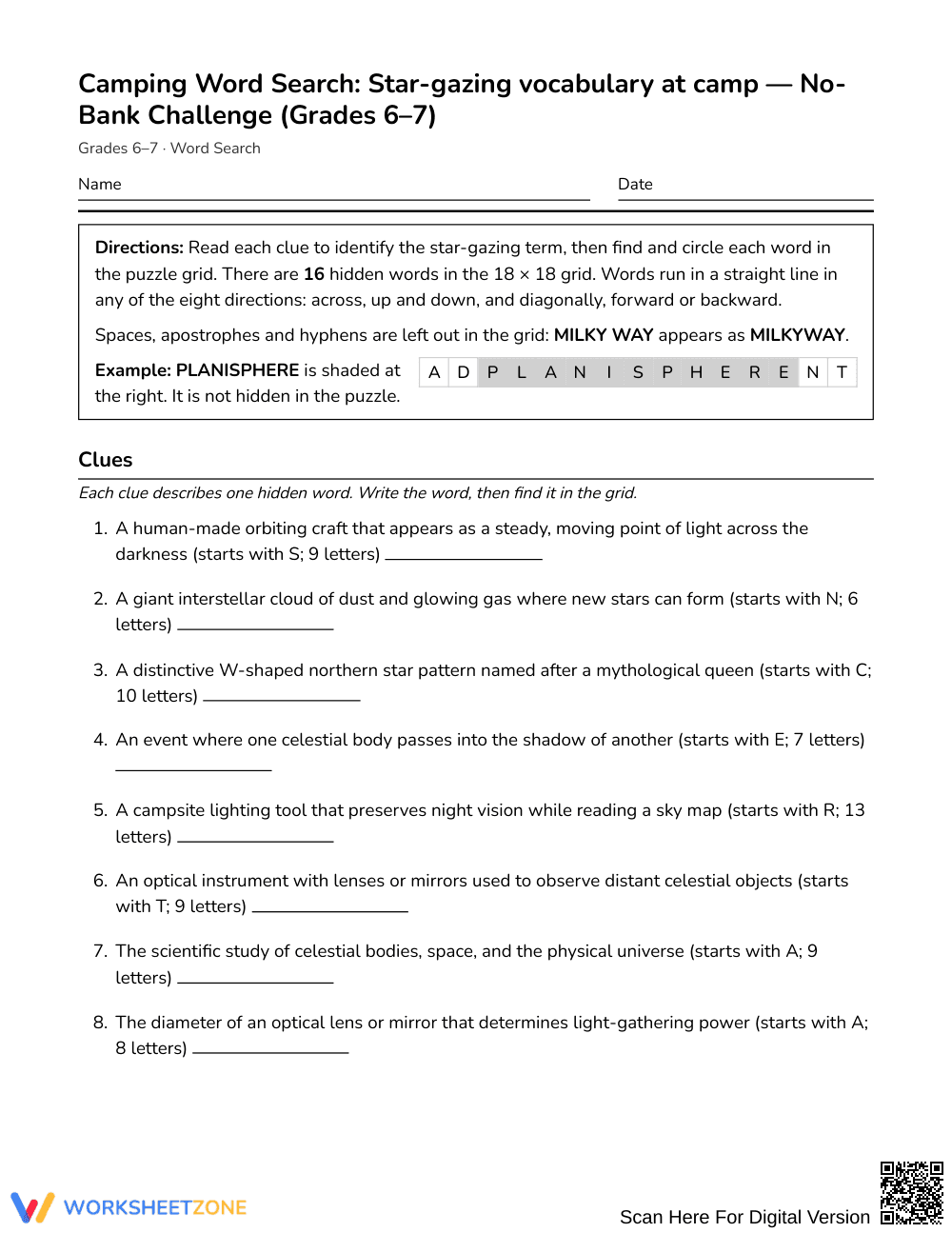
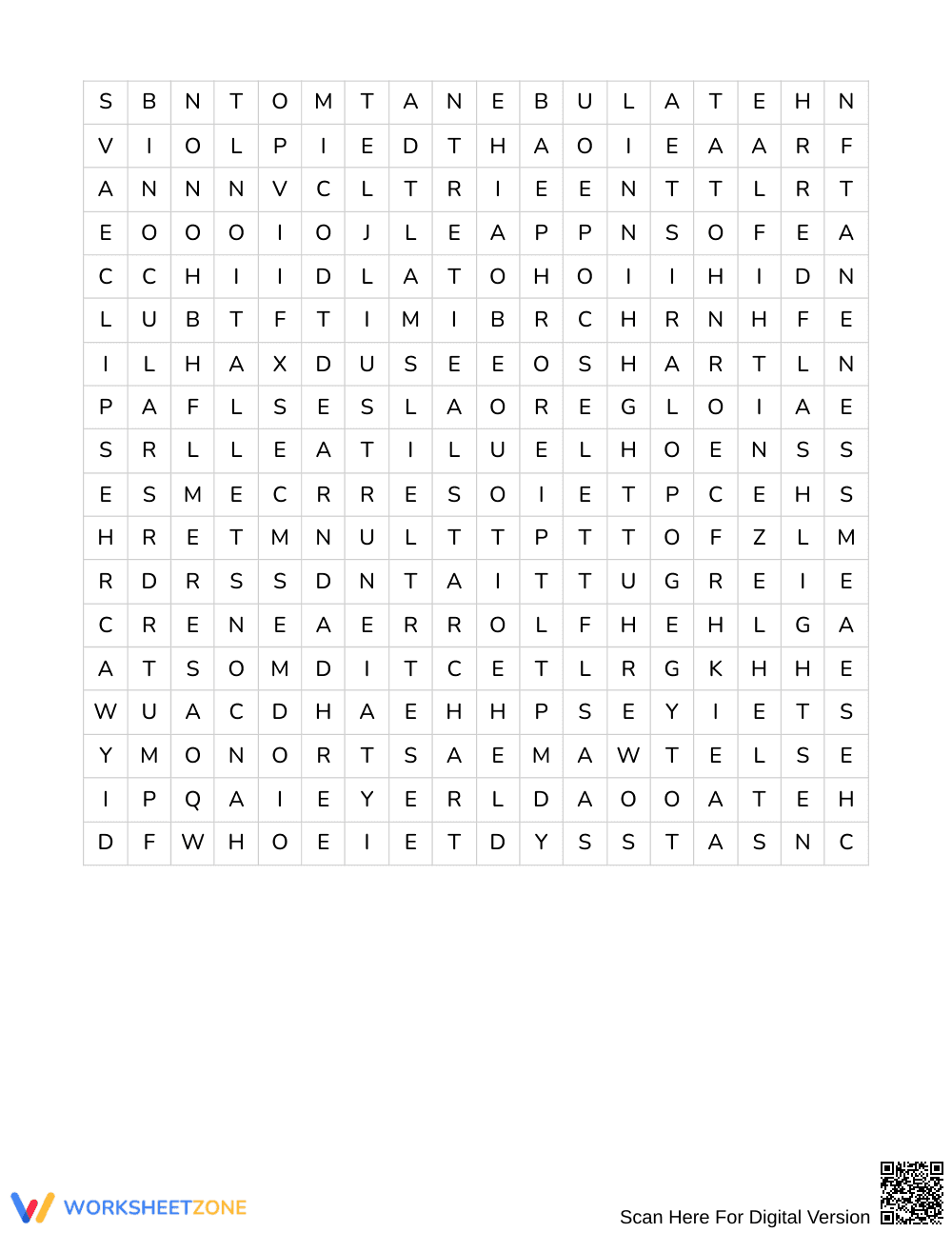
This star-gazing word search strengthens astronomy vocabulary for middle school learners exploring the night sky. Students identify and locate 16 key celestial and observational terms, connecting campsite stargazing to core science concepts. The no-bank clue format reinforces definition recall and independent terminology mastery without requiring teacher preparation.
At a Glance
- Grade: Grades 6–7 · Subject: Science (Astronomy)
- Standard: Not standards-assessed — vocabulary enrichment
- Skill Focus: Star-gazing vocabulary at camp and observational astronomy terms
- Format: 3 pages · 16 hidden words · 18×18 grid · Full answer key included · PDF
- Best For: Astronomy unit vocabulary review, campsite science enrichment, and early finishers
- Time: 20–30 minutes
What’s Inside: This 3-page printable science resource contains an 18-by-18 letter grid featuring 16 hidden astronomy words. Instead of a standard word bank, the activity provides descriptive clues for each term, challenging learners to recall concepts like Polaris, zenith, light pollution, and Cassiopeia. A complete 3-page answer key provides full visual solutions for fast checking.
How the Puzzle Works
The activity engages students through a clue-based search across an 18-by-18 letter grid:
- Clue-Based Identification: Students read 16 descriptive clues defining celestial bodies, navigational markers, and tools to determine each word without a word bank.
- Eight-Direction Search: Words run in all 8 directions—horizontally, vertically, and diagonally (North, Northeast, East, Southeast, South, Southwest, West, and Northwest).
- Observational Astronomy Terms: Vocabulary covers practical campsite equipment like red flashlights and binoculars alongside phenomena such as nebulae and meteors.
Standards Alignment
This resource serves as vocabulary enrichment and is not aligned to a specific standard. It is designed to reinforce domain-specific science vocabulary and observational terminology within an astronomy unit or outdoor education program.
How to Use It
This word search fits effectively into two core instructional routines:
- Post-Instruction Review: Assign the puzzle after direct instruction on the celestial sphere and astronomy tools to consolidate vocabulary. Students solve definitions before finding terms in the grid.
- Camp Science Preparation: Distribute before an evening stargazing session or field trip to familiarize learners with red flashlights, star charts, and Polaris.
During completion, observe whether students identify terms directly from clues without reference aids, gauging retention. Most learners finish in 20 to 30 minutes.
Who It's For
This activity is designed for Grades 6–7 science students, middle school outdoor education groups, and young stargazers. For students needing support, teachers can write 4 to 6 target words on the board as a starter bank. Advanced learners can write sentences linking related terms like aperture and telescope. Pair this puzzle with an interactive star chart or introductory lesson on constellations.
This Grades 6–7 science word search provides targeted vocabulary enrichment focused on star-gazing and campsite astronomy terminology. By eliminating the traditional word bank and substituting 16 descriptive clues, the activity promotes active cognitive retrieval rather than passive letter matching. Students recall domain-specific concepts such as Polaris, zenith, light pollution, aperture, and constellations, then locate them across an 18-by-18 letter grid spanning all eight cardinal and intercardinal directions. According to Fisher & Frey (2014), intentional domain-specific vocabulary retrieval during independent practice substantially solidifies conceptual frameworks and enhances academic reading comprehension in secondary science. The resource includes a comprehensive 3-page answer key that expedites visual verification for teachers and group leaders. Functioning as a vocabulary enrichment tool, this 3-page printable activity delivers meaningful science reinforcement suitable for astronomy units, outdoor education camps, and independent science study.


