





























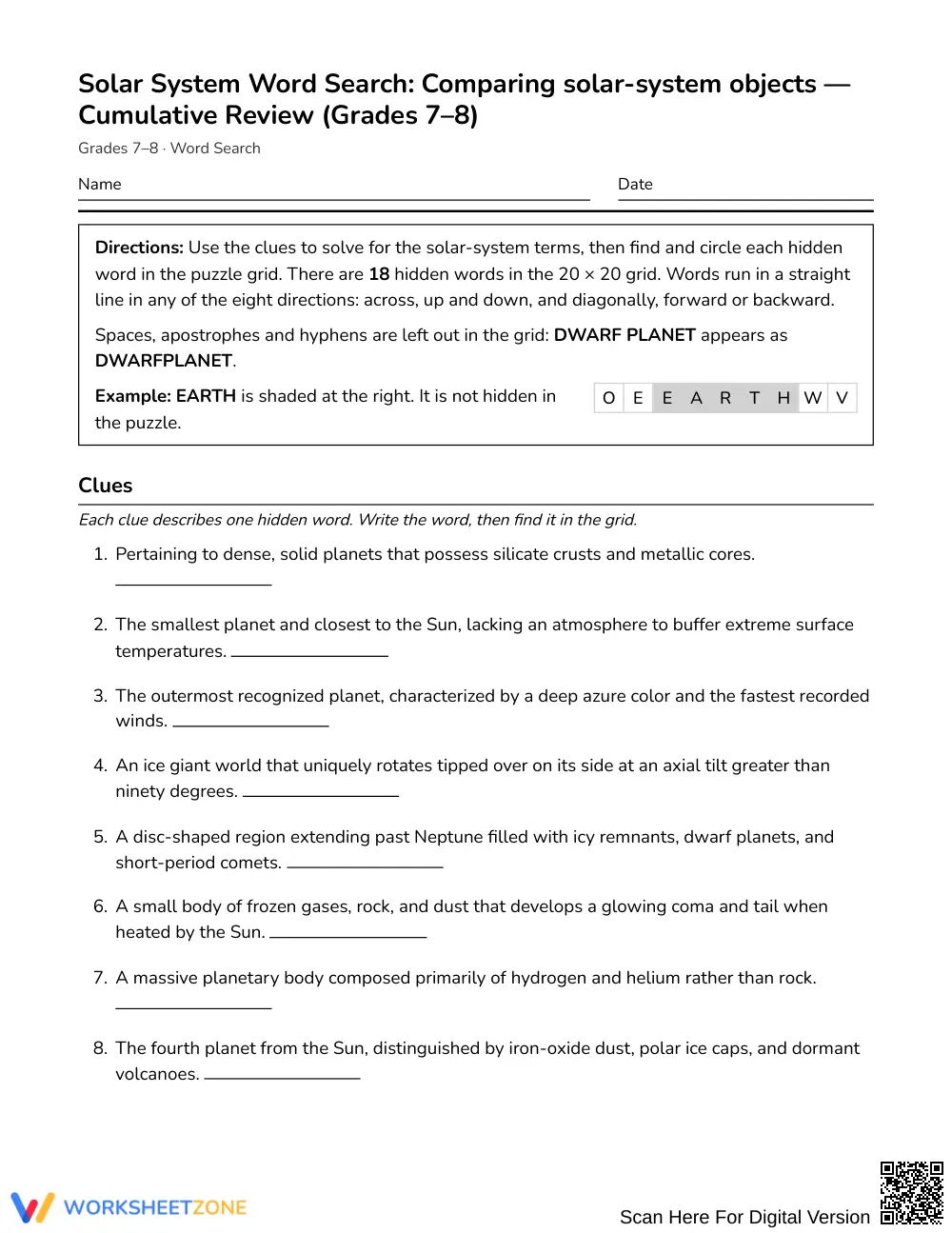


Printable Solar System Word Search | Grades 7–8 Science

Paste this activity's link or code into your existing LMS (Google Classroom, Canvas, Teams, Schoology, Moodle, etc.).
Students can open and work on the activity right away, with no student login required.
You'll still be able to track student progress and results from your teacher account.
This Grades 7–8 science word search reinforces celestial vocabulary by challenging students to compare solar system objects. Learners read descriptive astronomical clues to identify key terms before locating them across the grid. The activity consolidates core planetary science definitions, supporting long-term retention of physical properties, orbital characteristics, and space classifications.
At a Glance
- Grade: Grades 7–8 · Subject: Science
- Standard: Not standards-assessed — vocabulary enrichment
- Skill Focus: Comparing solar-system objects
- Format: 3 pages · 18 words · Answer key included · PDF
- Best For: Cumulative review and science vocabulary reinforcement
- Time: 25–35 minutes
This 3-page printable science resource contains a dense search grid accompanied by 18 clue-driven vocabulary tasks. Rather than working from a basic word bank, students analyze concise definitions describing terrestrial planets, gas giants, icy bodies, and impact structures to determine each mystery term. A 4-page answer key provides clear grid solutions and completed term matches for rapid checking.
Puzzle Structure and Mechanics
The activity features an expansive 20 x 20 letter grid designed to engage middle school learners. Vocabulary entries are hidden in all eight directions: North, Northeast, East, Southeast, South, Southwest, West, and Northwest. Students read content-rich clues for each of the 18 targets, identify the corresponding scientific concept from a shuffled word bank, and track down diagonal, forward, and backward letter placements.
Standards Alignment
This activity serves strictly as targeted vocabulary enrichment and is not aligned to a specific formal state standard. It reinforces essential domain-specific terminology that underpins middle school astronomy units. Teachers can integrate these planetary terms directly into existing space science modules to build background knowledge without altering formal pacing guides.
How to Use It
This puzzle functions effectively as a mid-unit checkpoint after direct instruction on inner and outer planets, or as an engaging wrap-up during cumulative unit reviews. As students read the descriptive clues, circulate to observe whether they can distinguish between gas giants, dwarf planets, and rocky worlds without referencing class notes. Most middle school classes complete the search within 25 to 35 minutes.
Who It's For
Designed specifically for general education and introductory physical science classrooms in Grades 7–8, this activity also supports English language learners through contextual definitions. Pair this puzzle with an illustrated solar system anchor chart or a comparative data table detailing planetary mass and density to assist visual learners during independent seatwork.
Vocabulary acquisition in middle school science requires repeated exposure to domain-specific terminology within meaningful academic contexts. According to Fisher & Frey (2014), intentional word-learning tasks that require students to connect technical definitions to conceptual categories significantly strengthen reading comprehension and scientific literacy. This Grades 7–8 solar system word search delivers targeted vocabulary enrichment centered on comparing solar-system objects, including terrestrial planets, gas giants, and orbital debris. By pairing rigorous descriptive clues with an 18-word puzzle search, the activity demands active semantic processing rather than passive letter scanning. Students must decipher essential physical characteristics such as density, composition, and orbital pathways before searching the 20 x 20 letter matrix. This dual-step approach embeds disciplinary concepts into working memory, ensuring learners establish the foundational academic vocabulary necessary for complex astronomical reasoning across middle school Earth and space science curricula.


