


























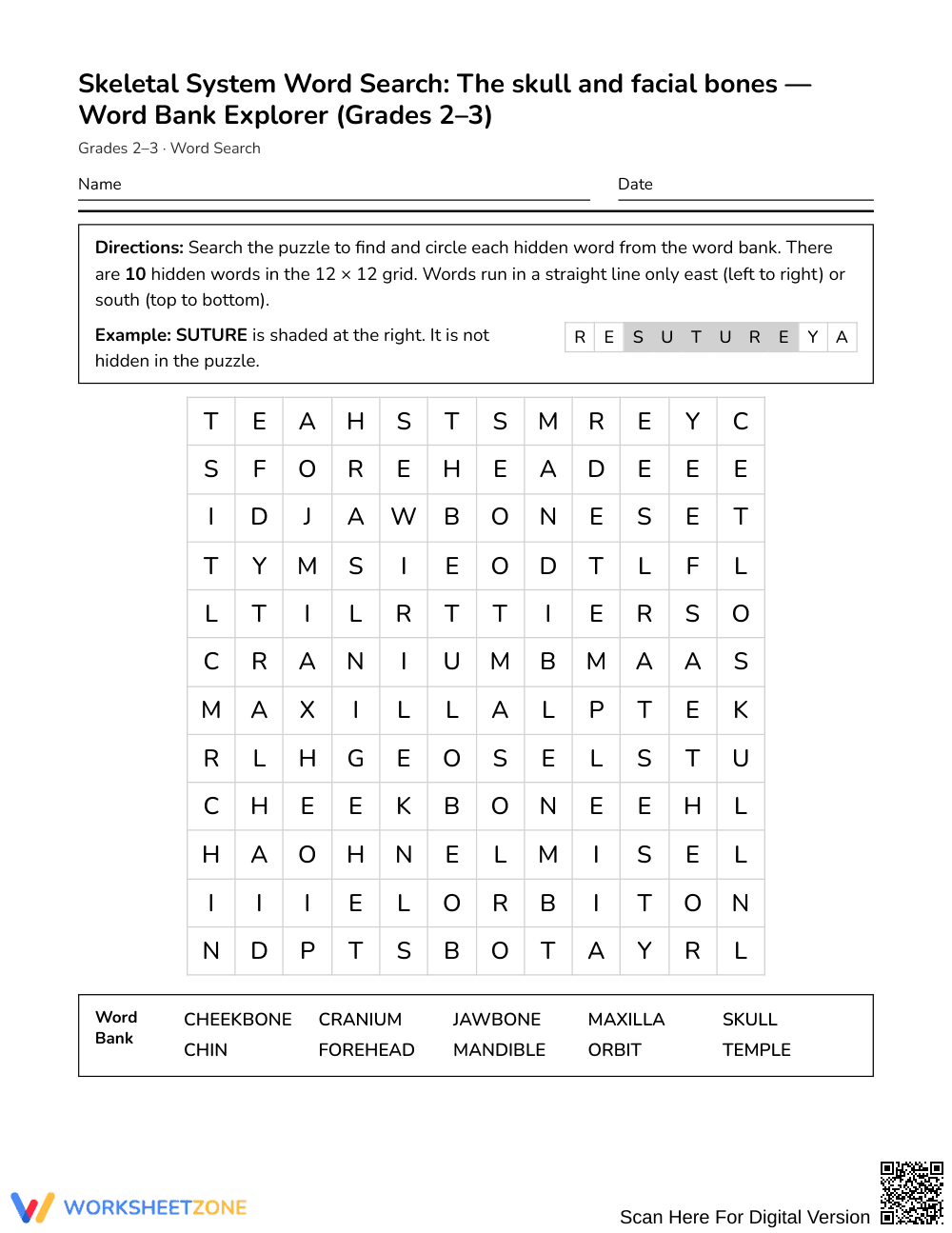

Printable Skull Bones Word Search | Grades 2–3 Science
Paste this activity's link or code into your existing LMS (Google Classroom, Canvas, Teams, Schoology, Moodle, etc.).
Students can open and work on the activity right away, with no student login required.
You'll still be able to track student progress and results from your teacher account.
This printable science word search reinforces foundational skeletal anatomy by helping early elementary students identify key terminology for the human skull and facial bones. Learners locate 10 high-frequency anatomy terms arranged within an accessible letter layout, boosting scientific spelling, letter recognition, and reading confidence across your life science unit.
At a Glance
- Grade: Grades 2–3 · Subject: Science
- Standard: Not standards-assessed — vocabulary enrichment
- Skill Focus: Human skull and facial bone anatomy terms
- Format: 1 page · 10 words · Answer key included · PDF
- Best For: Independent science warm-ups and early finishers
- Time: 15–20 minutes
What's Inside
The activity sheet contains a single-page puzzle featuring 10 vocabulary terms paired with an organized alphabetical word bank. Target words include terms such as cranium, mandible, maxilla, forehead, cheekbone, and orbit. A complete two-page answer key provides teacher-ready answer verification with highlighted solution paths.
Puzzle Mechanics and Structure
Designed specifically for emerging spellers in Grades 2–3, this puzzle operates on clear, accessible mechanics:
- Compact Grid Layout: The search utilizes a 12 × 12 grid suited to developing visual tracking skills.
- Predictable Word Paths: Words run only from left to right (East) and top to bottom (South), avoiding confusing diagonal or backward orientations.
- Alphabetical Word Bank: Words are listed alphabetically at the top to reinforce reference skills and methodical scanning.
Standards Alignment
This activity serves strictly as supplemental vocabulary enrichment and is not aligned to a formal state or national content standard. It reinforces terminology through visual scanning rather than standardized assessment targets.
How to Use It
Use this word search immediately after direct instruction introducing the skeletal system to reinforce new terminology. Alternatively, deploy the puzzle as an independent station during science rotations or as an effortless substitute plan activity. As students search, observe whether they scan the initial letters systematically or randomly to gauge visual tracking fluency. Typical completion requires 15 to 20 minutes.
Who It's For
This activity is designed for Grades 2–3 science learners building their academic vocabulary. Restricting word paths to forward and downward directions provides age-appropriate support for developing readers and English language learners. Pair this puzzle with a labeled skull diagram or an introductory anatomy read-aloud.
Early elementary vocabulary acquisition thrives when students interact frequently with precise domain-specific words. According to Fisher & Frey (2014), purposeful word-recognition tasks strengthen orthographic processing and facilitate deeper content-area comprehension across informational science texts. By locating terms like cranium, mandible, and orbit in a constrained 12 × 12 grid without backward text, Grades 2–3 learners internalize correct anatomical spelling patterns in low-stress environments. Because this resource functions strictly as vocabulary enrichment rather than a formal standards-based assessment, teachers can integrate it flexibly across introductory skeletal system units. Structured vocabulary exposure directly supports reading automaticity, establishing a stable foundation for advanced biological concepts in subsequent elementary grades.


