


























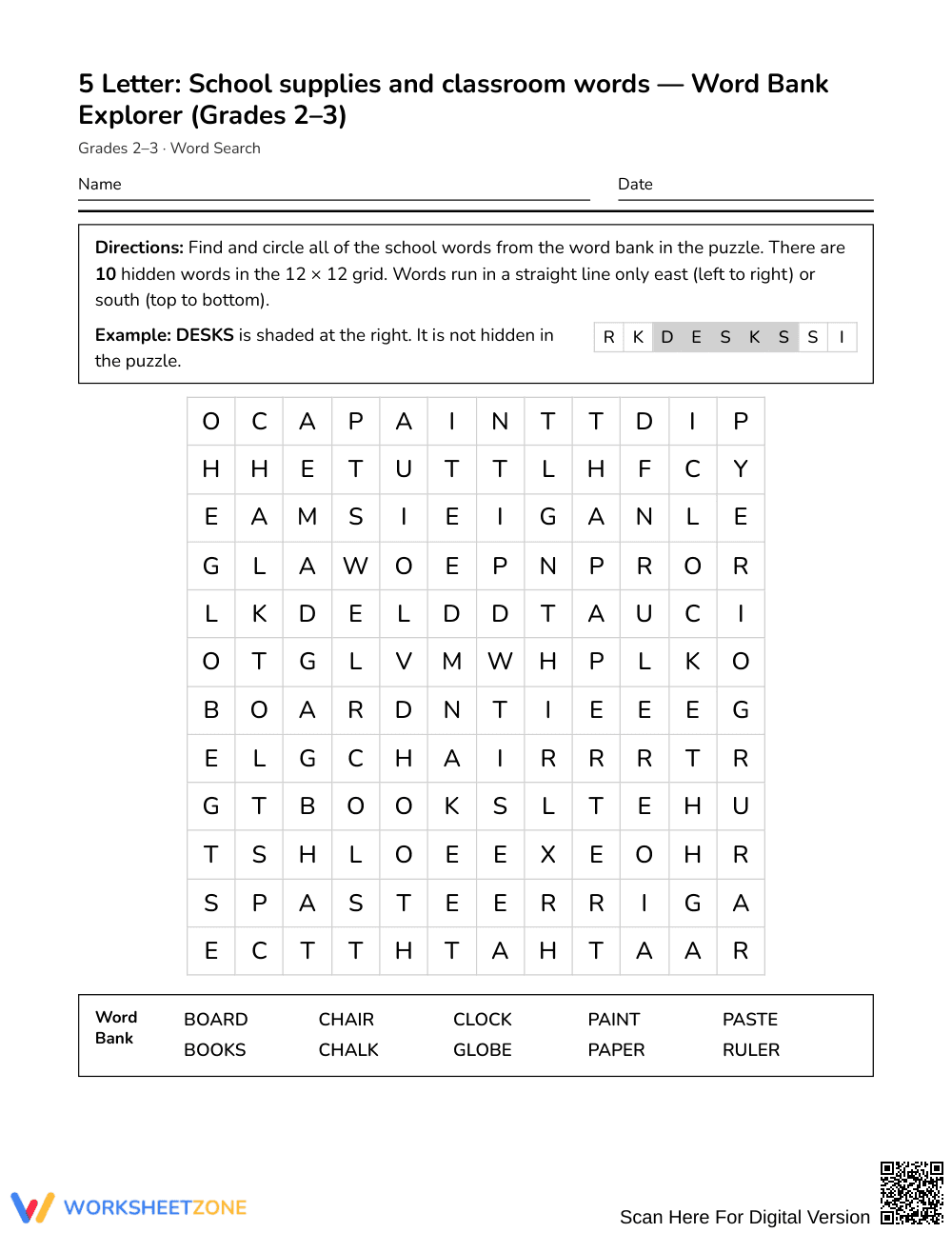

Printable School Supplies Word Search | Grades 2–3 ELA
Paste this activity's link or code into your existing LMS (Google Classroom, Canvas, Teams, Schoology, Moodle, etc.).
Students can open and work on the activity right away, with no student login required.
You'll still be able to track student progress and results from your teacher account.
This Grades 2–3 classroom vocabulary word search reinforces essential school supply terminology through focused visual scanning. Students locate 10 foundational five-letter school words embedded within a compact puzzle grid, building word recognition, letter sequencing skills, and classroom vocabulary familiarity. It delivers an engaging, screen-free learning activity complete with a clear solution key.
At a Glance
- Grade: Grades 2–3 · Subject: English Language Arts (ELA)
- Standard: Not standards-assessed — vocabulary enrichment
- Skill Focus: School supplies and classroom words
- Format: 1 pages · 10 words · Answer key included · PDF
- Best For: Morning work, early finishers, sub plans
- Time: 10–15 minutes
What's Inside
This single-page printable activity features an uncluttered 12 x 12 letter grid paired with an organized, alphabetical word bank. Students search for 10 common five-letter classroom terms: board, books, chair, chalk, clock, globe, paint, paper, paste, and ruler. The resource includes a two-page answer key that clearly highlights every hidden term for rapid grading.
Puzzle Structure and Mechanics
Designed specifically for early elementary learners, this word search limits word orientation to beginner-friendly paths:
- Grid Dimensions: A clean 12 x 12 grid provides sufficient space without overwhelming developing readers.
- Word Orientations: All 10 hidden vocabulary terms run strictly East (left to right) and South (top to bottom), avoiding reverse or diagonal frustration.
- Alphabetical Bank: The reference list displays all target words alphabetically, reinforcing dictionary skills and systematic scanning habits.
Standards Alignment
This activity provides focused vocabulary enrichment and is not aligned to a specific grade-level academic standard. Instead, it supports foundational spelling recognition, spatial reasoning, and thematic vocabulary development. Teachers can integrate it flexibly across general English Language Arts units, back-to-school orientations, or thematic classroom supply centers without prescriptive tracking requirements.
How to Use It
Deploy this puzzle as an independent warm-up during morning arrival to settle students into focused work, or keep printed copies ready in an early-finisher folder after reading instruction. During independent work, circulate to observe visual tracking habits, noting whether learners scan systematically by initial letter clusters or search randomly. Most children complete the search in 10 to 15 minutes.
Who It's For
This activity suits students in Grades 2–3 who are solidifying basic spelling patterns and sight recognition for everyday academic objects. It accommodates emerging readers and English language learners needing low-stress exposure to classroom vocabulary. Pair this word search naturally with an illustrated classroom object anchor chart or an interactive labeling tour of the physical classroom.
Vocabulary acquisition research highlighted in Fisher & Frey (2014) emphasizes that repeated visual exposures to high-utility thematic words strengthen orthographic mapping and lexical retrieval among developing readers. Providing structured word-finding tasks allows primary students to inspect internal letter sequences, confirm spelling patterns, and anchor functional terms within everyday school environments. This 10-word puzzle supports print awareness through manageable directional pathways that build task persistence and visual fluency without cognitive overload. When paired with meaningful oral discussion of school routines, word recognition exercises help second and third graders connect written forms to physical objects across the instructional space.


