


























Views
Downloads

Printable Rib Cage Word Search | Grades 3–4 Science
Paste this activity's link or code into your existing LMS (Google Classroom, Canvas, Teams, Schoology, Moodle, etc.).
Students can open and work on the activity right away, with no student login required.
You'll still be able to track student progress and results from your teacher account.
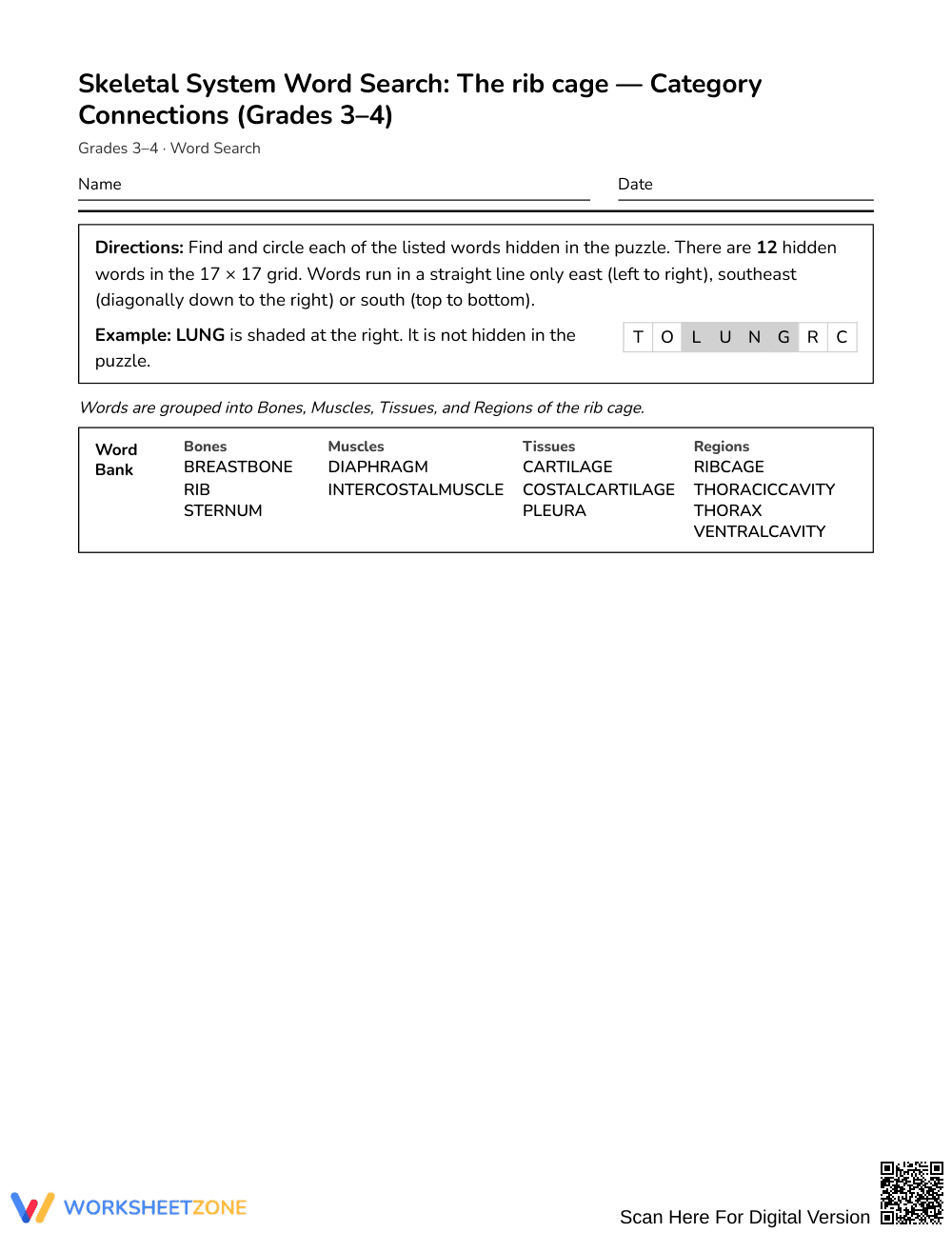
This skeletal system word search helps Grades 3–4 students build foundational human anatomy vocabulary by identifying key structures of the rib cage. Students locate 12 essential terms organized by category, reinforcing their understanding of protective bones, respiratory muscles, supporting tissues, and body cavities during life science units.
At a Glance
- Grade: Grades 3–4 · Subject: Elementary Life Science
- Standard: Not standards-assessed — vocabulary enrichment for human anatomy concepts
- Skill Focus: The rib cage anatomy and related muscular and tissue structures
- Format: 2 pages · 12 words · Full answer key included · Printable PDF
- Best For: Independent science center vocabulary review
- Time: 15–25 minutes of active learning
What's Inside
This 2-page science resource features a specialized word search containing 12 terms related to the human rib cage. The word bank groups terms into four categories: bones, muscles, tissues, and anatomical regions. Each entry includes a student-friendly clue defining its role, such as how the diaphragm aids breathing. A complete 3-page solution set with circled letter placements makes checking student work quick and reliable.
Puzzle Structure and Mechanics
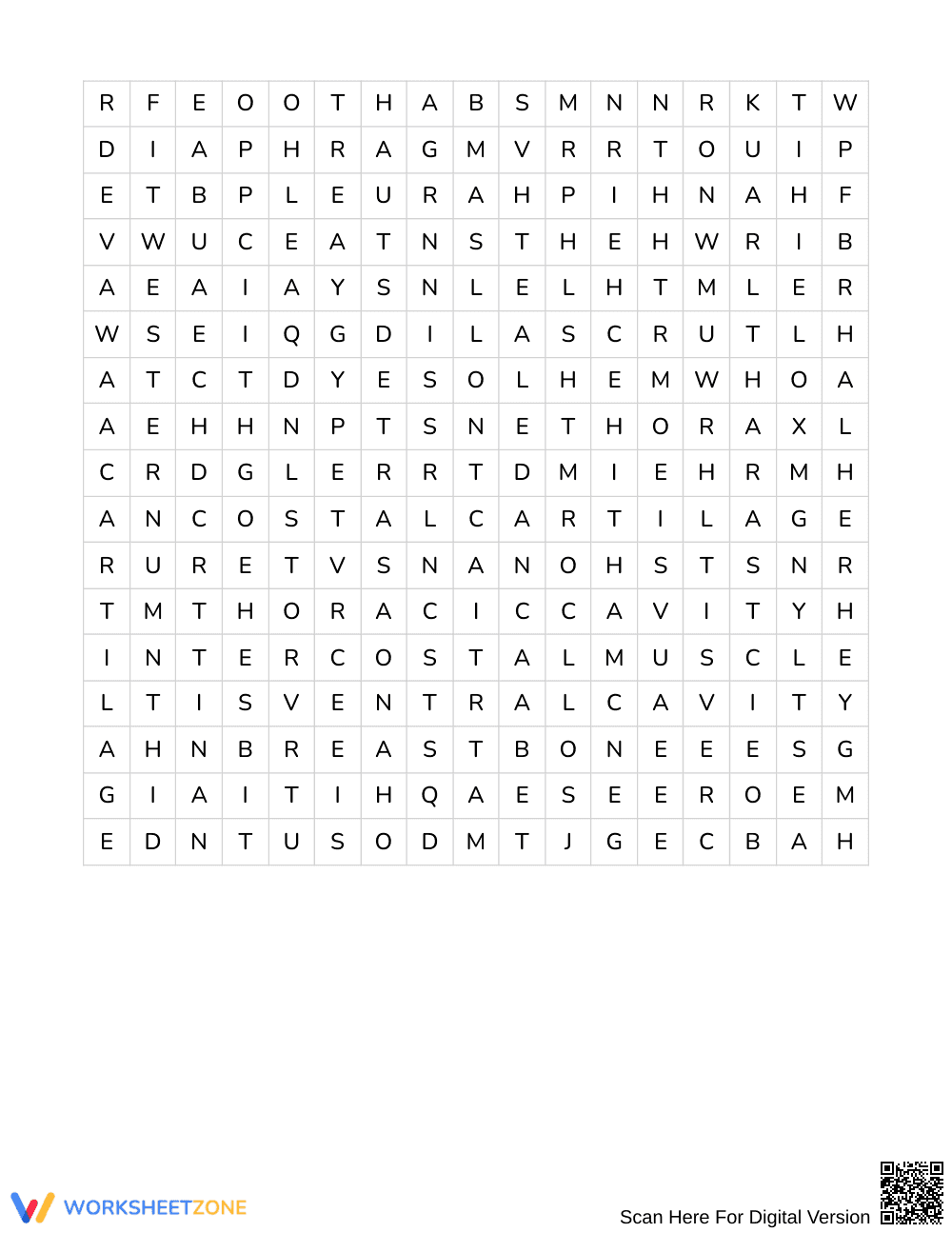
Students navigate a 17 x 17 letter grid designed specifically for elementary learners. Hidden terms follow three orientations: horizontally eastward (E), diagonally southeast (SE), and vertically southward (S). Because letters run forward and downward without backwards reversals, learners track anatomical terms without visual frustration. The categorized word bank groups all 12 terms across bones, muscles, tissues, and regions to support conceptual connections.
Standards Alignment
This activity provides dedicated vocabulary enrichment and is not aligned to a specific standard. It supports elementary life science units on the human body by reinforcing accurate anatomical terminology through visual word recognition and contextual definitions.
How to Use It
Introduce this word search after direct instruction on the skeletal system to reinforce organ protection and respiratory mechanics. Alternatively, assign it as a science station task during independent rotations. While students work, observe whether they reference category headers to locate multi-word terms like costal cartilage or intercostal muscle. Students typically complete the puzzle within 15 to 25 minutes.
Who It's For
This resource is designed for Grades 3–4 science classrooms, including general education students and English learners building domain-specific vocabulary. For students needing support, pre-highlighting category headings assists visual tracking across the grid. Pair this activity with a labeled rib cage anchor chart to connect spatial word identification to anatomical models.
Targeted domain-specific vocabulary instruction strengthens reading comprehension in elementary science, as highlighted by Fisher & Frey (2014) in their research on disciplinary literacy and word schema development. While categorized as a vocabulary enrichment resource rather than an assessed standard, this rib cage word search equips Grades 3–4 learners with essential anatomical terminology through structured categorization and clue-supported word identification. By organizing 12 anatomical terms into functional categories including protective bones, respiratory muscles, connective tissues, and ventral cavities, the activity reinforces conceptual relationships among bodily structures rather than isolating words as abstract spelling tasks. Students actively encounter key scientific terms such as sternum, diaphragm, and thoracic cavity across a 17 x 17 grid with forward-facing orientations. This focused visual practice solidifies academic language retention, enabling young elementary scholars to articulate how skeletal structures protect vital organs during subsequent life science investigations.


