

































Printable Register & Rhythm Worksheet | Grade 11 English III

Paste this activity's link or code into your existing LMS (Google Classroom, Canvas, Teams, Schoology, Moodle, etc.).
Students can open and work on the activity right away, with no student login required.
You'll still be able to track student progress and results from your teacher account.
This worksheet teaches Grade 11 students to analyze how register, diction, and sentence rhythm shape tone in a personal essay. Students move from locating details to explaining effects to defending a position with evidence.
At a Glance
- Grade: 11 · Subject: English III
- Standard: Explain how word choice and sentence structure shape tone, using quoted evidence
- Skill Focus: Analyze register and sentence rhythm
- Format: 6 pages · 12 problems · Answer key included · PDF
- Best For: Close reading of style in nonfiction
- Time: 40–50 minutes
What's Inside
The worksheet opens with a short reminder box defining register, diction, and syntax. It then presents a six-paragraph essay, 'The Kitchen Word and the Counter Word,' which contrasts a grandmother's invented word, 'lamp-lag,' with the standardized language of a county clerk's office. Twelve tasks follow in three parts. A 3-page answer key supports quick scoring and feedback.
Skill Progression
- Guided practice (Part A, 3 tasks): Students locate relevant details, including one exact quotation and two multiple-choice items.
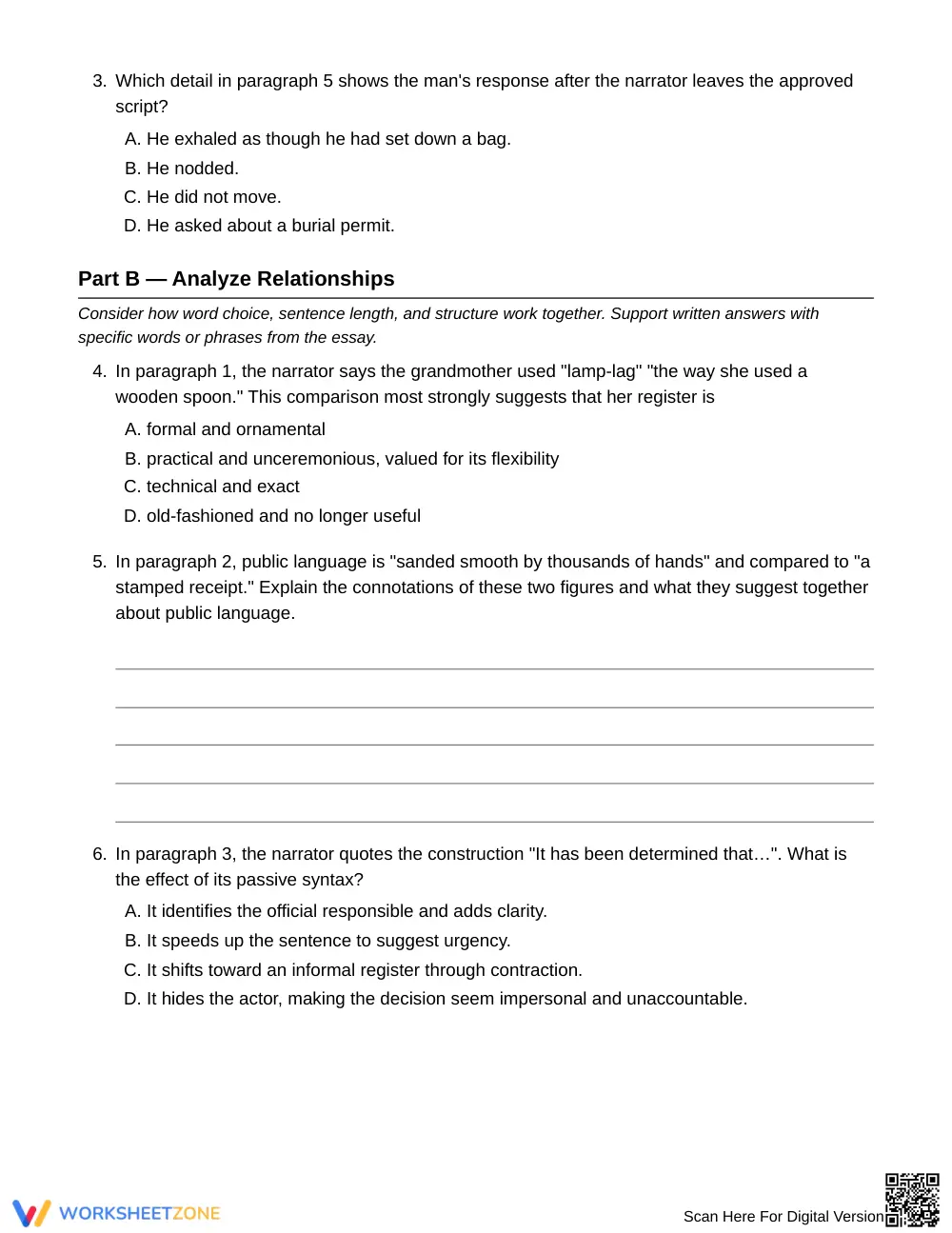
- Supported practice (Part B, 6 tasks): Students analyze relationships among diction, passive syntax, figurative language, and sentence length. Three items are multiple choice and three require written explanation with cited phrases.
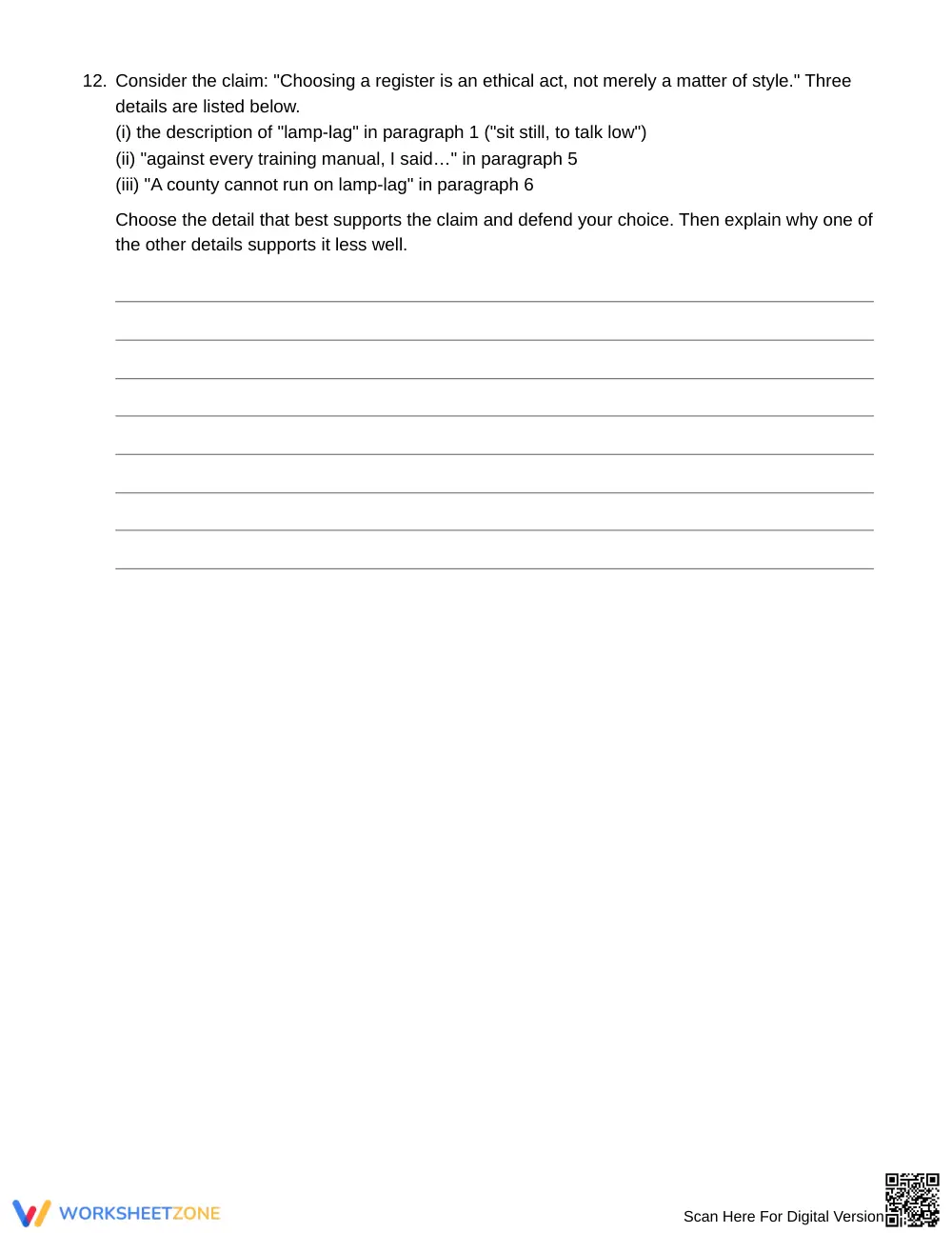
- Independent practice (Part C, 3 tasks): Students take a position, defend it with at least two pieces of evidence, and weigh competing details. The scaffold is minimal.
This sequence follows a gradual-release model (I Do, We Do, You Do): teachers can model Part A, work through Part B together, and release students to Part C.
Standards Alignment
No standard code was supplied for this resource, so none is listed here. The tasks target analyzing how an author's word choice, connotation, and sentence structure create tone, and citing textual evidence to defend an interpretation. Teachers can attach the local Grade 11 standard code that fits their framework.
How to Use It
- After direct instruction: Teach register, diction, and syntax in a mini-lesson, then assign the full worksheet as guided independent work.
- During a style unit: Assign Parts A and B in class, then Part C as a discussion or writing prompt.
As students work, watch whether they quote exact words or paraphrase loosely. Expect 40–50 minutes for all 12 tasks.
Who It's For
This resource suits Grade 11 English III students who can read a multi-paragraph essay and are ready to explain how style creates meaning. Students who need support can complete Parts A and B first and use the reminder box as a reference. Advanced students can spend extra time on the Part C ethics claim.
This Grade 11 English III worksheet, Analyze Register and Sentence Rhythm, asks students to explain how word choice and sentence structure create tone in a six-paragraph personal essay that contrasts a grandmother's private word 'lamp-lag' with the formal language of a county clerk's office. Twelve tasks move through locating details, analyzing relationships among diction, syntax, and connotation, and defending a claim with textual evidence. The design reflects the close-reading approach described by Fisher & Frey (2014), which emphasizes rereading a text and answering text-dependent questions that require evidence. The set includes a reminder box defining register, diction, and syntax, a 3-page answer key, and six pages of student material. No standard code was supplied for this resource, so teachers should map it to local Grade 11 reading and language standards. It suits instruction on style analysis and evidence-based argument.


