


























Views
Downloads




Printable Reductive Themes Worksheet | Grade 9 English I
Paste this activity's link or code into your existing LMS (Google Classroom, Canvas, Teams, Schoology, Moodle, etc.).
Students can open and work on the activity right away, with no student login required.
You'll still be able to track student progress and results from your teacher account.
This worksheet teaches Grade 9 students to spot and fix reductive theme statements. Students diagnose five flawed interpretations of a paired story and essay, then rewrite each as a qualified, evidence-backed theme grounded in paragraph-level text evidence.
At a Glance
- Grade: 9 · Subject: English I
- Standard:
RL.9-10.2— Identify a theme and explain how specific details develop it- Skill Focus: Repair a Reductive Interpretation
- Format: 7 pages · 10 problems · Answer key included · PDF
- Best For: Theme writing after paired-text reading
- Time: 45–60 minutes
What's Inside
A Reading Tools box defines five flaws: topic-as-theme, moral command, overgeneralization, misreading, and collapsed tension. It also gives a four-part repair test. Students then read an original story, “Receipts,” and an original essay, “The Signature.” A worked model comes next, followed by Part A (five diagnosis items) and Part B (five rewrite items). A 3-page answer key is included.
Skill Progression
- Guided practice: One fully worked example diagnoses and repairs a flawed response, with the Reading Tools box as the scaffold.
- Supported practice: Part A, items 1–5, supplies the flawed responses and flaw labels. Students name each flaw and cite the paragraphs it ignores.
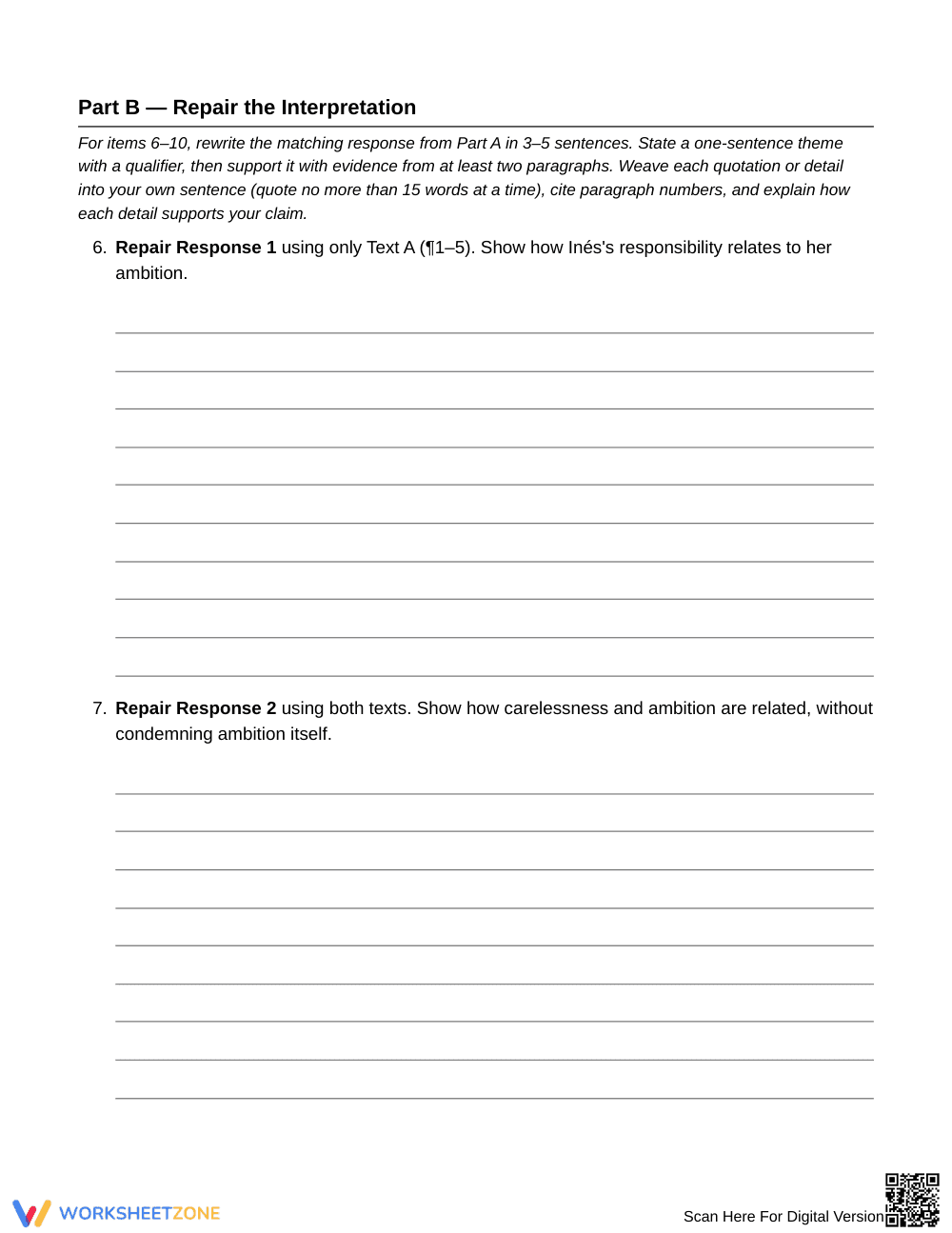
- Independent practice: Part B, items 6–10, asks for 3–5 sentence rewrites with a qualified theme and evidence from at least two paragraphs.
The sequence follows gradual release: I Do, We Do, You Do.
Standards Alignment
RL.9-10.2: Determine a theme or central idea of a text and analyze its development over the course of the text, including how it emerges and is shaped and refined by specific details. The standard code can be copied directly into lesson plans, IEP goals, or district curriculum mapping tools.
How to Use It
- After direct instruction: Assign Part A as a work-session task once students have read both texts.
- As a writing workshop: Use Part B to draft and revise theme statements.
While students work, watch whether they add a qualifier such as often or can, and whether they explain each quotation. Expect 45–60 minutes in total.
Who It's For
Grade 9 English I students who write vague or absolute theme statements. Pair it with an anchor chart on theme versus topic. Students who need more support can complete Part A first and finish Part B the next day.
Reductive theme statements are a common obstacle to RL.9-10.2: students name a topic, issue a moral command, or overgeneralize from one detail instead of analyzing how a theme develops. This Grade 9 English I worksheet addresses that problem through diagnosis and repair. Students use five labeled flaws and a four-part repair test to critique ten tasks built on a paired story and essay about responsibility and ambition. The structure follows the gradual release model described by Fisher & Frey (2014), which moves learners from modeling to guided practice to independent application. By the end, students can write a one-sentence theme with a qualifier, support it with evidence from at least two paragraphs, and explain how each detail supports the claim. A three-page answer key supports quick, consistent feedback.


