





























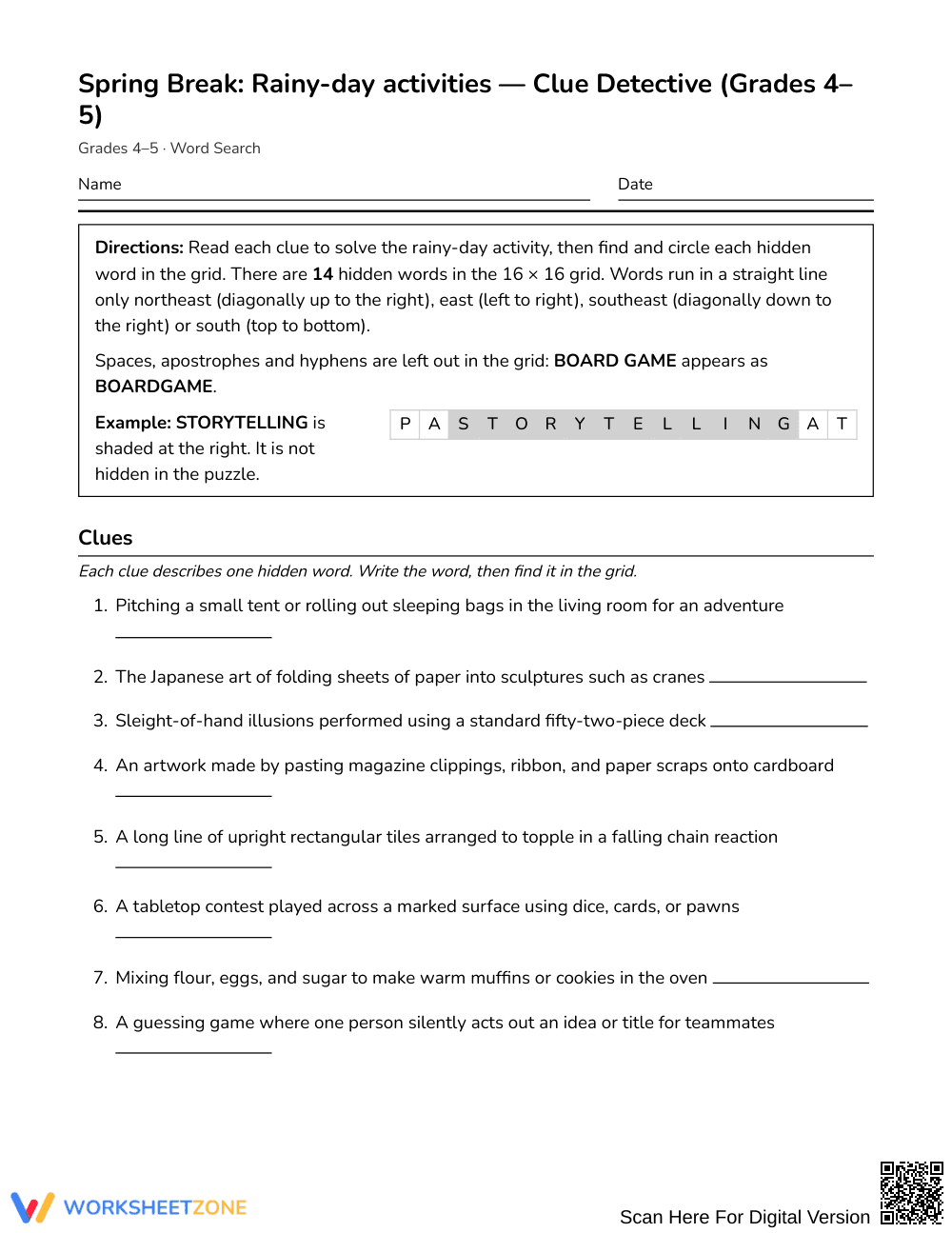


Printable Rainy-Day Activities Word Search | Grades 4–5 ELA

Paste this activity's link or code into your existing LMS (Google Classroom, Canvas, Teams, Schoology, Moodle, etc.).
Students can open and work on the activity right away, with no student login required.
You'll still be able to track student progress and results from your teacher account.
This rainy-day activities word search expands vocabulary knowledge for Grades 4–5 learners through contextual riddle solving and letter grid scanning. Students interpret descriptive clues to identify 14 indoor recreation pastimes before searching for each hidden term. The activity strengthens word recognition, spelling precision, and reading engagement during spring break or seasonal indoor recess periods.
At a Glance
- Grade: Grades 4–5 · Subject: English Language Arts (ELA)
- Standard: Not standards-assessed — vocabulary enrichment
- Skill Focus: Rainy-day activities vocabulary and definition decoding
- Format: 3 pages · 14 words · Full answer key included · Printable PDF
- Best For: Spring break leisure, fast finishers, and indoor recess
- Time: 20–35 minutes total completion time
This 3-page printable resource pairs clue detective definitions with an engaging letter puzzle. Instead of a straightforward list, learners read 14 descriptive sentences detailing classic indoor pastimes—such as building a blanket fort, folding origami, or constructing a domino train—and match each description to its target vocabulary term. Once students solve each definition, they search for the term across the letters. A full 3-page answer key provides visible word placements to support independent student self-checking or rapid teacher review.
Puzzle Mechanics and Layout
The activity is built around a structured 16 x 16 letter grid designed to reinforce spatial awareness and letter recognition. Words are hidden across four distinct directional paths: northeast, east, southeast, and south. Rather than presenting terms in alphabetical order, the printable provides a shuffled word bank alongside corresponding clues. Learners must actively decode each definition before tracing the targeted letter sequences throughout the grid.
Standards Alignment
This word search serves as an informal vocabulary enrichment activity and is not aligned to a specific academic standard. The exercise focuses on contextual semantics, domain-specific leisure vocabulary, and orthographic visual scanning to bolster student engagement during seasonal classroom transitions.
How to Use It
This puzzle functions effectively as an independent warm-up after direct instruction on context clues, or as an engaging seasonal center during spring break week. For a formative assessment observation tip, monitor whether students solve the descriptive definitions before scanning the grid or rely solely on letter matching, noting who requires support with descriptive context clues. Most learners complete the full 14-word search within 20 to 35 minutes.
Who It's For
This activity is designed for Grades 4–5 learners seeking entertaining vocabulary enrichment. For students needing additional scaffolding, educators can highlight starting letters or preview challenging compound terms like scavenger hunt and indoor camping together. Pair this printable alongside an informational passage about the history of parlor games or an anchor chart detailing context clue strategies.
Designed for Grades 4–5 classrooms, this rainy-day activities word search delivers an engaging vocabulary enrichment experience without formal alignment to a single standard code. Students apply context clues to identify 14 indoor recreational pastimes before locating hidden terms across a 16 x 16 letter grid. According to Fisher & Frey (2014), intentional word exposure embedded in motivating problem-solving tasks significantly strengthens orthographic mapping, reading fluency, and lexical retrieval for upper elementary learners. By requiring students to decode concise descriptive definitions—such as identifying a blanket fort or charades—prior to word location, the puzzle fosters active semantic processing rather than passive letter scanning. The resource functions reliably as a low-stakes seasonal exercise, sub plan, or indoor recess alternative, offering teachers an evidence-supported strategy to maintain literacy engagement and reinforce word-learning curiosity during upcoming spring school breaks.


