




























Views
Downloads



Printable Plate Motion Worksheet | Grade 8 Science

Paste this activity's link or code into your existing LMS (Google Classroom, Canvas, Teams, Schoology, Moodle, etc.).
Students can open and work on the activity right away, with no student login required.
You'll still be able to track student progress and results from your teacher account.
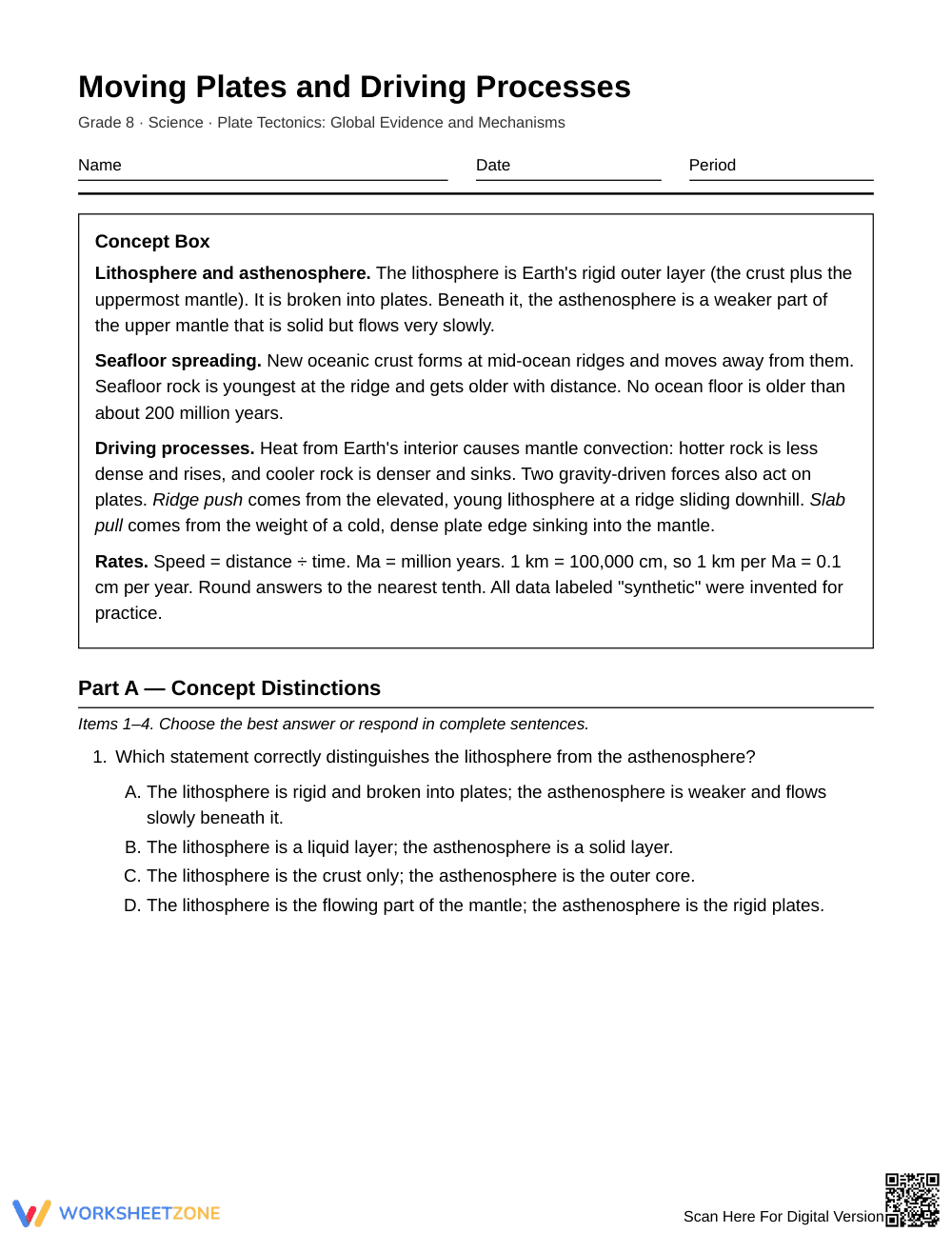
This Grade 8 science worksheet builds students' ability to explain what moves tectonic plates and to use data to show it. Students distinguish the lithosphere from the asthenosphere, calculate spreading and plate speeds, and justify predictions with mantle convection, ridge push, and slab pull.
At a Glance
- Grade: 8 · Subject: Science
- Standard: Not specified — students use data and models to explain plate motion.
- Skill Focus: Moving plates and driving processes
- Format: 5 pages · 12 problems · Answer key included · PDF
- Best For: Plate tectonics practice and review
- Time: 35–45 minutes
What's Inside
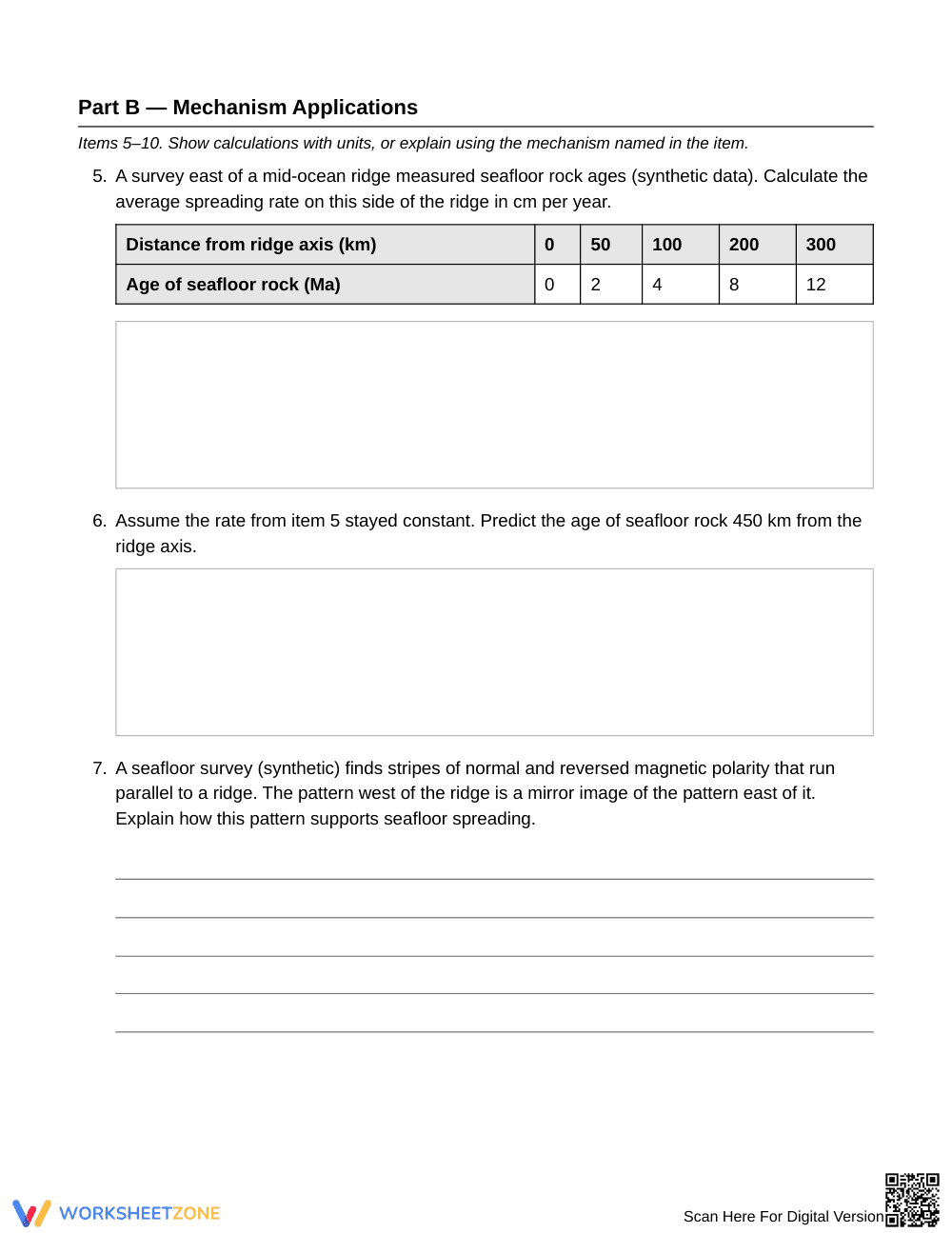
The worksheet runs 5 pages and opens with a Concept Box covering the lithosphere, asthenosphere, seafloor spreading, mantle convection, ridge push, slab pull, and a rate conversion (1 km per Ma = 0.1 cm per year). Twelve tasks follow in three parts: multiple-choice and short-answer concept distinctions, calculation and explanation tasks built on data tables, and two justified predictions. A 3-page answer key is included. All datasets are labeled synthetic.
Skill Progression
- Guided practice (Part A, items 1–4): Students lean on the Concept Box to separate layers, forces, present-day evidence, and Wegener's idea from the modern theory.
- Supported practice (Part B, items 5–10): Students calculate spreading rate and hot spot speed from tables, predict seafloor age, and explain magnetic stripes, convection, and slab pull.
- Independent practice (Part C, items 11–12): Students make a prediction and defend it with a calculation or named driving force.
This sequence follows gradual release: I Do, We Do, You Do.
Standards Alignment
No standard code was supplied for this worksheet, so none is listed here. The tasks target a clear skill: using evidence, data, and models to explain how Earth's interior heat and gravity-driven forces move plates and shape the seafloor. Teachers can map the tasks to their own state or district plate tectonics expectations when writing lesson plans or curriculum maps.
How to Use It
- During instruction: Assign Part A after a mini-lesson on plate layers and forces. Then have partners work Part B while you circulate.
- After instruction: Use the full packet as unit review or homework before an assessment.
Formative tip: watch items 5 and 8. Students who skip the unit conversion usually show a rate error of a factor of 10 or more. Expect 35–45 minutes for the full set.
Who It's For
Built for Grade 8 science classes studying plate tectonics. Students who need support can work Part A with the Concept Box open and use the answer key for self-checking. Students ready for more can focus on Part C and write fuller justifications. It pairs well with a seafloor age map or a short direct-instruction lesson on convection.
Moving Plates and Driving Processes is a Grade 8 Science worksheet on plate tectonics with 12 tasks across 5 pages, plus a 3-page answer key. Students distinguish the lithosphere from the asthenosphere, calculate seafloor spreading and hot spot speeds in centimeters per year, and justify predictions using mantle convection, ridge push, and slab pull. No standard code was supplied, so alignment is described by skill: using data and models to explain plate motion. The sequence follows the gradual release model described by Fisher & Frey (2014), moving from concept questions to calculations to independent predictions. All datasets are labeled synthetic and invented for practice, keeping the focus on reasoning. Teachers can assign it after direct instruction or as unit review to check whether students can explain how interior heat moves surface plates.


